
Secure Digital Diplomas for Universities in 2026: The Ultimate Issuance Guide
Published on May 17, 2026
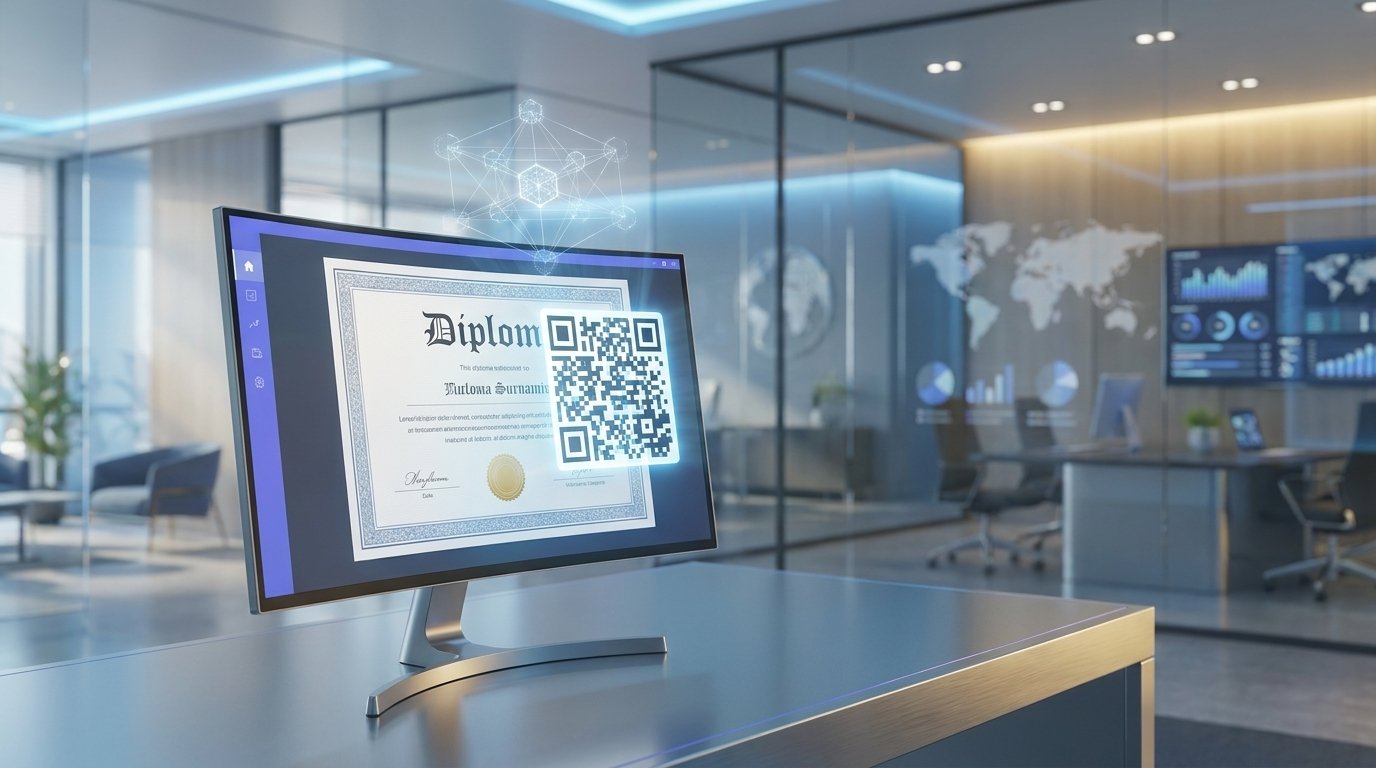
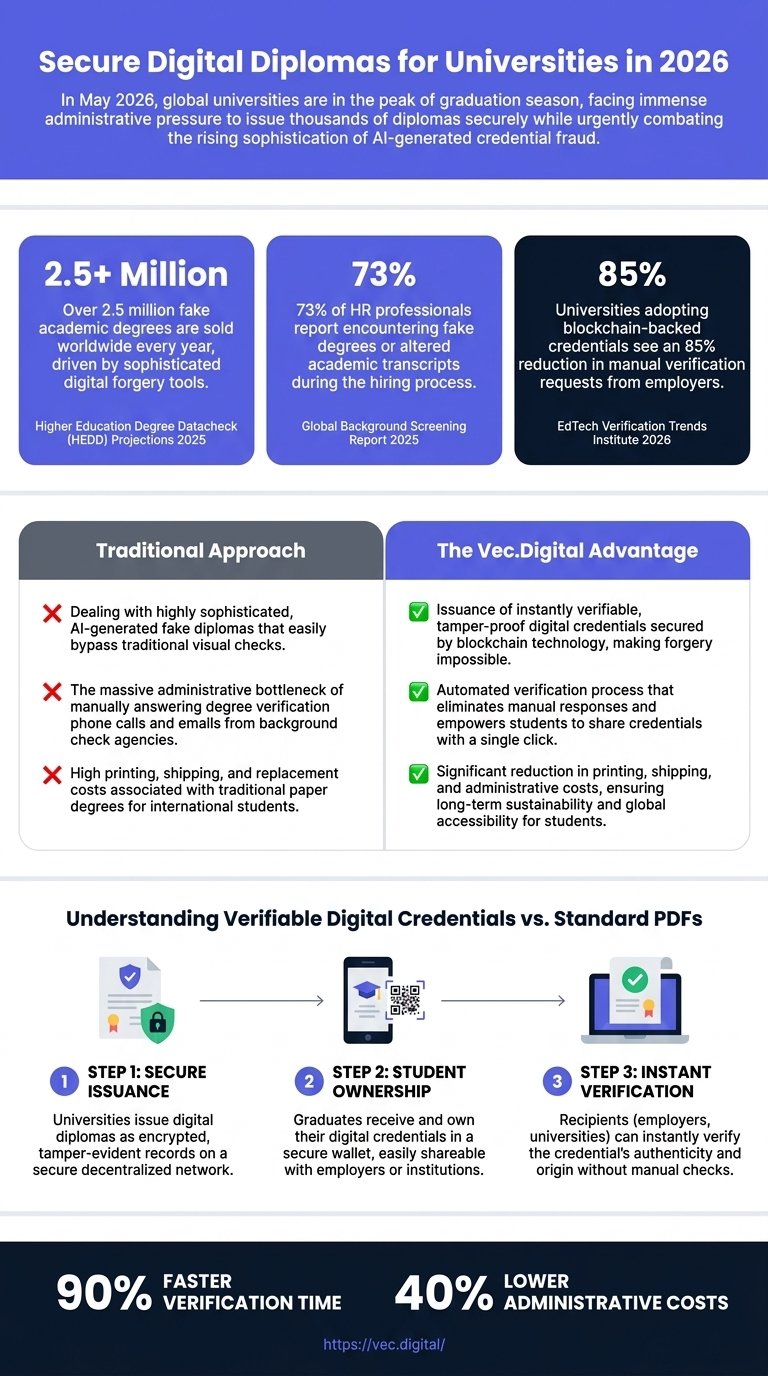
Every year, over 2.5 million fake academic degrees are sold worldwide, driven by increasingly sophisticated digital forgery tools, according to Higher Education Degree Datacheck (HEDD) Projections in 2025. As academic institutions face this unprecedented threat to their reputations, implementing secure digital diplomas for universities has shifted from a technological luxury to an absolute necessity. Administrators need a mathematically provable system to protect their graduates' achievements, eradicate fraud, and streamline the transition into the global workforce.
In this comprehensive guide, our team at Vec.Digital leverages our deep expertise in educational technology to outline a practical blueprint for modernizing your graduation systems. You will learn how to transition from legacy paper processes to automated issuance engines, integrate instant authentication, and utilize blockchain anchoring to completely eradicate credential fraud at scale.
Key Takeaways
- The global shift toward verifiable digital credentials is accelerating, standardizing how academic achievements are authenticated worldwide.
- Implementing a bulk certificate generator eliminates massive administrative bottlenecks during peak graduation seasons.
- Blockchain certificate verification provides an immutable, mathematically provable record that defeats AI-generated forgeries.
- Embedding QR code certificates allows global employers to authenticate academic degrees instantly without requiring specialized software.
- Transitioning to secure digital diplomas for universities reduces institutional carbon footprints while cutting printing and international shipping costs.
The Escalating Challenge of Credential Fraud in Higher Education
The landscape of academic credentialing is undergoing a seismic shift. As we navigate 2026, global universities are finding that legacy methods of issuing degrees are no longer sufficient to protect their institutional integrity. The adoption of secure digital diplomas for universities is heavily driven by a combination of technological threats and administrative inefficiencies that plague higher education institutions worldwide.
The Rise of AI-Generated Forgeries
One of the most pressing challenges facing academic registrars today is dealing with highly sophisticated, AI-generated fake diplomas that easily bypass traditional visual checks. In the past, fraudulent degrees were often identifiable by poor typography, incorrect seals, or mismatched paper stock. Today, artificial intelligence and advanced graphic design tools allow malicious actors to create pixel-perfect replicas of documents from the world's most prestigious universities.
The impact on the hiring market is profound. According to the Global Background Screening Report in 2025, 73% of HR professionals report encountering fake degrees or altered academic transcripts during the hiring process. When employers cannot trust the documents presented to them, the value of the university's brand diminishes. Academic institutions must adopt systems that rely on cryptographic truth rather than visual authenticity to protect the hard-earned achievements of their legitimate alumni.
The Hidden Costs of Traditional Paper Diplomas
Beyond the threat of fraud, physical degrees carry substantial financial and logistical burdens. Universities spend millions annually on high-quality parchment, specialized printing, embossing, and secure international shipping. For global institutions with a large population of international students, the logistics of mailing physical degrees across borders are fraught with delays, lost packages, and high replacement costs.
Furthermore, delayed credential delivery causes significant friction for graduates applying to competitive jobs immediately after graduation. A student who must wait six to eight weeks for a physical diploma in the mail may miss out on critical employment opportunities or visa applications that require immediate proof of graduation. Digital issuance solves this by delivering irrefutable proof of achievement the moment the graduation status is confirmed.
The Manual Verification Bottleneck
The administrative nightmare of manually answering degree verification phone calls and emails from background check agencies is a massive drain on university resources. During peak hiring seasons, registrar offices are inundated with requests to verify alumni records. This manual administrative sequence is slow, prone to human error, and costly to maintain.
By modernizing the issuance system, universities can completely automate this process. When institutions provide self-verifying documents, they empower employers to authenticate records instantly, freeing up academic staff to focus on higher-value student services rather than acting as a perpetual verification clearinghouse.
Understanding Verifiable Digital Credentials vs. Standard PDFs
As the global digital credential market in education is projected to reach $4.5 billion by the end of next year (HolonIQ Education Market Data, 2026), it is crucial to understand the technological distinctions that make modern digital degrees secure. Not all digital documents are created equal, and understanding the underlying technology is the first step in digital transformation.
What is the difference between a PDF certificate and a verifiable credential?
A common misconception among academic administrators is that emailing a PDF of a diploma constitutes a digital credential. A standard PDF is merely a digital picture of a physical document. It can be easily altered using basic PDF editing software, making it entirely unsuitable as proof of high-stakes academic achievement.
In contrast, verifiable digital credentials are mathematically provable data packets. They contain cryptographic signatures that link the document directly to the issuing institution. If a single pixel or character of a verifiable credential is altered, the cryptographic signature breaks, and the document instantly registers as invalid upon verification. This ensures absolute data integrity and provides relying parties (like employers) with undeniable proof that the document was issued by your institution and belongs to the specific graduate.
What is a blockchain-verified university degree?
To achieve the highest level of security, modern credentials utilize distributed ledger technology. A blockchain-verified university degree is a digital diploma whose unique cryptographic hash (a digital fingerprint) has been permanently anchored to a public blockchain. This creates an immutable, timestamped record of the issuance.
Blockchain certificate verification means that the proof of the degree's authenticity exists independently of the university's internal servers. Even if the university's database undergoes maintenance or experiences an outage, employers can still verify the degree against the public blockchain. This decentralized approach guarantees long-term survivability and global trust, ensuring that the credential remains verifiable for the entirety of the graduate's career.
Global Standards and the W3C Framework
The push for secure digital diplomas is not happening in a vacuum. With the European Union's expansion of the European Digital Identity (EUDI) Wallet and the global standardization of verifiable credentials by the World Wide Web Consortium (W3C), higher education institutions worldwide are under regulatory and market pressure to issue interoperable, mathematically provable digital degrees. Aligning with these global frameworks ensures that the credentials your university issues today will be universally recognized and compatible with the digital wallets of tomorrow.
How to Implement Secure Digital Diplomas for Universities (Step-by-Step)
Most existing guides focus heavily on the philosophical concepts of cryptography in education, lacking actionable instructions for university administrators. At Vec.Digital, we believe in practical application. Here is a step-by-step blueprint on how to implement bulk issuance and integrate verification into your graduation systems without needing massive IT overhauls.
Designing with a Digital Certificate Maker
The first step in modernizing your issuance process is digitizing your institution's visual identity. Using a professional digital certificate maker, administrators can upload their official university seals, authorized signatures, and specific branding elements into a secure, cloud-based design environment.
During this phase, you will define dynamic fields—such as Student Name, Degree Program, Graduation Date, and Honors. These dynamic variables act as placeholders that the system will automatically populate during the issuance phase. A robust design system ensures that the final digital output retains the prestige and aesthetic beauty of a traditional physical diploma, which is highly valued by graduates.
How to issue digital certificates to students in bulk?
For universities graduating thousands of students simultaneously, manual data entry is impossible. This is where a bulk certificate generator becomes indispensable. The process is straightforward and designed for high-volume efficiency:
- Data Preparation: Academic registrars export a final list of approved graduates from their Student Information System (SIS) into a standard CSV file.
- System Upload: The CSV file is uploaded to the credentialing platform, mapping the data columns (Name, Major, Date) to the dynamic fields in the certificate template.
- Signatory Approval: Before issuance, the system initiates an automated approval sequence. The University President or Dean receives a secure prompt to digitally sign off on the batch, ensuring institutional governance and oversight.
- Automated Delivery: Once approved, the system generates thousands of unique, cryptographically secure diplomas in seconds. Each student receives an automated email containing a secure link to access, download, and share their digital degree.
Anchoring to the Blockchain for Immutability
Simultaneous to the generation of the visual document, the platform calculates the unique cryptographic hash for every single diploma in the batch. These hashes are bundled and anchored to an immutable blockchain. This backend process happens instantaneously and requires zero blockchain coding knowledge from your university's IT staff. The result is a seamless, enterprise-grade security layer applied effortlessly to every credential you issue.
The Role of QR Code Certificates in Instant Authentication
The true value of a digital credential lies in its ability to be easily verified by third parties. Embedding dynamic verification tools directly onto the credential bridges the gap between digital security and real-world usability.
How do employers verify a digital diploma?
The most user-friendly method for authentication is the use of QR code certificates. Every diploma issued through a modern platform features a unique, scannable QR code. When an employer, background checker, or admissions officer scans this code using any standard smartphone camera, they are instantly routed to a dedicated, public verification page hosted on a secure domain.
This page displays the official issuer details, the recipient's name, the date of issuance, and a clear "Verified" badge indicating that the cryptographic signature and blockchain anchor are intact. There is no need for the employer to download a specific app, register for an account, or navigate complex software. The verification is instantaneous, frictionless, and completely transparent.
Are digital certificates legally recognized by employers?
Yes. As digital transformation accelerates globally, verifiable credentials are not only recognized but actively preferred by modern employers. An advanced HR employee certification platform relies on these verified data points to automate their own internal compliance and hiring processes. Because verifiable credentials provide mathematical proof of origin and integrity, they carry the same—if not greater—legal and professional weight as a physical document sealed by a university registrar.
How can universities prevent academic diploma fraud?
Universities can prevent academic diploma fraud by removing the human element from the verification process. Traditional fraud relies on deceiving a human eye with a convincing piece of paper. By transitioning to a system where the primary method of verification is a cryptographic scan, universities render visual forgeries useless. According to the EdTech Verification Trends Institute in 2026, universities adopting blockchain-backed credentials see an 85% reduction in manual verification requests from employers, proving that the market rapidly adapts to and trusts automated, secure verification systems.
The ROI and Sustainable Impact of Going Paperless
Beyond security and efficiency, the transition to digital credentialing offers significant measurable returns on investment and aligns with global corporate social responsibility initiatives.
Cutting Costs and Administrative Overhead
The financial savings realized by eliminating physical diplomas are substantial. Universities save on the direct costs of specialized paper, custom printing, embossing, and postal logistics. More importantly, they drastically reduce the hidden administrative costs associated with replacing lost diplomas, managing returned mail, and staffing call centers to handle verification requests from background screening agencies.
Supporting UN Sustainability Goals
Academic institutions are increasingly expected to lead by example in environmental stewardship. Replacing physical diplomas with paperless digital alternatives reduces an institution's graduation-related carbon footprint by up to 18%, according to the UN Higher Ed Sustainability Initiative in 2026. By adopting cloud-based, paperless issuance systems, universities directly contribute to global sustainability goals, reducing deforestation, eliminating the carbon emissions associated with international shipping, and minimizing institutional waste.
Secure Your Institution's Legacy Today
The future of higher education credentialing is undeniably digital, verifiable, and secure. As the sophistication of credential fraud continues to evolve, universities must proactively adopt systems that protect their institutional reputation and empower their graduates in the global job market. Transitioning to a secure, automated issuance engine is no longer a complex IT burden—it is a streamlined, accessible process that delivers immediate value.
At Vec.Digital, we provide a comprehensive suite of tools to create, manage, publish, and authenticate online certificates effortlessly. With our 99.98% uptime SLA and seamless bulk issuance capabilities, we simplify document authentication while eliminating the risk of fraud.
Are you ready to modernize your graduation processes and issue globally trusted credentials? Discover how our platform can transform your academic administration.
Website: https://vec.digital/
Email: support@vec.digital
Contact: +971521373078