
Secure Digital Diplomas in 2026: How Universities Can Stop Credential Fraud
Published on May 29, 2026

The global diploma mill industry generates over $7 billion annually, selling millions of fraudulent degrees to individuals worldwide, according to the Higher Education Evaluation and Accreditation Council (2025). For academic registrars and university IT directors facing the peak of graduation season, the need to issue secure digital diplomas for universities has never been more urgent. As advanced AI document forgery becomes increasingly sophisticated, institutions are battling unprecedented risks to their hard-earned academic reputations and desperately need scalable, tamper-proof credentialing solutions.
In this comprehensive guide, our team at Vec.Digital leverages our extensive expertise in educational technology to bridge the gap between high-level blockchain theory and practical administrative execution. You will discover actionable strategies to transition from expensive, slow paper printing to an automated system, learn how to embed foolproof QR verification, and understand how modernizing your graduation processes can drastically reduce operational costs while protecting your institution's legacy.
Key Takeaways
- Discover why implementing secure digital diplomas for universities is critical to combating the $7 billion academic fraud industry.
- Learn how a bulk certificate generator can eliminate the administrative nightmare of manually printing and mailing thousands of physical credentials.
- Understand the mechanics of blockchain certificate verification and why it offers unparalleled immutability for high-stakes academic records.
- Explore how to answer the question, "How can you verify a university degree online?" using instant QR code certificates.
- See how transitioning to verifiable digital credentials aligns with global mobility standards and reduces institutional costs by up to 65%.
The Escalating Threat of Credential Fraud in Higher Education
As we navigate the complexities of higher education in 2026, the proliferation of digital manipulation tools has made it easier than ever for bad actors to forge academic records. The traditional paper diploma, once the gold standard of academic achievement, is now highly vulnerable to replication. Institutions across the globe are recognizing that relying solely on physical documents is no longer sufficient to protect their brand or their students' hard work. The push toward secure digital diplomas for universities is not just a technological upgrade; it is a fundamental necessity for institutional survival.
The reputational damage suffered by universities when fake versions of their degrees enter the job market can be catastrophic. When employers discover that a candidate holding a degree from a prestigious institution lacks the foundational knowledge expected, the institution's credibility takes a direct hit. This erosion of trust affects future enrollment, alumni donations, and global university rankings. To combat this, academic leaders must adopt systems that guarantee the absolute authenticity of every credential they issue.
The Cost of Fake Degrees on Institutional Reputation
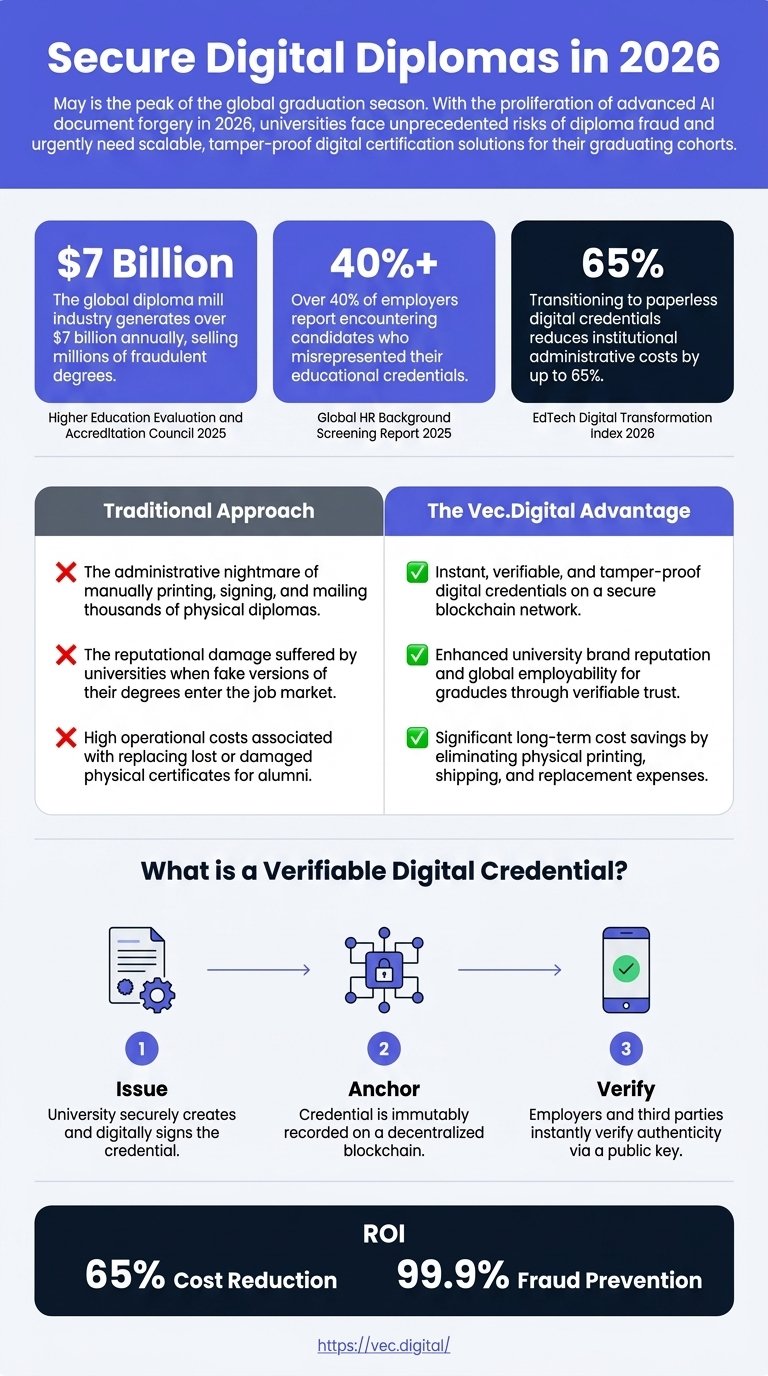
The financial and reputational costs of credential fraud are staggering. The Higher Education Evaluation and Accreditation Council (2025) reports that the global diploma mill industry generates over $7 billion annually, selling millions of fraudulent degrees. This massive underground economy directly undermines the value of legitimate higher education. When anyone can purchase a convincing replica of a university degree online, the intrinsic value of genuine academic rigor is diluted.
Furthermore, the Global HR Background Screening Report (2025) revealed that over 40% of employers report encountering candidates who misrepresented their educational credentials. This high prevalence of fraud forces employers to implement stringent, time-consuming background checks, which in turn puts immense pressure on university registrar offices to manually verify thousands of alumni records each year. The friction in this system is unsustainable for both the corporate sector and academic institutions.
How Can Universities Prevent Fake Degrees?
To effectively prevent fake degrees, universities must shift their focus from the physical document to the underlying cryptographic proof of the achievement. The solution lies in anchoring academic records to decentralized, immutable ledgers. By utilizing a secure digital infrastructure, institutions can issue credentials that are mathematically impossible to forge. When a university generates a digital diploma, the system creates a unique cryptographic hash of that document.
This hash serves as a digital fingerprint. If a bad actor attempts to alter even a single pixel or character on the diploma, the hash fundamentally changes, instantly flagging the document as fraudulent. By adopting these advanced technological measures, universities can completely neutralize the threat of AI document forgery and diploma mills, ensuring that their brand remains synonymous with trust and excellence.
What is a Verifiable Digital Credential?
At its core, a verifiable digital credential is a tamper-evident, machine-readable record of an individual's achievement. Unlike a simple PDF or a scanned image of a paper certificate, a verifiable digital credential contains rich metadata, including the issuer's identity, the recipient's details, the date of issuance, and the specific qualifications met. More importantly, this metadata is cryptographically signed by the issuing institution, providing mathematical certainty of its origin and integrity.
For universities, this means transitioning from a model of "trust based on appearance" to "trust based on cryptography." When a student graduates, they receive a digital asset that they can permanently own and share across professional networks. Because the credential is self-verifying, anyone who views it can instantly confirm its authenticity without needing to contact the university's registrar office.
Are Digital Certificates as Valid as Paper Degrees?
A common question raised by students, parents, and traditionalist educators is: "Are digital certificates as valid as paper degrees?" The answer is unequivocally yes—in fact, from a security and utility standpoint, they are vastly superior. While a paper degree is a ceremonial representation of an achievement, a verifiable digital credential is the actual, irrefutable proof of that achievement.
Paper degrees can be lost in a fire, destroyed by a flood, or simply misplaced during a cross-country move. Replacing them involves high operational costs associated with re-printing and mailing physical certificates for alumni, often taking weeks to fulfill. In contrast, digital certificates are stored securely in cloud-based digital lockers. They are permanently accessible, easily shareable, and inherently protected against physical loss or degradation. Legally and academically, they carry the exact same weight, but with infinitely more security.
How Do Blockchain Certificates Work for Education?
Understanding the mechanics of blockchain certificate verification is crucial for modern educational administrators. When a university issues a digital diploma via a blockchain-backed platform, the platform takes the unique cryptographic hash of that diploma and records it on a public blockchain ledger. The blockchain acts as a decentralized, immutable notary public. Once the record is etched into the blockchain, it cannot be altered, deleted, or hacked by any single entity.
The demand for this level of security is skyrocketing. According to the Global Academic Technology Forecast (2026), demand for blockchain-backed digital credentialing in education is growing at a compound annual growth rate (CAGR) of 28.5%. This growth is driven by the realization that blockchain provides a universal source of truth. When an employer wants to verify a degree, the system simply compares the hash of the presented document against the hash stored on the blockchain. If they match, the document is 100% authentic.
Overcoming Administrative Bottlenecks During Graduation Season
Graduation season is traditionally a time of immense stress for university administrative staff. The logistical hurdles of finalizing grades, formatting names, printing thousands of high-quality parchment papers, organizing manual signature sessions with the Dean, and coordinating postal delivery are staggering. This antiquated process is not only prone to human error but is also incredibly resource-intensive and environmentally unsustainable.
By implementing a modernized bulk certificate generator, universities can completely overhaul this administrative nightmare. The focus shifts from manual labor to strategic oversight. Automation allows registrars to handle cohorts of 10,000 students as easily as a cohort of 10, freeing up valuable staff time to focus on student success and institutional growth rather than stuffing envelopes.
The Hidden Costs of Traditional Paper Diplomas
The financial burden of traditional credentialing goes far beyond the cost of parchment and ink. Universities spend heavily on secure storage, specialized printing equipment, postage, and the massive amount of labor required to manage the process. Furthermore, the weeks-long manual effort required by university staff to verify degrees for background check agencies represents a massive hidden operational cost that drains departmental budgets year-round.
The transition to modern systems offers profound financial relief. The EdTech Digital Transformation Index (2026) highlights that transitioning to paperless digital credentials reduces institutional administrative costs by up to 65%. This capital can be reallocated to critical areas such as student services, research funding, or upgrading campus technology infrastructure. Additionally, going paperless aligns perfectly with global UN sustainability goals, drastically reducing the institution's carbon footprint.
How Do Universities Issue Digital Diplomas at Scale?
The question of "How do universities issue digital diplomas?" is often met with apprehension by IT departments fearing complex software integrations. However, modern platforms are designed for seamless, bulk automated processes. Utilizing a bulk certificate generator, a registrar simply exports a CSV file containing the graduating students' data (names, honors, degree types) from their existing Student Information System (SIS).
This CSV is uploaded into the digital credentialing platform. The platform's automated engine maps the data to dynamic fields within a pre-approved, beautifully designed digital template. Within minutes, thousands of personalized, cryptographically secure diplomas are generated and instantly emailed to the graduates. The entire process—from data upload to student delivery—can be completed in a fraction of the time it takes to print a single batch of paper certificates.
A Practical Guide: How Universities Issue Digital Diplomas
Bridging the gap between high-level blockchain theory and practical administrative execution is essential. Many universities hesitate to modernize because they fear the transition will disrupt their existing operations. However, implementing secure digital diplomas for universities can be achieved smoothly within a single academic cycle if approached methodically. Here is a practical, step-by-step guide for academic registrars and IT directors to transition to an automated, secure credentialing system.
The key to success is choosing a platform that prioritizes user experience while handling the complex cryptography in the background. Administrators should not need a degree in computer science to issue a diploma. The system should be intuitive, robust, and capable of handling high-volume issuance without faltering.
Step 1: Transitioning to an Automated System
The first step is establishing the visual identity and data structure of the digital diploma. Using a drag-and-drop design editor, universities can upload their official seals, custom typography, and authorized signatures. It is vital to ensure that the digital credential retains the prestige and aesthetic weight of the traditional parchment. Once the template is designed, administrators configure dynamic fields—such as [Student Name], [Degree Program], and [Graduation Date].
Next, the university sets up an automated approval sequence. Before a batch of diplomas is published, the system can require digital sign-off from the Dean or the Registrar. This ensures strict quality control. Once approved, the platform's automated engine processes the student data via CSV upload or a direct REST API connection to the university's LMS, generating the credentials instantaneously.
Step 2: Embedding Instant QR Code Verification
The most critical feature of a modern digital diploma is its ease of verification. Every credential generated must include a unique, scannable QR code. QR code certificates bridge the physical and digital worlds. If a student chooses to print their digital diploma for framing, the QR code remains active on the physical paper.
When an employer scans this QR code with any standard smartphone camera, they are instantly routed to a dedicated, university-branded public verification page. This page displays the issuer, the recipient, the signatory details, and a "blockchain verified" badge. This completely bypasses the need for the employer to create an account, download an app, or contact the university, providing foolproof, easily shareable proof of authenticity.
Step 3: Aligning with Global Mobility Standards
Universities do not operate in a vacuum; they are part of a highly interconnected global ecosystem. Worldwide regulatory shifts are pushing for cross-border digital credential standardization. Initiatives like the EU's eIDAS 2.0 digital identity framework and the UNESCO Global Convention on the Recognition of Qualifications demand that academic records be portable, standardized, and instantly verifiable across borders.
By issuing blockchain-backed digital diplomas, universities ensure compliance with these emerging global standards. International students, in particular, benefit immensely from this. They can easily prove their qualifications to foreign employers or immigration authorities without the need for expensive, time-consuming notarization and apostille processes, thereby significantly enhancing global student mobility.
How Can You Verify a University Degree Online?
The traditional method of degree verification is a relic of the past. Historically, an employer or background check agency would have to submit a formal request to the university's registrar, pay a fee, and wait days or weeks for a manual confirmation. This friction is detrimental to the graduate's career prospects. The University Graduate Employment Study (2025) noted that wait times for manual degree verification have caused up to 20% of new graduates to experience delays in securing employment.
The modern answer to "How can you verify a university degree online?" is instant, decentralized, and entirely self-serve. Digital diploma verification platforms empower employers to authenticate credentials in seconds, completely removing the university's administrative staff from the verification loop.
Empowering Employers and Background Check Agencies
When a graduate shares their digital diploma—whether via a direct link, an embedded badge on LinkedIn, or a QR code on a resume—the employer has immediate access to the truth. The verification page queries the blockchain in real-time. It checks the cryptographic signature to ensure the document was indeed issued by the claimed university, and it checks the blockchain ledger to ensure the credential has not been revoked or altered since issuance.
This level of transparency builds immense confidence in the hiring process. Employers can hire without doubt, knowing that the qualifications they are reviewing are mathematically proven to be authentic. This efficiency drastically reduces the time-to-hire and lowers the operational costs for corporate HR departments and background screening agencies.
Eliminating the Burden on University Registrars
For the university, the benefits of instant online verification are transformational. Registrar offices are frequently overwhelmed by the sheer volume of verification requests, especially in the months following graduation. By decentralizing the verification process through QR codes and public blockchain ledgers, universities effectively reduce their inbound verification requests to near zero.
This allows the institution to reallocate administrative resources to proactive student support rather than reactive paperwork. Furthermore, because the system is entirely automated and hosted on cloud infrastructure with 99.98% guaranteed uptime, verifications can happen 24/7, 365 days a year, regardless of the university's operating hours or local time zones.
Securing the Future of Global Education
The transition to secure digital diplomas for universities is a defining movement in modern education. As the global threat of credential fraud continues to rise, institutions must abandon outdated, vulnerable paper processes in favor of cryptographic certainty. By embracing verifiable digital credentials, universities not only protect their prestigious reputations but also empower their graduates with portable, instantly verifiable proof of their hard work.
At Vec.Digital, we are committed to making credential fraud impossible. Our comprehensive suite of tools, from our intuitive drag-and-drop certificate maker to our patented blockchain anchoring and instant QR verification, provides institutions with everything they need to issue credentials with absolute confidence. We simplify document authentication at scale, helping universities align with global mobility standards and UN sustainability goals.
Don't let outdated processes put your institution's reputation at risk. Start issuing tamper-proof, globally accessible digital diplomas today.
Ready to modernize your graduation processes?
Visit us at https://vec.digital/ or contact our team directly at support@vec.digital to learn how we can secure your organization's credentials.