
Secure Digital Diplomas in 2026: Preventing Credential Fraud in Higher Education
Published on May 31, 2026
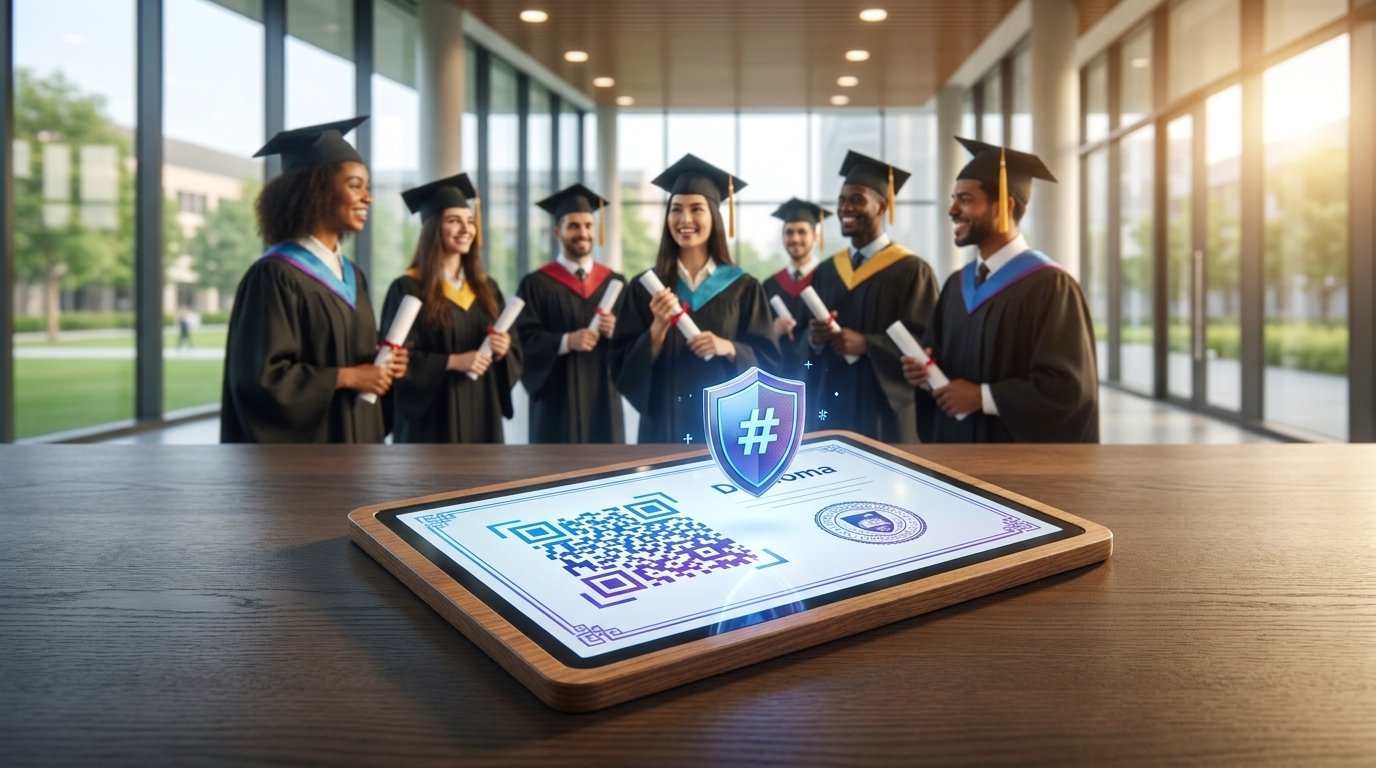
Over 2 million fake degrees are sold worldwide annually, creating a multi-billion-dollar illicit industry that directly threatens academic integrity and institutional reputation. As we approach peak graduation seasons, implementing secure digital diplomas for universities has never been more critical for academic registrars and deans. Traditional paper certificates are no longer sufficient to protect your institution from the rising tide of sophisticated, AI-generated credential fraud.
In this comprehensive guide, our team at Vec.Digital leverages our deep expertise in Technology to provide a clear, actionable blueprint for modernizing your credentialing system. You will learn how to eradicate diploma fraud using immutable technology, drastically reduce the administrative costs of graduation season, and deploy an automated process that issues universally readable, tamper-proof records for your global student body.
Key Takeaways
- Credential fraud prevention requires moving beyond paper to mathematically proven, tamper-proof digital systems.
- Blockchain certificate verification anchors academic records to an immutable ledger, making forgery impossible.
- QR code certificates allow global employers to conduct instant, foolproof background checks without manual registrar intervention.
- A bulk certificate generator automates the issuance of thousands of diplomas simultaneously, cutting administrative costs by nearly half.
- Verifiable digital credentials empower alumni with portable, globally recognized proof of their academic achievements.
The Global Crisis of Credential Fraud in Higher Education
The Cost of Diploma Mills and Forged Transcripts
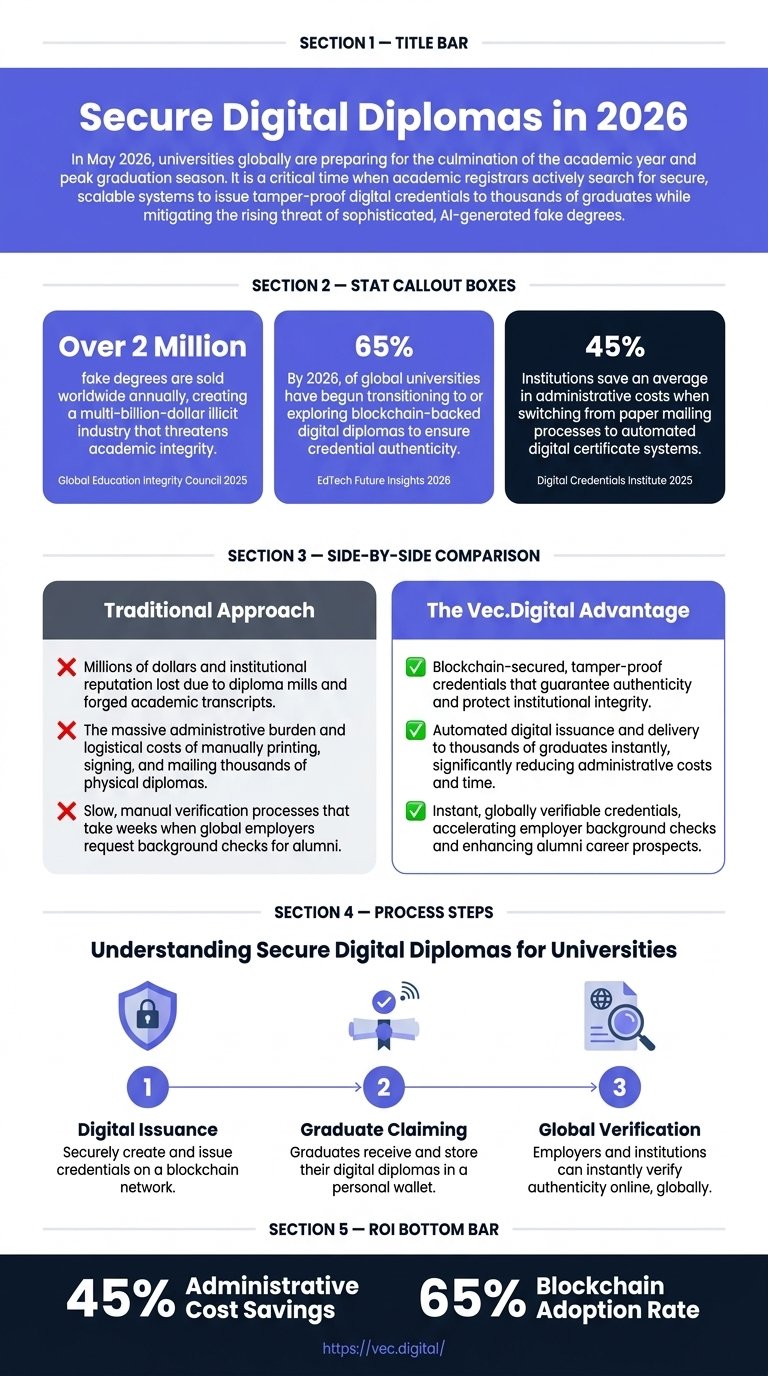
The academic sector is currently facing an unprecedented crisis of authenticity. According to the Global Education Integrity Council (2025), over 2 million fake degrees are sold worldwide annually, creating a multi-billion-dollar illicit industry that threatens academic integrity. Diploma mills and sophisticated forgery operations have made it incredibly easy for individuals to purchase counterfeit academic transcripts that look nearly identical to official university documents. When employers discover that a candidate holds a forged degree from your institution, the reputational damage is severe and long-lasting, undermining the hard work of your legitimate graduates.
Implementing secure digital diplomas for universities is the only definitive way to combat this threat. Traditional security measures on physical paper—such as watermarks, embossed seals, and special ink—are routinely bypassed by modern printing technology and AI image generation. To truly protect institutional reputation, universities must shift the paradigm of trust from physical paper to mathematical certainty. By adopting digital-first credentialing, academic institutions can guarantee that every degree issued is an authentic, verifiable representation of a student's academic journey.
The Administrative Burden of Physical Diplomas
Beyond the security risks, the traditional method of issuing credentials is fundamentally inefficient. University registrars understand the massive administrative burden and logistical costs of manually printing, signing, and mailing thousands of physical diplomas during peak graduation seasons. This manual process is not only prone to human error but is also incredibly expensive, consuming resources that could be better allocated to student services or technological innovation.
The financial argument for modernization is compelling. Research from the Digital Credentials Institute (2025) reveals that institutions save an average of 45% in administrative costs when switching from paper mailing processes to automated digital certificate systems. By eliminating the need for specialty paper, international postage, and manual data entry, universities can streamline their operations drastically. An automated system allows a single administrator to issue thousands of credentials with a few clicks, transforming a weeks-long ordeal into a task that takes mere minutes.
Why Global Mobility Demands New Standards
Cross-border student and professional mobility is at an all-time high in 2026. Graduates are no longer confined to local job markets; they are seeking employment and further educational opportunities across the globe. This international mobility demands credentials that are universally readable and universally verifiable, regardless of the country in which they are presented.
Legislative pushes are accelerating this transition. Frameworks such as the European Union's eIDAS 2.0 and comprehensive digital public infrastructure initiatives in the UAE and across Asia are forcing academic institutions to adopt universally verifiable digital records to stay compliant and globally relevant. Institutions that fail to modernize risk having their credentials rejected or delayed by international employers and border agencies, ultimately hindering their alumni's career prospects.
Understanding Secure Digital Diplomas for Universities
What Makes a Digital Certificate Secure?
A common question among academic deans is: What makes a digital certificate secure? The answer lies in moving beyond simple PDF documents. A standard PDF can be easily edited using basic software, making it just as vulnerable to fraud as a piece of paper. True secure digital diplomas for universities rely on cryptographic hashing and digital signatures to ensure absolute data integrity.
When a secure credential is generated, the system creates a unique mathematical fingerprint (a hash) of the document's contents. If even a single pixel or character is altered—such as changing a "B" grade to an "A"—the mathematical fingerprint changes completely, instantly flagging the document as tampered with. This ensures that the data remains exactly as it was when the university authorized it, providing a level of security that physical documents can never achieve.
Can Blockchain Certificates Be Forged or Hacked?
Another frequent inquiry from IT directors is: Can blockchain certificates be forged or hacked? The short answer is no. Blockchain technology operates on a decentralized ledger system. When a university issues a credential, the cryptographic hash of that credential is anchored to the blockchain. Because the blockchain is distributed across thousands of independent nodes globally, altering the record would require simultaneously hacking the majority of these nodes—a feat that is computationally impossible.
This immutability is the cornerstone of modern credentialing. Once a university anchors a diploma to the blockchain, it becomes a permanent, tamper-proof record. Even if the university's internal servers were compromised, the authenticity of the issued credentials would remain intact on the public ledger. This provides absolute certainty to employers and academic institutions verifying the graduate's background.
How Universities Verify Digital Diplomas
Registrars often ask: How do universities verify digital diplomas? The beauty of a modern automated system is that it removes the university from the manual verification loop entirely. Traditionally, when an employer wanted to verify a degree, they had to contact the registrar's office, pay a fee, and wait days or weeks for a manual background check. This bottleneck is highly inefficient for all parties involved.
With secure digital credentials, verification is decentralized and instant. The credential contains embedded cryptographic proofs. When an employer receives the digital diploma, they simply scan it or click the verification link. The system automatically checks the mathematical fingerprint against the blockchain ledger and confirms the issuer's identity. It immediately displays a dedicated public verification page showing the issuer, recipient, date, signatory details, and a verified badge. This process takes seconds, requires no app or account, and completely frees up the registrar's staff.
The Technology Powering Verifiable Digital Credentials
Blockchain Certificate Verification Explained
The adoption of decentralized technology in education is accelerating rapidly. According to EdTech Future Insights (2026), by 2026, 65% of global universities have begun transitioning to or exploring blockchain-backed digital diplomas to ensure credential authenticity. Blockchain certificate verification is no longer an experimental concept; it is the industry standard for high-stakes documents.
This technology works by separating the private student data from the public proof. The blockchain does not store the student's name or grades (which would violate privacy laws like GDPR or FERPA). Instead, it stores only the cryptographic hash—the proof of the document's existence and integrity. When an employer checks the credential, the system recalculates the hash of the presented document and matches it against the blockchain. If they match, the document is 100% authentic. This elegant solution provides maximum security while maintaining strict data privacy.
How QR Code Certificates Work for Background Checks
Employers are driving the demand for instant verification. A recent HR Tech & Compliance Report (2026) noted that 82% of corporate employers prefer candidates who can provide instantly verifiable digital credentials via QR codes or links over traditional paper documents. How do QR code certificates work for background checks? It is remarkably straightforward.
Every digital diploma issued through a modern platform is embedded with a unique, dynamic QR code. During a background check, an HR professional simply scans this code using any standard smartphone camera. The scan instantly routes them to a secure, public authentication page hosted on a 99.98% uptime server. This page displays the immutable record of the achievement, confirming that the university did indeed issue the credential to that specific individual. There is no need for the employer to register for an account, download a proprietary app, or navigate complex software.
Replacing Manual Verification with Automated Systems
One of the most significant pain points for universities is the slow, manual verification processes that take weeks when global employers request background checks for alumni. This delay can cost graduates job opportunities and creates a constant backlog of administrative work for university staff.
By implementing an automated verification system, universities can eliminate this friction entirely. The technology serves as a 24/7 automated registrar. Whether an employer in Tokyo is verifying a degree at 2:00 AM or a university in London is checking a transcript on a weekend, the system provides instant, cryptographic proof of authenticity. This not only improves the operational efficiency of the university but drastically enhances the global employability of its alumni.
How to Issue Secure Digital Diplomas for Universities (Step-by-Step)
Choosing the Best Digital Certificate Maker for Universities
A major roadblock for many institutions is the perceived technical complexity of modernization. Administrators frequently ask: What is the best digital certificate maker for universities? The ideal platform must bridge the gap between advanced cryptographic security and user-friendly design. It should not require a massive IT overhaul, coding knowledge, or complex internal architecture changes.
When selecting a platform to issue secure digital diplomas for universities, prioritize solutions that offer an all-in-one automated process. The system should feature a drag-and-drop design editor, support custom dynamic data fields, and include built-in signatory approval sequences. Most importantly, it must offer native blockchain anchoring and QR code generation without requiring your staff to understand the underlying code. The goal is effortless digital certification at scale.
Designing Templates and Customizing Data Fields
The first practical step in issuing secure credentials is setting up your institutional templates. A robust platform allows you to upload your custom background designs, official university seals, and typography, ensuring that the digital diploma perfectly matches your brand identity. You are not forced to use generic layouts; you retain complete creative control.
Once the visual design is established, administrators map out custom dynamic fields. Beyond standard variables like "Student Name" and "Issue Date," you can create fields for "Degree Classification," "Major," or "Honors." These dynamic variables act as placeholders on the template. During the issuance process, the automated system seamlessly replaces these placeholders with the actual data from your student database, ensuring perfect accuracy for every single graduate.
Leveraging a Bulk Certificate Generator for Graduation Season
The true power of a modern credentialing system is revealed during peak graduation season. Instead of printing documents one by one, registrars can utilize a bulk certificate generator. Administrators simply export a CSV file from their existing Student Information System (SIS) or Learning Management System (LMS) containing the graduating class's data.
By uploading this single CSV file into the platform, the system's automation engine takes over. It maps the data to the dynamic fields, applies the required signatory approvals, anchors every individual record to the blockchain, generates unique QR codes, and distributes the digital diplomas to the students' inboxes—all within minutes. For enterprise-level universities, this process can even be triggered automatically via REST API integrations, creating a completely hands-off, highly secure issuance pipeline.
Enhancing the Alumni Experience and Institutional Reputation
Eliminating Lost Diplomas and Manual Reprints
A persistent frustration for both alumni and administrators is the issue of lost physical documents. Graduates frequently misplace their paper diplomas due to moving, natural disasters, or simple wear and tear. This leads to alumni losing physical diplomas and demanding expensive, time-consuming manual reprints from the registrar's office—a process that is tedious and costly for the university.
Secure digital diplomas for universities solve this problem permanently by providing graduates with a secure digital locker. Because the credential lives in the cloud and is anchored to the blockchain, it can never be truly "lost." Alumni can access their verifiable records from anywhere in the world, at any time, and download or share them as needed. This self-service model drastically improves alumni satisfaction while reducing the support ticket volume for university staff.
Empowering Graduates in the Digital Job Market
In today's digital-first economy, the way professionals present their qualifications has evolved. A framed piece of paper on a wall does little to help a graduate secure a job on digital networking platforms. Verifiable digital credentials empower learners by giving them portable, irrefutable proof of their skills that integrates seamlessly into the modern job hunt.
Modern credentialing platforms allow graduates to share their secure digital diplomas directly to their LinkedIn profiles with a single click. When a recruiter views the profile, they can click the credential and instantly verify its authenticity via the dedicated public verification page. By providing this technology, universities actively support their alumni's career advancement, which in turn boosts the institution's global reputation and graduate employment metrics. For more insights on the future of digital identity in the workforce, organizations like the World Economic Forum highlight the critical need for portable, verifiable digital records.
Meeting Sustainability Goals with Paperless Systems
Finally, the transition to digital credentials aligns perfectly with global sustainability initiatives. Universities are under increasing pressure to reduce their carbon footprint and meet UN sustainability goals. The traditional credentialing process—involving specialty paper production, chemical inks, plastic protective covers, and global physical shipping—is highly environmentally taxing.
By shifting to an automated, cloud-based certification system, institutions can drastically reduce their environmental impact. Going paperless is not just a technological upgrade; it is a commitment to sustainable operations. It demonstrates to prospective students and global partners that the university is forward-thinking, environmentally responsible, and dedicated to modernizing legacy processes for the betterment of the planet.
Secure Your Institution’s Future with Vec.Digital
The era of relying on vulnerable paper documents and slow, manual verification processes is over. To protect your institutional reputation, eliminate the threat of credential fraud, and provide your global student body with the modern tools they deserve, transitioning to verifiable digital credentials is a strategic imperative.
At our platform, we understand the unique challenges faced by academic registrars and enterprise IT directors. We have built an innovative, all-in-one automated system designed to make credential fraud impossible. With our 99.98% guaranteed uptime, seamless API integrations, and patented blockchain anchoring, we empower organizations to issue high-stakes documents with absolute confidence and zero setup fees.
Don't let outdated processes hold your institution back. Start issuing tamper-proof, globally accessible credentials today and ensure that every degree you award carries the mathematical certainty of truth.
Ready to modernize your credentialing system?
Visit our website: https://vec.digital/
Contact our Happiness Centre: support@vec.digital