
Shrink Background Check Delays to Seconds Using a Modern QR Code Certificate Maker
Published on July 17, 2026

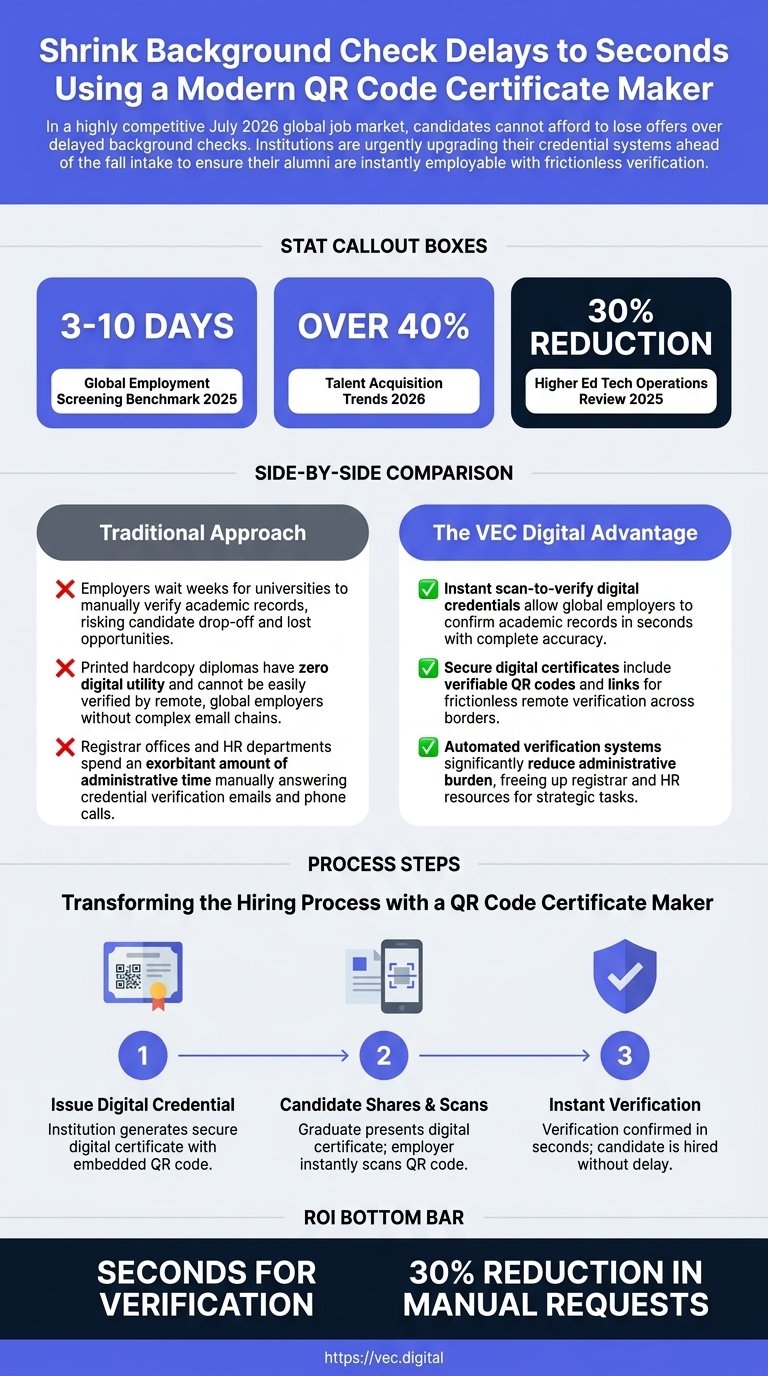
Education verification is the leading cause of background check delays, averaging 3 to 10 days for manual registrar confirmations according to the Global Employment Screening Benchmark (2025). As global hiring accelerates, institutions must equip their graduates with instantly verifiable records, making a QR code certificate maker an essential tool for modern education. When candidates lose job offers due to administrative bottlenecks, institutional reputation suffers right alongside them.
In this comprehensive guide, our team at VEC Digital leverages our deep expertise in credentialing technology to show you how to eliminate verification friction entirely. You will learn how to drastically reduce administrative workloads, accelerate graduate background screening, and transform your alumni achievements into powerful, verifiable marketing assets that hold immediate value in the global job market.
Key Takeaways
- Implementing an automated verification system eliminates the 3-to-10-day delay in traditional background checks.
- A robust QR code certificate maker bridges the gap between physical and digital records, offering zero-friction auditing.
- Registrar offices experience a massive drop in administrative overhead by removing manual email and phone confirmations.
- Verifiable digital credentials significantly boost alumni engagement and organic marketing on professional networks like LinkedIn.
- Cryptographically secure environments prevent fraud and ensure global interoperability for remote employers everywhere.
The Hidden Cost of Manual Credential Verification
For decades, the process of verifying a candidate's academic background has remained stubbornly analog. Even as other areas of human resources and recruitment have digitized, education verification has lagged behind, creating a severe bottleneck in the modern hiring pipeline. This delay is not just a minor inconvenience; it has profound operational and financial implications for both the issuing institutions and the job-seeking graduates.
To understand the urgency of adopting a QR code certificate maker, we must first examine the compounding failures of the traditional verification model. The reliance on manual checks, legacy databases, and physical document mailing creates a fragile ecosystem that routinely breaks down under the pressure of high-volume, global hiring initiatives.
Why Education Verification Delays Cost Candidates Jobs
In a highly competitive global job market, speed is a critical factor in talent acquisition. Employers are moving faster than ever to secure top candidates, but their efforts are frequently thwarted by slow background screening processes. When a recruiter extends a conditional job offer, the clock starts ticking. If the background check stalls because a university registrar is slow to respond, the employer's hiring timeline is disrupted.
The consequences of these delays are staggering. According to the Talent Acquisition Trends report (2026), over 40% of enterprise employers report abandoning a candidate if background screening takes longer than seven days. Employers simply cannot afford to keep critical roles vacant while waiting weeks for universities to manually verify academic records. This risks candidate drop-off, lost opportunities, and immense frustration for graduates who have earned their qualifications but cannot swiftly prove them.
The Administrative Burden on Registrar Offices
The pain of manual verification is not felt by employers and candidates alone; it places an exorbitant burden on the educational institutions themselves. Registrar offices, academic deans, and corporate HR departments spend an incredible amount of administrative time manually answering credential verification emails, fielding phone calls, and cross-referencing physical archives or disjointed legacy systems.
Every manual verification request requires a staff member to stop their strategic work, locate a specific student record, confirm the details, draft a formal response, and securely transmit that information back to the requesting employer or third-party screening agency. When multiplied by thousands of graduates entering the workforce simultaneously during peak graduation seasons, this manual process becomes an unsustainable operational nightmare that drains institutional resources.
How Long Does Education Verification Take for Background Checks?
A frequent question asked by both graduates and employers is: How long does education verification take for background checks? Under the traditional manual system, the answer is discouraging. As noted by the Global Employment Screening Benchmark (2025), it averages 3 to 10 days for manual registrar confirmations. However, this is merely an average. During peak periods, or when dealing with international verification requests across different time zones, the process can easily stretch into multiple weeks.
This prolonged timeline is entirely incompatible with the demands of the modern workforce. Candidates expect their hard-earned credentials to open doors immediately, not to serve as bureaucratic hurdles. By transitioning to automated digital systems, institutions can reduce this multi-day waiting period to mere seconds, fundamentally altering the trajectory of their graduates' careers.
Transforming the Hiring Process with a QR Code Certificate Maker
The solution to the verification bottleneck lies in seamlessly integrating technology directly into the credential itself. A modern QR code certificate maker is not merely a design tool; it is a comprehensive issuance engine that fundamentally changes how academic and professional achievements are authenticated in the real world.
By embedding a unique, scannable code onto every issued document, institutions can empower anyone—recruiters, hiring managers, or compliance auditors—to independently verify the claim without ever needing to contact the issuing organization's administrative staff.
What is a QR Code Certificate Maker?
At its core, a QR code certificate maker is an advanced digital platform that automates the creation, personalization, and secure delivery of credentials, while automatically generating and embedding a unique Quick Response (QR) code onto each specific document. Unlike generic QR codes that might simply link to a university's homepage, these specialized codes are dynamically linked to a secure, individualized verification URL (e.g., /certificate/[uuid]).
When an institution utilizes this technology, the system handles the heavy lifting behind the scenes. It maps the recipient's data, the course details, the issue date, and the authorized signatories to a unique cryptographic record. The resulting QR code acts as a permanent, physical-to-digital bridge, ensuring that whether the certificate is viewed as a PDF on a laptop or printed and framed on a wall, its authenticity can be proven instantly.
How Do Employers Verify Digital Certificates?
Another common inquiry in the HR space is: How do employers verify digital certificates? With traditional PDFs, employers are often forced to contact the university directly, as a standard PDF can be easily manipulated using basic photo editing software. However, when a credential is generated using a modern digital system equipped with QR integration, the verification process becomes frictionless.
To verify the credential, an employer simply opens the standard camera app on their smartphone and scans the embedded QR code. There is no need to download a proprietary app, create an account, or log into a third-party portal. The scan instantly routes the reviewer to a secure, dedicated public verification page hosted by the credentialing platform. This page displays the immutable details of the achievement: the issuing institution, the recipient's name, the date of issuance, and the official signatory details. The employer receives absolute certainty in under two seconds.
Eliminating Friction for Global Remote Employers
As remote work becomes the permanent global standard, cross-border background checks have grown increasingly complex. A digital diploma originating in the UAE or the UK must be instantly verifiable by an employer in the US without relying on international phone calls, time-zone delays, or complex administrative systems.
Scan-to-verify technology completely eliminates these geographical and temporal barriers. A hiring manager in New York can verify a candidate's engineering degree from a university in Dubai at 2:00 AM on a Sunday, receiving instant cryptographic proof of the document's validity. This level of global interoperability is vital for institutions that want their alumni to remain highly competitive in an international, borderless job market.
Bridging the Physical and Digital Worlds with a Digital Diploma Platform
While the future of credentialing is undeniably digital, the cultural and emotional significance of physical certificates remains strong. Graduates still want to walk across a stage and hold a physical representation of their hard work. A robust digital diploma platform does not force institutions to choose between physical tradition and digital innovation; it seamlessly unites both worlds.
By leveraging smart design and dynamic generation, institutions can provide credentials that look stunning when printed on high-quality parchment, yet possess all the advanced security features of a modern digital asset.
Can a Digital Diploma Platform Issue Both Physical and Digital Records?
Many academic administrators ask: Can a digital diploma platform issue both physical and digital records? The answer is a resounding yes. A high-quality platform provides a visual drag-and-drop template editor that allows institutions to design print-ready, high-resolution certificates. These designs can include custom background artwork, institutional logos, and precise typography.
Once the design is finalized and the issuance process is triggered, the platform generates a high-fidelity digital file (typically a secure PDF) that is automatically emailed to the recipient. The recipient can immediately share this digital version on professional networks. Simultaneously, the institution can print the exact same file—complete with the embedded QR code—for presentation at a physical graduation ceremony. The QR code ensures that the physical piece of paper retains its digital verifiability forever.
How Do You Add a QR Code to a Certificate of Completion?
For organizations looking to modernize, understanding the technical application is key. How do you add a QR code to a certificate of completion? In legacy systems, this might have required complex coding or manual image placement for every single student—a recipe for human error. Modern platforms completely automate this process through intuitive visual editors.
During the template design phase, administrators simply drag a "QR Code Placeholder" onto the certificate canvas, positioning it exactly where it fits best within the aesthetic layout. When the institution issues a batch of certificates—whether by uploading a CSV file of 5,000 students or triggering an automated API call from their Learning Management System (LMS)—the credentialing engine automatically generates a unique QR code for each individual and inserts it perfectly into the designated placeholder. The process is entirely zero-touch.
Why Hardcopy Diplomas Lack Digital Utility
It is crucial to recognize why upgrading is necessary. Printed hardcopy diplomas, while emotionally significant, have zero digital utility and cannot be easily verified by remote, global employers. A piece of paper cannot be attached to a LinkedIn profile, it cannot be easily embedded into a digital portfolio, and if it is scanned and emailed, the recipient has no way of knowing if the image was digitally altered.
By upgrading to a system that embeds digital verification directly onto the physical document, institutions solve this inherent flaw. They transform a static piece of paper into a dynamic, interactive gateway to a secure digital record, ensuring that the credential remains useful and secure in a digital-first economy.
The ROI of Verifiable Digital Credentials for Institutions
Transitioning to verifiable digital credentials is not just about helping students get hired faster; it delivers a massive, measurable Return on Investment (ROI) for the issuing institutions. From drastic reductions in operational costs to unprecedented gains in organic brand marketing, the business case for modernizing credential issuance is undeniable.
Educational institutions, EdTech platforms, and corporate training academies that adopt automated verification technologies position themselves as forward-thinking leaders, ultimately attracting more students and corporate partners.
Shrinking Administrative Workloads
The most immediate and tangible ROI is the drastic reduction in administrative overhead. According to the Higher Ed Tech Operations Review (2025), institutions utilizing instant scan-to-verify digital credentials experience a 30% reduction in manual verification requests to their registrar offices.
By empowering employers to self-serve their verification needs, university staff are freed from the endless cycle of answering emails and digging through archives. This allows registrars and HR professionals to redirect their valuable time toward strategic initiatives, student support, and improving the overall educational experience. The cost savings associated with reducing manual labor, eliminating physical postage, and minimizing paper waste are substantial.
Boosting Alumni Engagement and Organic Marketing
Historically, educational institutions have missed out on the organic marketing buzz generated when students share their achievements. A traditional paper certificate sits on a desk; it does not drive web traffic or brand awareness. Digital credentials, however, are inherently shareable.
Research from Social Professional Networking Stats (2026) reveals that QR-enabled certificates generate up to 5x more LinkedIn engagement for alumni compared to unverified text claims. When a graduate shares their secure credential online, their entire professional network sees the issuing institution's branding. Every click on that credential drives traffic back to the institution's verification page, serving as powerful, zero-cost organic marketing that validates the institution's authority and reach.
Meeting Recruiter Expectations in 2026
The expectations of the corporate hiring world have shifted dramatically. The Future of Hiring Report (2026) highlights that 78% of modern recruiters prioritize candidates who provide digital portfolios and instantly verifiable credentials over traditional paper resumes.
Institutions must align their outputs with these modern expectations. By providing graduates with modern, tech-forward credentials, universities and bootcamps directly increase their alumni's employability. High employability rates are the ultimate metric of success for any educational institution, directly influencing future enrollment numbers, institutional rankings, and alumni donor relations.
Security and Trust: Beyond the Novelty QR Code
It is important to emphasize that not all digital certificates are created equal. Many competitor blogs treat QR codes merely as a novelty design feature—a simple graphic that links to a static PDF hosted on a vulnerable server. However, true security requires a much deeper technological foundation. To truly protect institutional reputation and prevent degree fraud, the credentialing system must be built on immutable architecture.
The true value of a QR code certificate maker lies in the cryptographic security backing the URL it points to. Without this underlying security, a QR code is simply a convenient link, rather than a guarantee of absolute authenticity.
Are QR Code Certificates Secure for University Diplomas?
Administrators frequently ask: Are QR code certificates secure for university diplomas? The answer depends entirely on the underlying infrastructure. If a QR code simply links to an unencrypted database, it remains vulnerable to hacking, spoofing, and unauthorized alterations.
However, when paired with advanced cryptographic hashing and immutable ledger technology, QR code certificates become the most secure format available today. In these advanced systems, the moment a certificate is issued, its data is hashed into a unique digital fingerprint. This fingerprint is anchored to an unalterable record. When an employer scans the QR code, the verification page cross-references the document's current state with the original immutable fingerprint. If even a single pixel or character has been altered, the verification fails instantly, making credential fraud mathematically impossible.
The Role of Blockchain Certificate Solutions UAE and Globally
The demand for unbreakable security has led to the rise of specialized technologies, particularly in tech-forward regions. For instance, the adoption of blockchain certificate solutions UAE has set a global benchmark for how academic and corporate sectors can completely eradicate document forgery.
By anchoring credentials to a decentralized, publicly verifiable ledger, institutions ensure that their records are permanently tamper-proof and independent of any single internal server. This means that even if a university's local database experiences an outage, the graduate's credential remains 100% verifiable worldwide. This level of resilience is why immutable, decentralized storage is rapidly becoming the gold standard for professional records globally.
What is the Best QR Code Certificate Maker?
When evaluating technology, decision-makers often search for: What is the best QR code certificate maker? The superior choice is a platform that offers a holistic, end-to-end issuance engine rather than just a superficial design tool.
The best platforms provide seamless bulk issuance via CSV uploads, robust developer APIs for zero-touch integration with Learning Management Systems (LMS), and strict multi-signatory approval pipelines to ensure internal governance. Furthermore, they must guarantee 99.9% uptime, offer comprehensive customization without requiring coding skills, and natively support immutable anchoring to guarantee the long-term validity of every issued document.
Secure Your Graduates’ Future with VEC Digital
In a highly competitive July 2026 global job market, candidates cannot afford to lose offers over delayed background checks, and institutions cannot afford to be weighed down by manual verification processes. Upgrading to a secure, automated credentialing system is no longer optional; it is a critical operational necessity that directly impacts student success and institutional efficiency.
At VEC Digital, we provide the trust infrastructure required to issue, manage, and authenticate digital certificates effortlessly. Our comprehensive platform combines visual template design, zero-friction scan-to-verify technology, and immutable security to ensure your credentials are universally respected and instantly verifiable anywhere in the world.
Empower your learners to own their achievements and give employers the certainty to hire without doubt. Secure your organization’s credentials today by exploring our advanced solutions.
Visit us at https://vec.digital or contact our team directly at support@vec.digital to modernize your credentialing strategy.