
The Financial and Operational ROI of a Digital Diploma Platform
Published on October 29, 2026

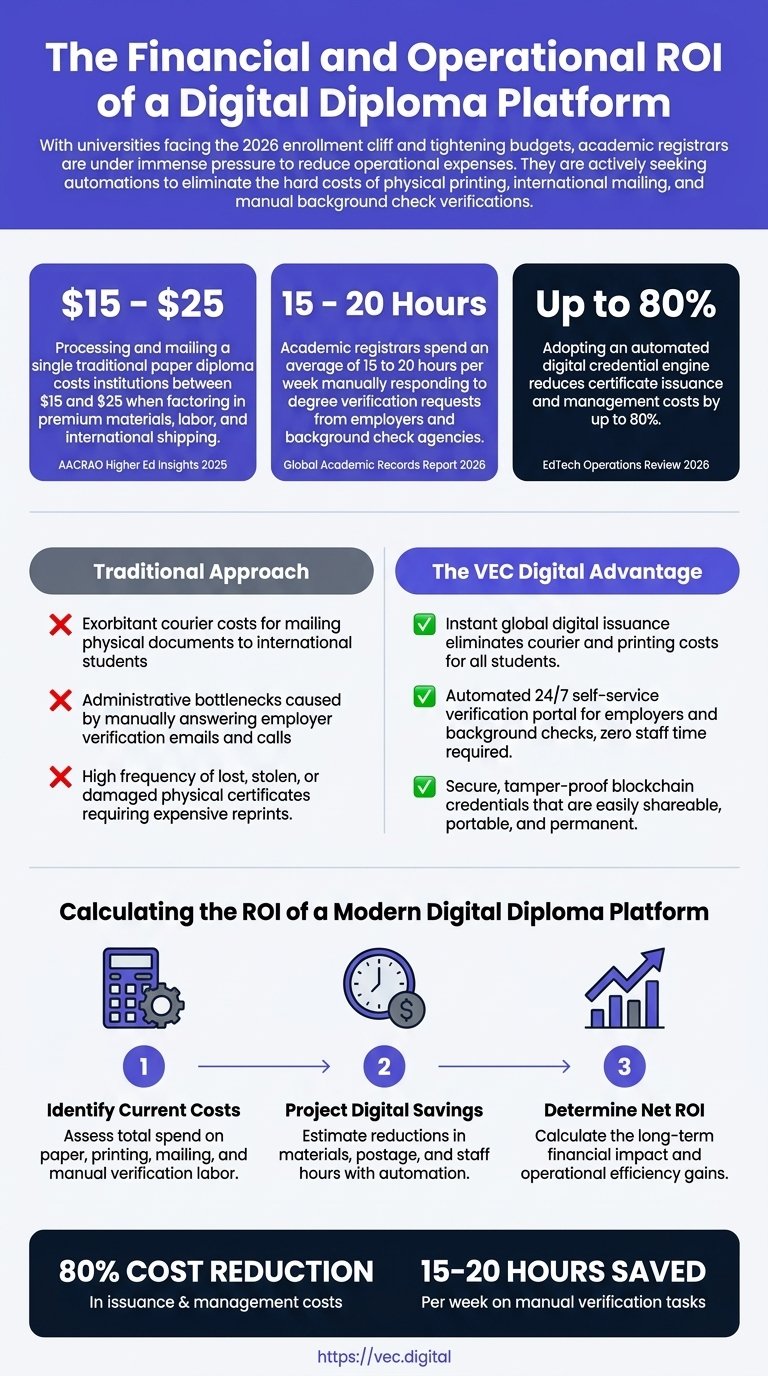
Processing and mailing a single traditional paper diploma costs institutions between $15 and $25 when factoring in premium materials, labor, and international shipping, according to 2025 AACRAO Higher Ed Insights. As universities globally face tightening budgets and shifting enrollment demographics, academic registrars are under immense pressure to reduce operational expenses without compromising institutional prestige. The reliance on legacy physical documents is rapidly becoming a financial liability that modern educational institutions can no longer afford to ignore.
By transitioning to a comprehensive digital diploma platform, higher education administrators can eliminate the hard costs of physical printing, international mailing, and manual background check verifications. In this article, our team at VEC Digital breaks down the concrete financial Return on Investment (ROI) of automated credentialing, providing the mathematical models and strategic insights you need to justify this technological upgrade. You will learn how to drastically cut administrative overhead, secure your institution's reputation against degree fraud, and meet the modern employer's demand for instantaneous credential verification.
Key Takeaways
- Transitioning to a digital diploma platform reduces credential issuance and management costs by up to 80%.
- Implementing blockchain certificate verification completely eliminates the risk of academic forgery and protects institutional reputation.
- Utilizing a bulk certificate generator reclaims hundreds of administrative hours during peak graduation seasons.
- Deploying a QR code certificate maker allows employers to conduct frictionless background checks in seconds without relying on university staff.
- Adopting verifiable digital credentials eliminates exorbitant international courier fees for a rapidly growing global alumni base.
The Hidden Financial Drain of Traditional Academic Credentialing
The True Cost of Paper, Printing, and International Shipping
For decades, the physical diploma has been the ultimate symbol of academic achievement. However, the logistical reality of producing and distributing these documents is highly inefficient. As noted by 2025 AACRAO Higher Ed Insights, processing and mailing a single traditional paper diploma costs institutions between $15 and $25. This figure accounts for premium parchment paper, specialized printing inks, embossed seals, protective packaging, and postage.The financial strain becomes even more pronounced when dealing with international alumni. Globally, as international student enrollment remains a key revenue driver for universities across the US, UK, Australia, and the Middle East, the logistical nightmare of shipping physical documents overseas has escalated. Exorbitant courier costs for mailing physical documents to international students can easily exceed $50 to $100 per package, depending on the destination. When multiplied across thousands of graduating students, these hard costs represent a massive, recurring drain on university budgets that a digital diploma platform can instantly resolve.
The Administrative Burden of Manual Degree Verifications
Beyond the initial issuance, the ongoing management of academic records requires significant human capital. Academic registrars spend an average of 15 to 20 hours per week manually responding to degree verification requests from employers and background check agencies, according to the Global Academic Records Report (2026). This manual process typically involves receiving an email or fax, pulling up a student's record in a legacy database, confirming the details, and drafting a formal response.These administrative bottlenecks caused by manually answering employer verification emails and calls pull highly skilled university staff away from strategic initiatives. In an era where institutional budget cuts are forcing registrar departments to manage growing alumni bases with less staff, allocating half a full-time employee's weekly hours to routine data verification is an unsustainable operational model.
The Endless Cycle of Lost and Damaged Replacements
Physical documents are inherently fragile. They are susceptible to fire, flood, misplacement during residential moves, and general degradation over time. Consequently, replacing lost or damaged physical diplomas accounts for nearly 30% of post-graduation administrative requests in higher education, according to a 2025 University Records Management Study.Each replacement request triggers the entire costly production cycle all over again. The university must verify the alumni's identity, process a replacement fee, order the print, and arrange for shipping. This high frequency of lost, stolen, or damaged physical certificates requiring expensive reprints creates a constant backlog for administrative teams, further highlighting the urgent need for a secure, permanent digital alternative.
Calculating the ROI of a Modern Digital Diploma Platform
Immediate Reduction in Material and Logistical Expenses
When administrators ask, "How much does a digital diploma platform cost?", the answer must be evaluated against the current baseline of physical issuance. While software platforms require a subscription or pay-as-you-go fee, this cost is a fraction of legacy methods. In fact, adopting an automated digital credential engine reduces certificate issuance and management costs by up to 80%, according to the EdTech Operations Review (2026).By eliminating the need for premium paper, specialized printing, and postage, institutions immediately recapture capital. A digital system allows universities to issue 10,000 certificates for the same administrative effortâ-and a drastically lower financial footprintâ-as issuing a single physical document. The shift from a variable, resource-heavy cost structure to a predictable, scalable software model is a primary driver of operational efficiency.
Reclaiming Registrar Hours with Automated Credential Issuance
What is the ROI of automated credentialing in higher education? Beyond the hard savings on postage and paper, the most significant return on investment comes from reclaiming administrative time. By implementing an automated credential issuance engine, universities transform a multi-week manual process into an instantaneous digital event.Instead of manually verifying data and stuffing envelopes, administrators can connect their Student Information Systems (SIS) or Learning Management Systems (LMS) directly to a digital platform via an API. The moment a student's graduation status is approved, the system automatically generates, secures, and emails the credential. This automation pipeline frees up hundreds of hours per semester, allowing registrar staff to focus on student counseling, data analytics, and improving the overall academic experience.
Building a Financial Model for University CFOs
Existing industry content often focuses heavily on the cryptographic security and eco-friendly nature of digital records. However, there is a distinct lack of content detailing the concrete financial ROI, cost-per-student savings, and the specific mathematical models that university CFOs and Registrars need to justify the software investment. Letâ's break down a hypothetical model for a mid-sized university graduating 5,000 students annually.Traditional Model Costs:
- Printing and Materials: 5,000 students x $10 = $50,000
- Domestic Shipping: 4,000 students x $5 = $20,000
- International Courier: 1,000 students x $45 = $45,000
- Labor (Issuance & Verifications): Estimated $35,000 annually
- Total Annual Cost: $150,000
Digital Platform Model Costs:
- Platform Subscription/Issuance Fees: Estimated $5,000 - $10,000 annually
- Labor (System Management): Estimated $5,000 annually
- Total Annual Cost: $15,000
In this conservative model, the university realizes an annual savings of $135,000â-a massive 90% reduction in direct costs. These freed-up funds can be reallocated to critical student services, faculty development, or campus infrastructure upgrades.
How Employers and Institutions Benefit from Verifiable Digital Credentials
Meeting the Demand for Instantaneous Background Checks
The modern job market moves at unprecedented speed, and delays in background screening can cost candidates lucrative job offers. Currently, 78% of modern employers now expect instantaneous, digital verification of applicant degrees to prevent hiring delays, according to 2026 HR Tech Trends. Traditional verification methods, which require employers to email the university and wait days or weeks for a response, are no longer acceptable.How do employers verify digital diplomas? When a university issues verifiable digital credentials, the graduate receives a secure, unique URL hosting their certificate. The graduate can embed this link on their LinkedIn profile, digital resume, or portfolio. When an employer clicks the link, they are instantly presented with a tamper-proof record of the studentâ's achievement, authenticated directly by the issuing institution's digital infrastructure. This zero-friction process dramatically accelerates the hiring timeline.
Are Blockchain Digital Diplomas Legally Recognized by Employers?
A common question among academic administrators is whether new technological formats hold the same weight as traditional paper. The answer is a resounding yes. Blockchain digital diplomas are widely recognized and increasingly preferred by global employers, background check agencies, and government entities due to their mathematical provability.Unlike a standard PDF, which can be easily edited using basic software, a credential anchored to a blockchain architecture provides an immutable audit trail. Employers recognize that if a credential passes cryptographic verification, it is mathematically impossible for it to have been forged or altered. This level of absolute certainty is exactly what corporate compliance and HR departments require in a high-risk hiring environment.
Frictionless Verification Using a QR Code Certificate Maker
To bridge the gap between the physical and digital worlds, modern platforms utilize a **QR code certificate maker**. This feature automatically embeds a unique, scannable QR code onto the design of every digital (and subsequently printed) certificate.If an alumnus chooses to print their digital diploma and frame it in their office, or hand a physical copy to a prospective employer, the verification capability remains intact. The employer simply points their smartphone camera at the QR code. Within seconds, they are routed to the official university verification portal, confirming the document's authenticity without needing to download any specialized apps or create an account. It is the ultimate frictionless auditing experience.
Securing Institutional Reputation and Preventing Degree Fraud
How Do Universities Stop Diploma Fraud?
Diploma fraud is a multi-million dollar global industry. With the rise of advanced generative AI and sophisticated graphic design tools, creating a convincing counterfeit of a traditional paper diploma or a standard PDF takes mere minutes. To effectively **prevent degree fraud**, universities must move away from visual trust (relying on watermarks or embossed seals) and transition to cryptographic trust.Stopping diploma fraud requires removing the human element of visual inspection. By adopting a digital diploma platform that issues cryptographically signed records, universities ensure that the validity of a document is determined by a computer algorithm checking a secure server or blockchain ledger, rather than an HR manager squinting at a PDF logo. If a single pixel of data is altered by a fraudster, the cryptographic signature breaks, and the verification instantly fails.
The Role of Blockchain Certificate Verification
The gold standard for securing academic records is **blockchain certificate verification**. When a university issues a diploma, the platform generates a unique cryptographic hash of the document's data and anchors it to a public, immutable blockchain. This process does not store personal student data on the blockchain (ensuring strict compliance with privacy laws like FERPA or GDPR), but rather stores the mathematical "fingerprint" of the document.When an employer attempts to verify the credential, the system recalculates the fingerprint of the document being presented and compares it to the fingerprint permanently locked on the blockchain. If they match perfectly, the system displays a "Blockchain Verified" badge. This completely eliminates the possibility of credential fraud and fiercely protects the issuing organization's brand reputation from being associated with fake degrees.
Can Digital Certificates Replace Paper Degrees Entirely?
Many institutions ask if digital certificates can replace paper degrees entirely. From an operational, legal, and financial standpoint, the answer is yes. Digital formats offer superior security, instant global portability, and massive cost savings. However, from a cultural standpoint, the transition is often handled as a hybrid approach.In 2026, most forward-thinking universities issue the official, verifiable digital credential immediately upon graduation, satisfying the immediate needs of employers and the graduate's digital identity. They may still offer a ceremonial physical printout for framing, but the digital version serves as the singular "source of truth" for all official verification purposes. Over time, as digital wallets and digital identity become ubiquitous, the reliance on paper will phase out entirely.
Scaling Global Operations with Automated Issuance Engines
Streamlining Cohorts with a Bulk Certificate Generator
For large universities, EdTech platforms, and global bootcamps, issuing thousands of certificates at the end of a semester or training cohort is a monumental task. Utilizing a **bulk certificate generator** is essential for scaling operations without lag.Instead of manually typing names into design templates, administrators can simply upload a standard CSV file containing recipient details (names, course titles, dates, honors). The system's automated engine instantly parses the data, maps it to dynamic placeholders on the certificate design, and generates thousands of personalized, secure credentials in minutes. This operations automation saves hundreds of administrative hours during massive graduations and post-event wrap-ups.
Automating Compliance and Continuing Education
The benefits of a digital diploma platform extend far beyond traditional universities. Corporate HR departments and professional associations also leverage these systems for **compliance training certificate automation**. In highly regulated industries like healthcare, finance, and manufacturing, tracking employee certifications is critical for audit readiness.By integrating a digital credential API with corporate Learning and Development (L&D) systems, organizations can achieve zero-touch automation. The second an employee completes a mandatory safety module or compliance exam, the system triggers the immediate generation and delivery of a verifiable digital badge. This ensures that internal compliance audits are always organized, accurate, and instantly provable to external regulators.
Supporting Borderless Education and International Alumni
Education is no longer confined by geography. Online academies, global enterprise training programs, and international university campuses require an infrastructure that operates seamlessly across borders. Traditional mailing systems fail in a borderless world due to high costs, lost packages, and weeks-long transit times.A digital credentialing system ensures that a graduate in Dubai receives their verifiable diploma at the exact same moment as a graduate in New York. This instant, equitable distribution empowers global alumni to immediately leverage their achievements in the local job market, driving student success and reinforcing the global prestige of the issuing institution.
Secure Your Institutionâ's Future with VEC Digital
The financial and operational mandate for higher education in 2026 is clear: institutions must modernize their administrative processes to survive tightening budgets and meet the digital expectations of the modern workforce. Continuing to rely on expensive, fragile, and easily forged physical paper is an operational risk that universities can no longer justify. By embracing a secure digital credentialing system, you can slash administrative overhead by up to 80%, reclaim thousands of staff hours, and absolutely guarantee the integrity of your academic records.At VEC Digital, we provide the trust infrastructure for global institutions. Our frictionless platform combines a visual drag-and-drop certificate maker, automated bulk issuance, and immutable blockchain anchoring to make credential fraud impossible. Secure your organizationâ's credentials todayâ-design your first template in minutes with no setup fees, and give your graduates the instantly verifiable proof of employability they deserve.
Ready to eliminate the hidden costs of legacy credentialing? Visit https://vec.digital or contact our enterprise implementation team at support@vec.digital to model your institutional ROI today.