
The Green Registrar: Cutting Carbon Emissions With a Digital Diploma Platform
Published on November 28, 2026

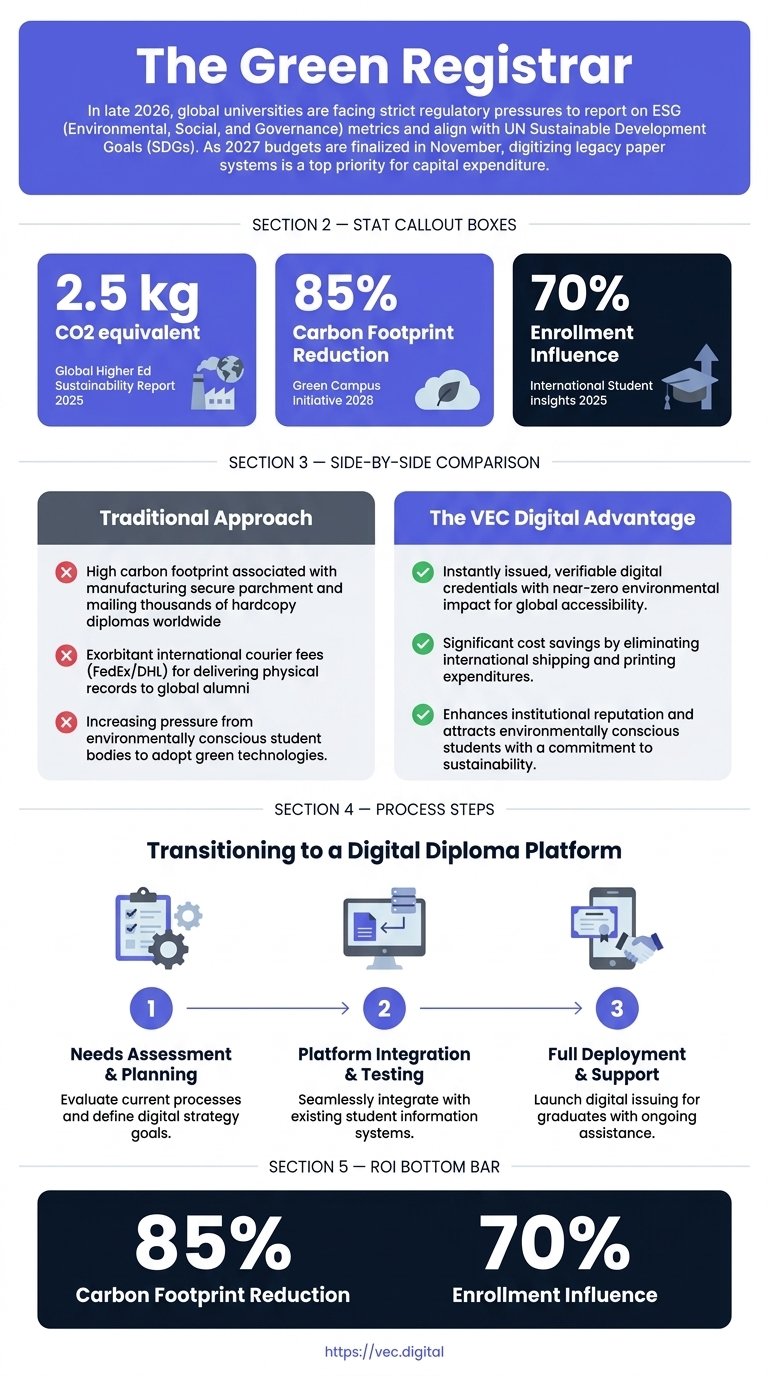
Producing and internationally shipping a single traditional paper diploma generates approximately 2.5 kg of CO2 equivalent, according to the 2025 Global Higher Ed Sustainability Report. As global universities face increasingly strict regulatory pressures to report on ESG (Environmental, Social, and Governance) metrics and align with UN Sustainable Development Goals (SDGs), digitizing legacy paper systems has become a top priority for capital expenditure. To eliminate the massive carbon footprint associated with physical records, academic institutions are rapidly transitioning to a secure digital diploma platform.
In this comprehensive guide, our team at VEC Digital leverages deep expertise in educational technology and cryptographic infrastructure to outline the measurable environmental ROI of paperless credentialing. You will discover how to eradicate international shipping emissions, satisfy the eco-conscious demands of prospective students, and streamline your registrar operations. By adopting an automated credentialing engine, your institution can drastically reduce waste while simultaneously enhancing the global verifiability and security of your academic records.
Key Takeaways
- Transitioning to a digital diploma platform eliminates the heavy carbon footprint associated with manufacturing and shipping paper certificates.
- Implementing eco friendly credential management systems can reduce a registrar's office carbon footprint by up to 85%.
- Utilizing a bulk certificate generator allows institutions to automate high-volume issuance, replacing physical logistics with instant digital delivery.
- Blockchain certificate verification not only ensures academic integrity but also provides measurable ESG benefits for institutional reporting.
- Issuing verifiable digital credentials aligns universities with global sustainability mandates, including UN SDGs 9, 12, and 13.
The Environmental Cost of Traditional Academic Records
The Hidden Carbon Footprint of Parchment and Ink
For centuries, the physical diploma has been the ultimate symbol of academic achievement. However, the modern manufacturing process behind these documents is highly resource-intensive. The high carbon footprint associated with manufacturing secure parchment involves significant water consumption, deforestation, and the use of chemical bleaching agents. Furthermore, the specialized toxic inks and metallic foils used for university seals introduce micro-pollutants into the environment during both production and eventual disposal.
When you multiply this impact across thousands of graduating students annually, the environmental toll becomes staggering. As noted in the 2025 Global Higher Ed Sustainability Report, producing and internationally shipping a single traditional paper diploma generates approximately 2.5 kg of CO2 equivalent. For a university graduating 10,000 students, that equates to 25 metric tons of carbon emissions solely dedicated to printing and mailing a single sheet of paper per student.
How much does it cost to print and ship a university degree internationally?
Beyond the environmental degradation, universities are grappling with exorbitant international courier fees (such as FedEx or DHL) for delivering physical records to global alumni. But exactly how much does it cost to print and ship a university degree internationally? The financial burden is immense. According to the 2026 Academic Operations Review, shipping physical academic transcripts globally costs higher education institutions an estimated $45 million annually while contributing massive scope 3 emissions.
Scope 3 emissionsâ-those that occur in the value chain of the reporting company, including transportation and distributionâ-are notoriously difficult for organizations to control. By relying on global aviation logistics to deliver a piece of parchment, universities are actively undermining their own institutional climate pledges. Reallocating these massive logistical budgets toward digital infrastructure not only saves money but instantly neutralizes these indirect emissions.
The Rising Pressure from the Modern Student Body
Today's generation of students is acutely aware of the climate crisis and expects the institutions they attend to reflect their values. There is increasing pressure from environmentally conscious student bodies to adopt green technologies across all campus operations. According to 2025 International Student Insights, over 70% of prospective international students state that a university's commitment to sustainability heavily influences their enrollment decisions.
When an institution mails a physical document wrapped in single-use plastics and cardboard tubes across the world, it sends a contradictory message to a demographic that values ecological responsibility. Modernizing the registrar's office is no longer just an administrative upgrade; it is a critical component of institutional marketing and student relationship management.
Transitioning to a Digital Diploma Platform
What is a digital diploma platform?
To solve the logistical and environmental crises of legacy record-keeping, institutions are turning to modern software solutions. But what is a digital diploma platform? In essence, it is a comprehensive, cloud-based engine designed to design, generate, distribute, and cryptographically secure academic records without the need for physical materials. Instead of printing paper, the platform utilizes dynamic templates and automated data mapping to create highly secure, visually stunning digital certificates that are delivered instantly to a student's inbox or digital wallet.
These platforms empower organizations to manage the entire lifecycle of a credential digitally. From multi-signatory approval pipelines that ensure administrative governance to the final issuance and permanent public verification hosting, every step of the process is digitized, tracked, and secured.
Are digital diplomas more eco-friendly than paper?
When academic deans evaluate new technology, a common question arises: Are digital diplomas more eco-friendly than paper? The answer is an unequivocal yes. The environmental savings of moving from a physical supply chain to a cloud-based infrastructure are profound. According to the 2026 Green Campus Initiative, universities utilizing cloud-based credential systems have reduced their registrar office carbon footprint by up to 85%.
While data centers and cloud servers do consume electricity, the carbon cost per digital transaction is microscopically small compared to the physical logging, milling, printing, and aviation fuel required to deliver a paper diploma. Furthermore, many modern cloud providers operate on renewable energy, pushing the carbon footprint of a digital credential closer to absolute zero.
How can universities reduce their carbon footprint through automation?
So, how can universities reduce their carbon footprint practically? The key lies in replacing manual, paper-heavy tasks with automated digital systems. By integrating a bulk certificate generator into the university's Learning Management System (LMS) or Student Information System (SIS), administrators can issue thousands of records simultaneously.
Instead of printing 5,000 documents and manually stuffing them into envelopes, administrators simply upload a standard CSV file of recipient data. The automated system maps this data to secure templates and dispatches them instantly. This frictionless scalability not only saves hundreds of administrative hours but entirely bypasses the physical manufacturing and shipping phases, directly slashing the institution's carbon output.
Aligning with Global ESG Mandates and SDGs
Navigating Complex ESG Reporting Requirements
In regions like the European Union and the UAEâ-especially following aggressive post-COP28 initiativesâ-educational institutions are legally mandated or strongly incentivized to digitize operations to meet 2030 net-zero targets. Universities face complex and mandatory ESG reporting requirements needed to secure institutional funding and government grants. To satisfy these audits, institutions must provide concrete, data-backed evidence of their carbon reduction strategies.
Transitioning to paperless university operations provides an immediate, high-impact win for regional sustainability mandates. By tracking the exact number of physical shipments eliminated through digital issuance, sustainability officers can easily quantify their scope 3 emission reductions for annual ESG reports, providing a clear narrative of environmental stewardship to stakeholders and government bodies.
How do verifiable digital credentials support UN sustainability goals?
The United Nations has established a blueprint for peace and prosperity through its Sustainable Development Goals (SDGs). A frequent inquiry from institutional boards is: How do verifiable digital credentials support UN sustainability goals? According to the 2025 UN Global Compact on Education, adopting a paperless credential infrastructure can help institutions actively align with up to three specific UN Sustainable Development Goals (SDGs 9, 12, and 13).
- SDG 9 (Industry, Innovation, and Infrastructure): By upgrading legacy paper systems to robust API-driven digital platforms, universities foster technological innovation and build resilient, modern administrative infrastructures.
- SDG 12 (Responsible Consumption and Production): Eliminating the mass production of parchment, toxic inks, and single-use packaging directly supports the mandate to substantially reduce waste generation.
- SDG 13 (Climate Action): Eradicating the global aviation logistics required to ship transcripts drastically reduces greenhouse gas emissions, actively combating climate change.
The ESG benefits of blockchain certificate verification
When discussing digital transformation, it is vital to understand the ESG benefits of blockchain certificate verification. While blockchain technology is often associated with energy-intensive cryptocurrency mining, modern credentialing platforms utilize highly efficient, low-energy consensus mechanisms.
The primary ESG benefit is transparency and governance (the "G" in ESG). Blockchain provides an immutable, decentralized ledger that permanently records the issuance of a credential. This creates a mathematically irrefutable audit trail. For ESG auditors, this means the university's digital records are transparent, tamper-proof, and fully compliant with international data integrity standards. It proves that the institution's transition to digital was executed securely, protecting both the student's data and the university's reputation.
Implementing Eco-Friendly Credential Management Systems
Digitizing the Registrar with Zero-Paper Operations
To successfully modernize, institutions must invest in eco friendly credential management systems that entirely replace the need for physical archives. Historically, university registrars have relied on massive filing cabinets filled with paper transcripts, which require significant physical real estate, climate control, and manual labor to manage.
By moving to a fully digital ecosystem, these records are stored securely in the cloud. Students gain access to a dedicated recipient portal where they can view, manage, and share their credentials permanently. This zero-paper approach not only reclaims valuable campus real estate but also ensures that records are never lost to physical degradation, fires, or natural disasters.
Eradicating Scope 3 Emissions with Instant Delivery
As previously highlighted, scope 3 emissions from third-party logistics represent a massive environmental liability for global universities. The implementation of an automated issuance engine eradicates this liability overnight. When a student graduates in Dubai, their digital diploma can be instantly delivered to their inbox, whether they are returning home to London, Mumbai, or New York.
This instant delivery mechanism is equally applicable to corporate environments. For enterprise HR departments, utilizing compliance training certificate automation means that thousands of remote employees can receive their mandatory safety or GDPR compliance certificates instantly upon course completion, completely bypassing internal mailrooms and physical printing resources.
The Role of a Bulk Certificate Generator in Sustainable Scaling
As universities expand their offerings to include short courses and stackable micro-credentials, the volume of certificates issued is skyrocketing. A traditional paper-based system would buckle under this volume, resulting in an ecological disaster of wasted paper.
A sophisticated bulk certificate generator is the linchpin of sustainable scaling. It allows an institution to scale its educational reach globally without a corresponding increase in physical waste. Whether issuing 50 or 50,000 certificates, the environmental impact remains negligible, allowing universities to grow their revenue and impact while maintaining strict adherence to their net-zero climate pledges.
Ensuring Security While Going Green
Why Sustainability Cannot Compromise Academic Integrity
While the environmental benefits of digitizing records are undeniable, university deans and IT directors rightfully insist that sustainability cannot come at the expense of academic integrity. A digital document is only valuable if it can be trusted by prospective employers and other academic institutions. Standard PDF files, while eco-friendly, are highly susceptible to manipulation using basic graphic design software, posing a severe threat to institutional reputation.
Cryptographic Anchoring to Prevent Degree Fraud
To actively prevent degree fraud, modern digital diploma platforms employ advanced cryptographic anchoring. When a certificate is issued, the system generates a unique digital fingerprint (a hash) of the document and anchors it to an immutable blockchain.
Because the blockchain is decentralized and cannot be altered, it serves as a permanent source of truth. If a malicious actor attempts to alter a digital certificateâ-even changing a single pixel or a letter in a nameâ-the cryptographic hash will break, immediately flagging the document as a forgery. This ensures that the university's transition to a green, paperless system simultaneously upgrades its security posture against sophisticated AI-driven document fraud.
Frictionless Auditing with a QR Code Certificate Maker
The final step in securing the digital transition is providing a seamless way for third parties to verify the records. By utilizing an embedded QR code certificate maker, institutions bridge the gap between complex cryptography and user-friendly verification.
Every issued credential features a unique QR code. When an employer or auditor scans this code with any standard smartphone camera, they are instantly routed to a dedicated, secure verification page on the institution's domain. This page displays a "Blockchain Verified" security badge and the immutable details of the credential. This frictionless process requires no app installations or account logins, completely eliminating the need for employers to request environmentally damaging physical transcripts from the university registrar.
Lead the Sustainable Transition with VEC Digital
The mandate for higher education is clear: modern universities must aggressively reduce their carbon footprints, eliminate wasteful logistical spending, and align with global ESG standards. By transitioning away from resource-intensive parchment and international courier services, institutions can drastically cut their scope 3 emissions and appeal to an increasingly eco-conscious global student body.At VEC Digital, we provide the comprehensive, blockchain-powered infrastructure necessary to make this sustainable transition effortless. Our platform acts as the ultimate trust infrastructure, allowing you to automate high-volume issuance, eradicate physical waste, and provide unbreakable cryptographic security for every credential you issue.
Ready to build a paperless campus, reduce your registrar's carbon footprint, and secure your academic records for the future?
Contact our team today to explore our eco-friendly digital credential solutions: Website: https://vec.digital Email: support@vec.digital