
The Paperless Campus: Why Universities Need a Digital Diploma Platform
Published on July 20, 2026

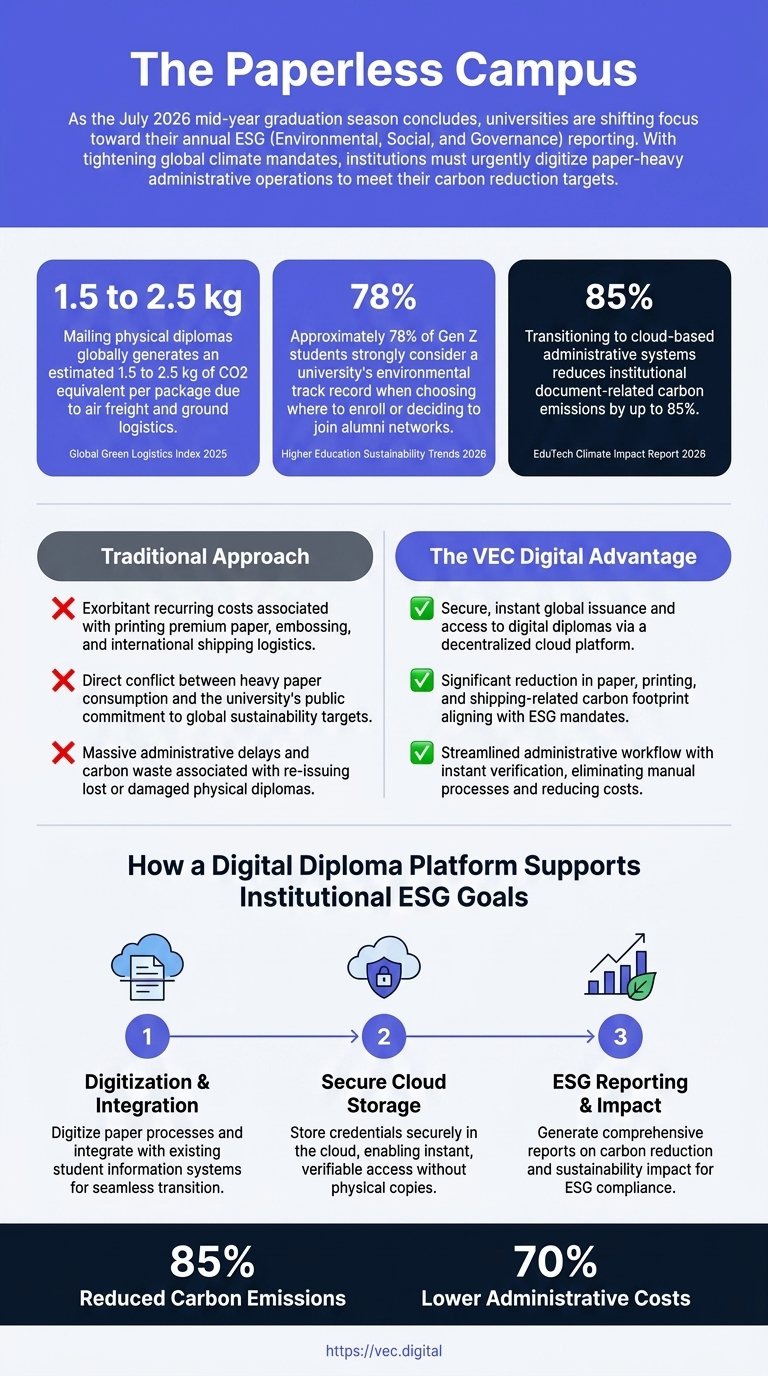
Mailing physical diplomas globally generates an estimated 1.5 to 2.5 kg of CO2 equivalent per package due to air freight and ground logistics, significantly inflating an institution's carbon footprint. To combat this waste and streamline operations, forward-thinking academic registrars are rapidly transitioning to a secure digital diploma platform. This shift immediately resolves the logistical nightmare of international shipping while aligning institutional practices with strict global climate mandates.
In this comprehensive guide, our team at VEC Digital leverages our deep expertise in educational technology to outline how modernizing your credentialing system drives both ecological and operational success. By reading this article, you will discover how to eliminate exorbitant printing costs, drastically reduce Scope 3 emissions to meet ESG targets, and deploy instantly verifiable credentials that appeal to eco-conscious Gen Z students. Ultimately, we will provide a clear roadmap for adopting a paperless strategy that enhances your institution's global reputation and operational efficiency.
Key Takeaways
- Scope 3 Emissions Reduction: Transitioning to digital credentials drastically cuts the carbon footprint associated with global shipping and logistics.
- Eliminating Administrative Waste: A robust digital diploma platform removes the exorbitant costs of printing, embossing, and mailing physical paper.
- Gen Z Brand Appeal: Modernizing document issuance aligns with the eco-conscious values of prospective students and global alumni networks.
- Instant Global Verification: Scan-to-verify technology allows international employers to authenticate degrees in seconds, accelerating graduate hiring timelines.
- Immutable Security: Blockchain anchoring provides absolute certainty, helping institutions permanently prevent degree fraud without compromising student privacy.
The Hidden Environmental Cost of Traditional Academic Credentials
For decades, the physical degree has been the ultimate symbol of academic achievement, but its production and distribution come at a steep ecological price. Implementing a digital diploma platform is no longer just a technological upgrade; it is a critical environmental imperative for institutions worldwide. As global climate mandates tighten, universities are being forced to audit their supply chains, revealing that the traditional paper credentialing process is heavily laden with hidden carbon costs and financial inefficiencies.
The Financial and Ecological Burden of Paper
Many academic administrators often ask: How much does it cost a university to print physical diplomas? The reality is staggering. According to the University Business Finance Review (2024), the cost of printing, embossing, and shipping physical certificates costs major universities upwards of $150,000 annually. This figure does not merely represent a financial drain; it highlights a massive consumption of premium paper, specialized inks, and non-recyclable packaging materials.
Beyond the direct financial cost, the ecological burden is immense. Premium diploma paper often requires specific milling processes that consume vast amounts of water and energy. When institutions scale this up to accommodate tens of thousands of graduating students each year, the environmental degradation becomes a direct contradiction to the sustainability pledges many universities proudly display on their websites. Transitioning away from this archaic model is a fundamental step toward responsible institutional management.
The Carbon Footprint of Global Logistics
The environmental impact of traditional diplomas extends far beyond the printing press. Once a degree is printed, it must be shipped, often internationally. The Global Green Logistics Index (2025) reports that mailing physical diplomas globally generates an estimated 1.5 to 2.5 kg of CO2 equivalent per package due to air freight and ground logistics. For a university with a diverse, global student body, shipping thousands of documents across continents results in metric tons of unnecessary carbon emissions.
This logistical carbon footprint falls squarely into Scope 3 emissions—indirect emissions that occur in a company’s or institution's value chain. With regulatory frameworks like the EU Corporate Sustainability Reporting Directive (CSRD) taking full effect, institutions are now legally required in many jurisdictions to report and reduce these exact types of emissions. Adopting modern digital solutions is a direct, measurable way to slash these logistical emissions to near zero.
The Waste of Re-Issuing Lost Documents
The inefficiency of physical documents is compounded when they are inevitably lost, damaged, or destroyed. The traditional process for re-issuing a physical diploma requires students to submit formal requests, pay administrative fees, and wait weeks for a new document to be printed and shipped. This creates massive administrative delays and doubles the carbon waste associated with that single credential.
Every re-issued document means more paper, more ink, and another round of carbon-heavy global shipping. By digitizing the process, universities can provide graduates with permanent, cloud-based access to their records. If a graduate needs to present their credentials to an employer, they simply share a secure digital link, completely eliminating the need for physical reprints and the associated environmental toll.
How a Digital Diploma Platform Supports Institutional ESG Goals
As the mid-year graduation seasons conclude, institutional focus naturally shifts toward annual ESG (Environmental, Social, and Governance) reporting. A modern digital diploma platform serves as a cornerstone for these initiatives, transforming a historically wasteful administrative process into a beacon of institutional sustainability. By digitizing student records, universities can tangibly demonstrate their commitment to global climate goals.
What is a Digital Diploma Platform?
A common question among higher education administrators is: What is a digital diploma platform? In essence, it is a secure, cloud-based software system that allows academic institutions to design, generate, issue, and manage official student credentials digitally. Instead of printing a physical piece of paper, the system generates a cryptographically secure digital asset that is emailed directly to the graduate.
These platforms typically feature visual drag-and-drop editors, automated bulk issuance capabilities, and integrated verification mechanisms like embedded QR codes. More importantly, they replace the entire physical supply chain of credentialing with a streamlined, zero-emission digital process. By serving as a centralized hub for all academic records, these platforms provide registrars with complete control over the credentialing lifecycle without the need for physical storage or shipping infrastructure.
Aligning with the UN Race to Zero
Universities are under increasing pressure to back up their green marketing with verifiable actions. How do digital credentials support university ESG and sustainability goals? The answer lies in measurable carbon reduction. According to the UN Environment Programme (2025), over 1,000 universities worldwide have committed to the UN's Race to Zero campaign, pledging to halve emissions by 2030. Achieving this ambitious target requires the digitization of paper-heavy administrative operations.
By eliminating the physical production and distribution of diplomas, universities can instantly cross off a significant source of recurring carbon emissions. This transition provides concrete, auditable data that ESG directors can include in their annual sustainability reports. Whether an institution is adapting to European climate directives or exploring blockchain certificate solutions UAE as part of the Middle East's post-COP28 green initiatives, digitizing credentials is a universally recognized strategy for hitting environmental targets.
Attracting the Eco-Conscious Gen Z Demographic
Sustainability is no longer just a regulatory requirement; it is a core component of brand appeal, particularly for younger generations. The Higher Education Sustainability Trends report (2026) highlights that approximately 78% of Gen Z students strongly consider a university's environmental track record when choosing where to enroll or deciding to join alumni networks. This demographic is acutely aware of corporate greenwashing and demands authentic, operational sustainability.
When a university issues verifiable digital credentials, it sends a powerful message to its student body. It demonstrates that the institution is forward-thinking, technologically advanced, and genuinely committed to reducing its environmental impact. Furthermore, providing graduates with modern, shareable digital assets empowers them to showcase their achievements on professional networks like LinkedIn, organically boosting the university's brand visibility among eco-conscious professionals.
Overcoming Logistical Bottlenecks for International Graduates
The globalization of higher education means that universities are routinely issuing degrees to students from all corners of the world. However, the reliance on physical mail creates severe friction in this process. A digital diploma platform entirely bypasses international borders, ensuring that every graduate receives their hard-earned credentials the very second they are officially approved by the registrar.
Accelerating Global Workforce Entry
One of the most significant pain points for international students is waiting weeks or even months to receive their physical degrees via international mail. This delay can have serious real-world consequences, often stalling visa applications, delaying start dates for new jobs, and causing immense stress for graduates transitioning into the global workforce. Employers need proof of graduation, and a delayed physical document creates a bottleneck in the hiring process.
Are digital diplomas accepted by international employers? Absolutely. In fact, modern employers prefer them. Digital credentials feature instant verification mechanisms, such as scan-to-verify QR codes, which allow hiring managers to authenticate a degree in seconds. This frictionless verification process speeds up background checks and allows international graduates to enter the workforce without unnecessary administrative delays.
How Do Universities Issue Verifiable Digital Degrees?
Administrators often wonder about the technical logistics: How do universities issue verifiable digital degrees? The process is surprisingly straightforward when utilizing a modern digital certificate maker. Instead of manually typing names into a printing template, registrars can leverage an automated process. By uploading a standard CSV file containing the graduating cohort's details, the system dynamically populates the certificate templates.
Once the data is uploaded, the platform's engine automatically generates personalized, high-resolution digital certificates for each student. These credentials are then instantly dispatched via email. This bulk automation saves hundreds of administrative hours during peak graduation seasons. Whether an institution is looking for a robust solution in North America or a reliable bulk certificate generator Saudi Arabia for regional campuses, the underlying technology ensures that scaling issuance to thousands of students is seamless and instantaneous.
Security Meets Sustainability: Preventing Degree Fraud
While the environmental benefits of digitizing credentials are clear, universities cannot compromise on security. In an era where AI-generated forgeries are becoming increasingly sophisticated, a standard PDF is no longer sufficient. A true digital diploma platform marries ecological sustainability with cryptographic immutability, ensuring that academic integrity is preserved at all times.
The Role of Blockchain Certificate Verification
To truly prevent degree fraud, institutions are turning to decentralized technologies. Blockchain certificate verification represents the gold standard in academic security. When a digital diploma is issued, a unique cryptographic hash of that document is anchored to a public blockchain. This creates a permanent, tamper-proof record of the credential that exists independently of the university's internal servers.
If a malicious actor attempts to alter the name, date, or grade on a digital certificate, the cryptographic hash will change, and the verification system will immediately flag the document as invalid. This guarantees absolute authenticity and completely eliminates the possibility of credential fraud. It provides a level of security that physical paper—which can be easily copied or forged—could never achieve, protecting the issuing organization's brand reputation worldwide.
What is the Most Secure Digital Certificate Maker for Academic Institutions?
Registrars tasked with upgrading their systems frequently ask: What is the most secure digital certificate maker for academic institutions? The most secure platforms are those that combine visual design flexibility with deep cryptographic anchoring. They do not merely generate a visual image; they create a dynamic data asset. These platforms require multi-signatory approval pipelines, ensuring that certificates are held in a draft status until designated organizational authorities securely log in to review and electronically sign them.
This strict internal governance prevents accidental or rogue issuance. Furthermore, the best platforms integrate zero-friction verification, such as embedded QR codes. When exploring verifiable digital credentials Dubai or other global tech hubs, institutions should prioritize platforms that offer this seamless physical-to-digital link, allowing auditors to verify credentials instantly without needing to download specialized apps or create accounts.
Implementing an Eco-Friendly Credential Management System
Transitioning from a legacy paper system to a modern digital diploma platform is a strategic move that requires careful planning, but the operational and environmental returns are immediate. By adopting comprehensive eco friendly credential management systems, universities can future-proof their administrative processes and set a new standard for operational excellence.
Transitioning to Cloud-Based Administrative Systems
The shift to the cloud is the most impactful step an institution can take toward sustainability. According to the EduTech Climate Impact Report (2026), transitioning to cloud-based administrative systems reduces institutional document-related carbon emissions by up to 85%. By moving the entire credentialing lifecycle—from design and approval to issuance and storage—into a secure cloud environment, universities eliminate the need for physical infrastructure, servers, and paper storage rooms.
This digital transformation also introduces unparalleled data resilience. Cloud-based platforms ensure that student records are backed up redundantly, protecting against physical disasters like fires or floods that could destroy paper archives. The result is a leaner, greener, and vastly more secure administrative operation that operates with maximum efficiency.
Automating the Issuance Process
A key component of these modern systems is their ability to integrate seamlessly with existing university infrastructure. Through robust Developer APIs, universities can connect their Learning Management Systems (LMS) or student information databases directly to the credentialing engine. This enables zero-touch automation, triggering immediate certificate generation the second a student meets their graduation requirements.
This level of automation isn't just for academic degrees. Universities can also utilize compliance training certificate automation for their internal staff and faculty, ensuring that mandatory safety, GDPR, or FERPA training is tracked, issued, and verified without manual intervention. By automating these repetitive tasks, university staff are freed from tedious spreadsheet management and can focus on higher-value student services, all while maintaining a completely paperless environment.
Secure Your Institution's Sustainable Future with VEC Digital
The transition to a paperless campus is no longer a distant ideal; it is an urgent necessity driven by environmental mandates, logistical realities, and the expectations of a modern, globalized student body. Clinging to traditional paper diplomas means accepting exorbitant recurring costs, unnecessary carbon emissions, and severe vulnerabilities to credential fraud. By embracing a secure, blockchain-anchored digital infrastructure, your institution can solve these challenges simultaneously, delivering instant, verifiable proof of achievement to graduates worldwide.
At VEC Digital, we provide the ultimate trust infrastructure for modern organizations. Our comprehensive platform empowers you to design beautifully branded digital certificates, automate bulk issuance via CSV or API, and secure every document with unbreakable blockchain verification. We eliminate the friction of legacy systems, helping you reduce your carbon footprint and protect your institutional reputation without requiring any complex technical setup.
Secure your organization’s credentials today and take a definitive step toward a sustainable, fraud-free future. Design your first template in minutes with no setup fees.
Ready to modernize your credentialing system?
Visit us at https://vec.digital or contact our expert team directly at support@vec.digital to discuss your institution's specific needs.