
The Q4 Audit Survival Playbook: Master Compliance Training Certificate Automation
Published on November 10, 2026

As Q4 approaches, multinational organizations face a familiar administrative nightmare: the massive end-of-year scramble to aggregate decentralized compliance records across global branches. With regulatory scrutiny tightening worldwide, manually tracking employee milestones is no longer a viable strategy for enterprise human resources. To eliminate this operational bottleneck and protect institutional integrity, forward-thinking enterprise leaders are turning to compliance training certificate automation.
In this comprehensive guide, we will explore how modern enterprises can transition from disjointed legacy systems to streamlined, API-driven credentialing engines. Drawing on VEC Digital's deep expertise in secure technology infrastructure, you will learn how to instantly generate immutable, auditor-ready proofs, eliminate the risk of document forgery, and achieve complete corporate compliance audit readiness without the traditional end-of-year panic.
Key Takeaways
- Compliance training certificate automation eliminates hundreds of hours of manual HR administrative work during audit seasons.
- Implementing blockchain certificate verification ensures that employee records are mathematically immutable and tamper-proof.
- A modern QR code certificate maker allows external auditors to validate credentials instantly via smartphone, bypassing complex database queries.
- Organizations must learn to automate employee training certificates directly from their LMS to prevent data entry errors and delays.
- Deploying verifiable digital credentials satisfies strict global regulatory standards by providing non-repudiable proof of completion.
1. The Global Q4 Audit Crisis: Why Manual Tracking Fails Modern Enterprises
For decades, the standard procedure for managing corporate learning has involved fragmented spreadsheets, native LMS exports, and physical filing cabinets. However, as global regulatory frameworks become increasingly stringent, these outdated methods expose organizations to severe operational and financial risks. The sheer volume of data generated by thousands of remote employees makes manual verification an unsustainable practice.
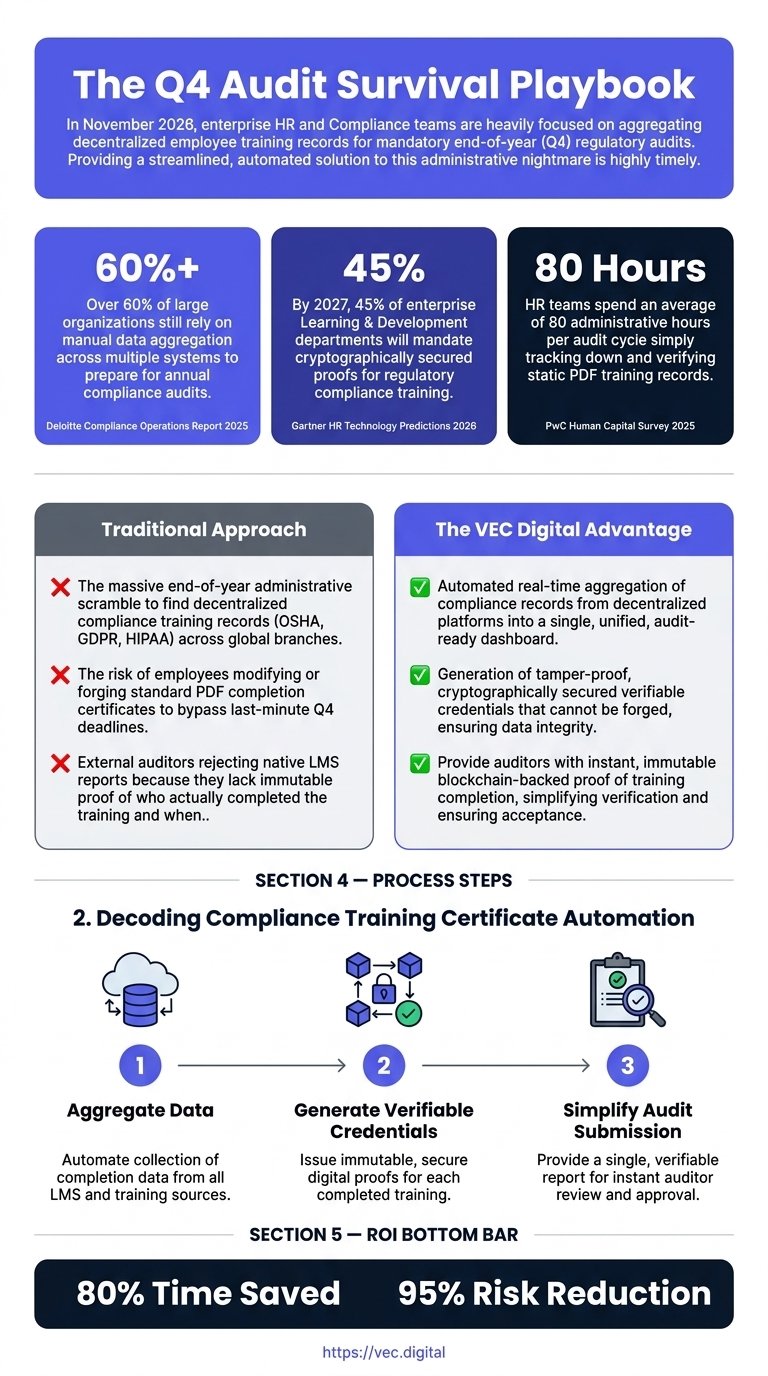
According to the Deloitte Compliance Operations Report (2025), over 60% of large organizations still rely on manual data aggregation across multiple systems to prepare for annual compliance audits. This reliance on human intervention not only slows down the auditing process but introduces a massive margin for error, leaving companies vulnerable during critical Q4 reviews.
The Hidden Costs of Fragmented Employee Records
The financial and temporal costs associated with manual credential management are staggering. High operational costs are directly caused by HR personnel manually downloading, organizing, and emailing compliance documents to audit committees. Instead of focusing on strategic workforce development, highly paid HR professionals are relegated to data-entry clerks during the final months of the year.
The PwC Human Capital Survey (2025) reveals that HR teams spend an average of 80 administrative hours per audit cycle simply tracking down and verifying static PDF training records. When multiplied across multiple departments and global branches, the financial drain of this inefficiency becomes a major liability for the enterprise.
The Rising Threat of Forged PDF Training Certificates
One of the most critical vulnerabilities in legacy HR systems is the reliance on static PDF documents. Because standard PDFs lack cryptographic security, they are highly susceptible to manipulation. There is a profound risk of employees modifying or forging standard PDF completion certificates using basic editing software to bypass last-minute Q4 deadlines.
This lack of document integrity carries severe consequences. Thomson Reuters Cost of Compliance (2026) notes that regulatory fines associated with missing or unverifiable employee compliance training records increased by 18% globally over the last 12 months. Without compliance training certificate automation, organizations have no reliable way to prove that a document has not been altered after its initial creation.
Why External Auditors Reject Standard LMS Reports
A common question among corporate leaders is: What is the difference between an LMS completion report and a verifiable digital credential? While a Learning Management System (LMS) can track when a user clicks through a module, native LMS reports are essentially internal spreadsheets. They lack the external, immutable proof required to verify who actually completed the training and when.
External auditors are increasingly rejecting native LMS reports because they do not satisfy the strict non-repudiation requirements of modern regulatory frameworks. A verifiable digital credential, by contrast, is a cryptographically sealed asset that exists independently of the LMS, carrying embedded metadata that proves its origin, timestamp, and authenticity beyond any doubt.
2. Decoding Compliance Training Certificate Automation
To overcome the limitations of manual tracking and static PDFs, enterprises must transition to automated credentialing systems. Compliance training certificate automation is the strategic implementation of API-driven software that programmatically issues, secures, and delivers digital proofs the exact moment an employee fulfills a regulatory requirement.
By removing human intervention from the issuance pipeline, organizations can ensure that every credential is generated consistently, accurately, and securely, providing a real-time ledger of corporate compliance that is perpetually ready for external review.
How Do You Automate Compliance Training Certificates?
Many HR directors ask: How do you automate compliance training certificates? The process begins by establishing a seamless data bridge between your employee training platform and a dedicated digital credentialing engine. Instead of an administrator manually exporting a list of course graduates and running a mail-merge program, the system relies on programmatic triggers.
When an employee achieves a passing score on a mandatory moduleâ-such as OSHA safety protocols or GDPR data privacy guidelinesâ-the LMS instantly sends a secure data payload to the credentialing API. This payload contains the employee's unique identifier, the course details, and the completion timestamp. The system then dynamically populates a pre-approved digital template, anchors the record to a secure database, and automatically dispatches the verifiable credential directly to the employee's inbox.
Connecting Your LMS to an Automated Certificate Generator
Another frequent inquiry is: Can you connect an LMS to an automated certificate generator? Yes, and doing so is the cornerstone of modern HR infrastructure. Through robust REST APIs, enterprise systems like Canvas, Moodle, or proprietary corporate intranets can communicate flawlessly with advanced credentialing platforms.
This integration enables zero-touch automation. By utilizing standard webhooks and API endpoints, developers can configure the LMS to act as the catalyst for credential generation. This ensures that the moment a learner finishes a module, their achievement is permanently recorded and issued without a single click from the HR department.
The Role of API-Driven Credentialing Engines
The efficiency gains of implementing an API-driven credentialing engine are transformative. By centralizing the generation and storage of all compliance records, organizations create a single source of truth that is easily accessible during Q4 audits.
Training Industry Magazine (2025) reports that enterprises utilizing API-driven automated credentialing engines experience a 90% reduction in time spent fulfilling auditor evidence requests. This massive reduction in administrative overhead allows compliance officers to focus on policy enforcement and risk mitigation rather than chasing down elusive digital files.
3. The Power of Blockchain Certificate Verification in Corporate Audits
While automation solves the problem of speed and efficiency, it must be paired with unbreakable security to satisfy external auditors. This is where blockchain certificate verification becomes indispensable. By anchoring digital credentials to an immutable public ledger, organizations can guarantee absolute authenticity and protect their corporate reputation.
Blockchain technology acts as the ultimate trust layer for enterprise data. It provides a decentralized, mathematically verifiable record that cannot be altered, deleted, or spoofed by bad actors, making it the perfect foundation for high-stakes regulatory compliance.
Securing the Proof: Immutability and Non-Repudiation
To understand the value of blockchain in HR, we must examine the evidence standards demanded by external auditors. Auditors require non-repudiationâ-the assurance that the issuer cannot deny having issued the credential, and the recipient cannot alter its contents. By anchoring a cryptographic hash of the certificate to the blockchain, organizations create an indelible digital fingerprint.
If a single pixel or character on the certificate is altered, the cryptographic hash changes, immediately flagging the document as invalid. This level of mathematical certainty completely eliminates the possibility of credential fraud and provides auditors with the irrefutable evidence they require.
How to Prevent Employees from Faking Compliance Training Records
HR professionals frequently struggle with the question: How to prevent employees from faking compliance training records? The answer lies in removing the verification burden from the document itself and placing it on a secure, independent infrastructure.
When an organization issues a blockchain-secured credential, the proof of completion does not live merely in a PDF file; it lives on the blockchain. Even if an employee attempts to Photoshop their name onto a colleague's certificate, the unique identifier embedded in the document will not match the immutable record on the ledger. When an auditor checks the credential, the system will instantly expose the forgery, effectively neutralizing the threat of internal data manipulation.
The Shift Toward Cryptographically Secured Proofs
The corporate world is rapidly recognizing the necessity of advanced cryptographic security. As regulatory fines increase and data privacy laws become more complex, reliance on legacy formats is fading.
The Gartner HR Technology Predictions (2026) forecast that by 2027, 45% of enterprise Learning & Development departments will mandate cryptographically secured proofs for regulatory compliance training. Organizations that adopt blockchain verification today are not just solving their immediate Q4 audit challenges; they are future-proofing their HR infrastructure against the compliance demands of tomorrow.
4. Creating a Frictionless Review Process for External Auditors
The ultimate test of any compliance system occurs during the audit itself. If the process of verifying records is slow, confusing, or requires proprietary software, the audit will still be a painful experience. A modern credentialing strategy must prioritize a frictionless review process, allowing auditors to validate information instantly.
By embedding intelligent verification technology directly into the credentials, organizations can transform a grueling, multi-week audit into a seamless, highly organized review session.
How Do External Auditors Verify Corporate Compliance Training Records?
Understanding the audit process is key to optimizing it. How do external auditors verify corporate compliance training records? Historically, auditors would request a massive database export from the HR department, randomly sample a percentage of employees, and demand physical or digital proof of their training completion.
Today, auditors expect self-serve verification. Instead of requesting files from HR, auditors are provided with a centralized digital locker or a secure spreadsheet containing links to the employees' digital credentials. The auditor simply clicks the link or scans the embedded code to view a real-time, tamper-proof validation page hosted by the credentialing platform.
Deploying a QR Code Certificate Maker for Instant Validation
To achieve this zero-friction verification, enterprises are utilizing a QR code certificate maker. Every certificate generated through an automated platform features a unique, embedded QR code. This serves as a physical-to-digital bridge, ensuring that even if a certificate is printed out and placed in a physical personnel file, it retains its digital security.
When an auditor scans the QR code using any standard smartphone camera, they are instantly routed to a dedicated, secure certificate URL. This page displays the issuer, the recipient, the exact timestamp of completion, and the "Blockchain Verified" security badge. There are no apps to install and no logins required, reducing the verification time from days to mere seconds.
Eliminating the Q4 Administrative Scramble
The massive end-of-year administrative scramble to find decentralized compliance training records across global branches is a symptom of disjointed systems. When branches in Europe, Asia, and North America use different tracking methods, aggregating that data for a global Q4 audit is a logistical nightmare.
Automated, centralized credentialing completely eliminates this scramble. Because every credential is automatically generated and stored in a unified digital ecosystem the moment training is completed, the Q4 audit becomes a non-event. The data is already aggregated, already verified, and instantly accessible to the audit committee on demand.
5. Building Your Enterprise Audit-Readiness Strategy
Achieving true audit readiness requires more than just purchasing software; it requires a strategic overhaul of how an organization views and manages employee milestones. The goal is to build an ecosystem where compliance is an automated byproduct of daily operations, rather than a frantic end-of-year project.
By implementing strict governance pipelines and embracing global interoperability standards, enterprise leaders can ensure their organizations are always prepared for regulatory scrutiny.
What is the Best Way to Track Mandatory Employee Training?
When executives ask, What is the best way to track mandatory employee training?, the answer is a hybrid approach combining LMS delivery with automated, decentralized credentialing. The LMS handles the curriculum, the assessments, and the user experience. The credentialing engine handles the permanent, verifiable proof of outcome.
This separation of duties ensures that even if an enterprise migrates to a new LMS vendor in the future, their historical compliance records remain intact, verifiable, and securely anchored to the blockchain. This architectural resilience is critical for long-term audit readiness.
Leveraging Verifiable Digital Credentials Across Distributed Teams
With the tightening of European NIS2 cybersecurity directives and global data privacy laws in 2026, multinational corporations are facing unprecedented scrutiny regarding their internal employee training. Auditors worldwide no longer accept unverified spreadsheets; they require instant, tamper-proof validation of compliance credentials across all distributed teams.
Deploying verifiable digital credentials ensures global interoperability. Whether an employee is based in Dubai, London, or New York, their compliance proof adheres to the same unbreakable cryptographic standard. This unified approach protects the enterprise from regional compliance failures and standardizes the auditing process worldwide.
Centralizing Multi-Signatory Approvals for High-Stakes Training
Not all compliance training is created equal. For high-stakes regulatory requirementsâ-such as hazardous materials handling, financial anti-money laundering (AML) protocols, or advanced medical complianceâ-automated issuance must be gated by human governance.
Modern credentialing platforms provide multi-signatory verification pipelines. In this scenario, when an employee passes a high-stakes course, the certificate is generated but held in a secure "draft" status. Designated organizational authoritiesâ-such as the course instructor and the Chief Compliance Officerâ-are automatically notified to log in and securely apply their electronic signatures. The certificate is only minted, blockchain-anchored, and dispatched once all required sign-offs are complete, ensuring strict administrative governance and preventing rogue issuance.
6. Secure Your Organization's Credentials Today
The era of manually tracking compliance training through static spreadsheets and easily forged PDFs is over. As global regulatory bodies demand higher standards of evidence, enterprises must adopt systems that provide instant, immutable proof of employee training. By embracing compliance training certificate automation, HR and L&D leaders can completely eliminate the Q4 audit panic, save thousands of administrative hours, and protect their organizations from costly regulatory fines.
VEC Digital provides the comprehensive, blockchain-powered trust infrastructure required to scale your credentialing operations flawlessly. Our visual certificate maker, robust developer API, and instant QR-code validation empower your enterprise to issue with absolute confidence and achieve total audit readiness.
Stop risking your institutional reputation on outdated legacy systems. Secure your organizationâ's credentials todayâ-design your first template in minutes with no setup fees, and transform how your enterprise manages compliance.
Ready to automate your compliance audits? Visit us at: https://vec.digital Contact our enterprise team: support@vec.digital