
The Registrar's Guide to Privacy-Compliant Blockchain Certificate Verification
Published on November 24, 2026

Credential fraud incidents in higher education have increased by 42% since the widespread availability of advanced generative AI tools (Global Academic Integrity Network, 2026). At the same time, the average financial impact of a data breach in the higher education sector has escalated to $3.9 million globally (IBM Cost of a Data Breach Report, 2025). As a result, academic registrars, deans, and institutional IT directors face an agonizing dilemma: how do you secure student records against highly sophisticated forgery without exposing sensitive personal information on a public ledger? The answer lies in mastering blockchain certificate verificationâ-a technological framework that, when implemented correctly through cryptographic hashing, fundamentally enhances rather than compromises student data privacy.
In this comprehensive guide, our team at VEC Digital will demystify the complex intersection of academic credential security and global data sovereignty. You will learn the critical mechanical differences between on-chain plain-text data storage and anonymous cryptographic hashing, discover how to satisfy stringent GDPR and FERPA regulations, and acquire the actionable knowledge needed to overcome internal legal pushback when upgrading your institution's digital credentialing engine.
Key Takeaways
- Blockchain certificate verification uses anonymous cryptographic hashes, not plain-text personal data, ensuring absolute privacy compliance.
- Modernizing to a secure digital diploma platform mitigates the $3.9M average cost of educational data breaches by keeping actual files on local servers.
- Implementing verifiable digital credentials bridges the gap between institutional security and rapid employer background checks.
- Institutions can successfully prevent degree fraud while fully honoring a student's legal Right to be Forgotten.
- Achieving GDPR compliant credentialing requires a strict separation between off-chain data hosting and on-chain mathematical proofs.
Table of Contents
- The Privacy Dilemma in Modern Academic Credentialing
- Demystifying Blockchain Certificate Verification: Hashing vs. Hosting
- Navigating Global Data Sovereignty and Compliance Frameworks
- Structuring a Future-Proof Digital Diploma Platform
- The Employability Loop: Protecting the Institution and the Graduate
- Secure Your Institutionâ's Future with VEC Digital
The Privacy Dilemma in Modern Academic Credentialing
As the academic landscape shifts rapidly toward digital transformation, institutions are finding themselves caught between two opposing forces: the urgent need to secure records against rampant forgery and the strict legal obligation to protect student data privacy. Understanding this tension is the first step toward implementing a viable, long-term solution.
The Rise of AI-Driven Forgery vs. Regulatory Compliance
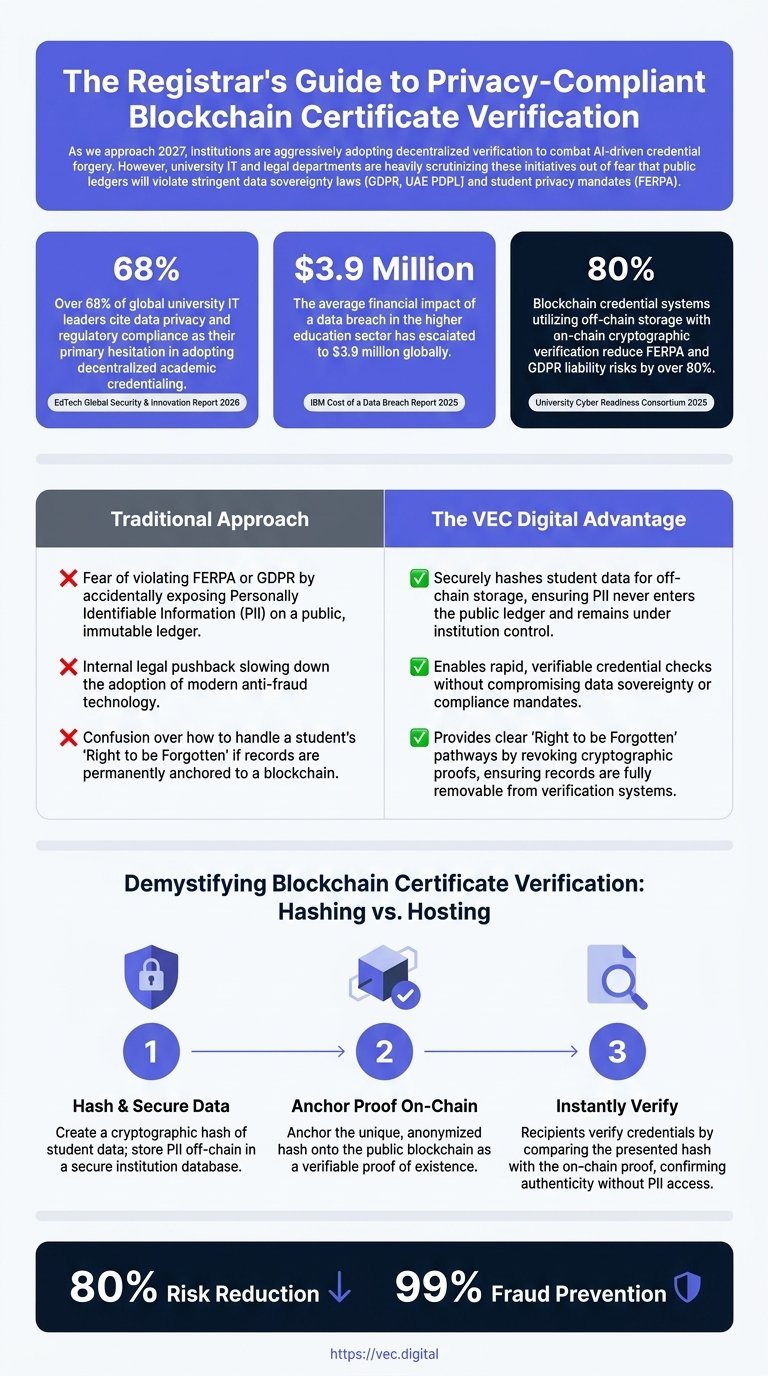
The proliferation of generative artificial intelligence has democratized forgery. Today, malicious actors can generate pixel-perfect replicas of traditional PDF diplomas and physical transcripts in mere seconds. This has led to the alarming 42% increase in credential fraud incidents noted by the Global Academic Integrity Network in 2026. To combat this, many universities are looking toward decentralized security solutions. However, over 68% of global university IT leaders cite data privacy and regulatory compliance as their primary hesitation in adopting decentralized academic credentialing (EdTech Global Security & Innovation Report, 2026).
This hesitation is rooted in a fundamental misunderstanding of how modern blockchain certificate verification operates. Many administrators harbor a deep-seated fear of violating FERPA (Family Educational Rights and Privacy Act) or GDPR (General Data Protection Regulation) by accidentally exposing Personally Identifiable Information (PII) on a public, immutable ledger. The assumption is that if a record is on a blockchain, everyone can see the student's name, grades, and personal details. As we will explore, this is a dangerous misconception that stalls vital security upgrades.
Understanding the Cost of Data Breaches in Higher Education
The stakes for getting data privacy right have never been higher. With the average financial impact of a data breach in the higher education sector reaching $3.9 million globally (IBM Cost of a Data Breach Report, 2025), institutions cannot afford to experiment with insecure data storage methods. A data breach goes beyond immediate financial penalties; it inflicts catastrophic damage on an institution's prestigious reputation, erodes alumni trust, and invites severe regulatory audits.
Traditional centralized databases are honeypots for cybercriminals. When a university relies on legacy systems to store unencrypted digital diplomas, a single point of failure can expose thousands of student records. Transitioning to a secure credentialing engine that separates data storage from data validation is an essential risk mitigation strategy for the modern era.
Can Blockchain Certificates Be Deleted or Revoked if They Are Immutable?
One of the most persistent concerns among registrars is managing the complex balance between immutability and compliance. Specifically, there is widespread confusion over how to handle a student's "Right to be Forgotten"â-a core tenet of GDPR and similar privacy lawsâ-if records are permanently anchored to a decentralized ledger.
The answer is a definitive yes: blockchain certificates can be effectively revoked or deleted. The solution lies in the architecture of the system. Because the actual personal data (the certificate file, the student's name) is never stored on the blockchain itself, the university retains complete control over the original data. If a student requests deletion, or if a certificate must be revoked due to academic misconduct, the institution simply deletes the off-chain file from their local secure server. The mathematical hash remaining on the blockchain becomes a "dead link" pointing to nothing, rendering the credential instantly invalid and completely honoring the student's privacy rights.
Demystifying Blockchain Certificate Verification: Hashing vs. Hosting
To overcome internal legal pushback and confidently adopt next-generation security, academic IT directors and compliance officers must understand the mechanical reality of cryptographic hashing. This is the pivotal concept that bridges the gap between absolute data privacy and unbreakable digital trust.
What is the Difference Between On-Chain Data Storage and Cryptographic Hashing?
The most critical informational gap in the credentialing industry is the failure to distinguish between storing data and storing proofs. On-chain data storage involves writing plain-text information directly onto a decentralized ledger. If a university were to write "John Doe graduated with a B.S. in Computer Science in 2026" onto a public blockchain, they would be committing a severe compliance violation, as that data cannot be erased.
Cryptographic hashing, however, is entirely different. When a modern digital diploma platform issues a credential, it processes the certificate file through a cryptographic algorithm (such as SHA-256). This algorithm generates a unique, fixed-length string of alphanumeric charactersâ-a digital fingerprint, or "hash." This hash is completely anonymous and irreversible. It is impossible to reverse-engineer the hash to discover the student's name or degree. Only this anonymous hash is anchored to the blockchain. The actual certificate data remains safely hosted on the university's private, compliant servers.
The Myth of PII on the Public Ledger
By understanding the hashing process, we can thoroughly debunk the myth that blockchain technology inherently exposes Personally Identifiable Information (PII). When an employer or auditor wants to verify a digital diploma, they do not search a public ledger for the student's name. Instead, they upload the digital certificate file they received from the graduate into a verification portal.
The verification portal independently runs that file through the exact same cryptographic algorithm. If the resulting hash matches the anonymous hash anchored on the blockchain, the document is mathematically proven to be 100% authentic and unaltered. If even a single pixel or letter has been changed by a forger, the resulting hash will be completely different, and the verification will fail. At no point is PII exposed to the public; the blockchain merely acts as a decentralized notary confirming that a specific (but hidden) document existed at a specific time.
How Does Blockchain Certificate Verification Ensure Student Privacy?
Blockchain certificate verification ensures student privacy by acting as a zero-knowledge proof system. It allows an institution to prove the validity of a document without ever exposing the contents of that document to unauthorized third parties. This architecture provides three distinct privacy benefits:
- Data Minimization: The public ledger contains zero personal data, ensuring compliance with strict data minimization principles.
- Decentralized Authentication, Centralized Control: The university maintains absolute sovereignty over the actual student records, hosting them in compliance with local regional laws, while leveraging global networks purely for authentication.
- Granular Consent: The student retains control over who sees their actual diploma. The blockchain only validates the document after the student has chosen to share it with a prospective employer.
Navigating Global Data Sovereignty and Compliance Frameworks
For global universities and corporate training academies, navigating the web of international data sovereignty laws is a daunting task. However, when architected correctly, decentralized credentialing systems are not just compliantâ-they are the safest possible route for managing sensitive academic data.
Does Blockchain Technology Violate GDPR?
A common question raised by legal departments is whether blockchain technology inherently violates the General Data Protection Regulation (GDPR) enforced by the European Union. The European Parliamentary Research Service has extensively explored this intersection. The conclusion is that while storing personal data on a public blockchain is highly problematic under GDPR, utilizing a blockchain strictly for cryptographic hashing is entirely compliant.
Because a cryptographic hash cannot be reverse-engineered to identify a natural person, it is generally considered anonymized data (or strongly pseudonymized data) under GDPR, provided the underlying file is kept secure. Furthermore, because the actual data remains off-chain on compliant local servers, the institution can fully execute GDPR Article 17 (the Right to Erasure). For more detailed insights on data protection standards, administrators often consult authoritative resources like GDPR.eu to ensure their digital infrastructure aligns with European privacy mandates.
How Do Universities Issue Digital Diplomas Without Exposing Student Names?
To issue a digital diploma without exposing student names, universities utilize an automated process that separates the visual generation of the certificate from the cryptographic anchoring. When a batch of graduates is processed, the digital credential engine generates a secure PDF or web-hosted credential for each student. Simultaneously, the engine computes the cryptographic hash of each credential in the background.
The system then batches these anonymous hashes together (often using a Merkle tree structure) and anchors a single root hash to the blockchain. The student's name, graduation date, and academic honors remain securely encrypted within the university's private database. The public ledger records nothing but a string of mathematics, ensuring that the institution can prevent degree fraud without ever broadcasting sensitive student information to the public domain.
Achieving Over 80% Reduction in Compliance Liability
The adoption of off-chain storage combined with on-chain verification is proving to be a massive risk mitigator. According to the University Cyber Readiness Consortium (2025), blockchain credential systems utilizing off-chain storage with on-chain cryptographic verification reduce FERPA and GDPR liability risks by over 80%.
This dramatic reduction in risk is due to the elimination of the "honeypot" effect. Even if a bad actor were to somehow gain access to the blockchain data, they would find nothing of valueâ-only irreversible hashes. By removing the financial incentive for cybercriminals to target the verification infrastructure, universities significantly insulate themselves from the devastating financial and reputational damages associated with modern data breaches.
Structuring a Future-Proof Digital Diploma Platform
As the technological landscape evolves, institutions must build digital infrastructures that are resilient, scalable, and legally sound. Transitioning to a secure digital diploma platform requires careful planning, stakeholder alignment, and a clear understanding of future regulatory trends.
Overcoming Internal Legal Pushback
One of the most significant hurdles to modernizing credentialing systems is internal legal pushback slowing down the adoption of modern anti-fraud technology. Legal teams are inherently risk-averse, and the word "blockchain" often triggers immediate concerns regarding regulatory compliance and data sovereignty.
To overcome this, IT directors and registrars must change the internal narrative. The conversation should not be about "moving student records to the blockchain." Instead, it must be framed around "upgrading our cryptographic security to prevent AI forgery, while keeping all student data securely on our existing local servers." Providing legal teams with clear architectural diagrams that illustrate the strict separation between the off-chain data repository and the on-chain verification ledger is usually the key to securing institutional buy-in.
What is the Safest Digital Diploma Platform for FERPA Compliance?
When evaluating solutions, the safest digital diploma platform for FERPA compliance is one that guarantees zero plain-text data is transmitted to public networks. FERPA mandates that educational agencies protect the privacy of student education records. Therefore, a compliant platform must feature:
- End-to-End Encryption: All data in transit and at rest must be heavily encrypted before any hashing occurs.
- Local Data Sovereignty: The platform must allow the institution to host the actual credential data on servers that comply with local regional laws (e.g., within the US for FERPA, within the EU for GDPR, or within the UAE to satisfy the PDPL).
- Instant Revocation Capabilities: The system must feature a seamless administrative dashboard that allows registrars to instantly revoke or delete a credential, effectively breaking the link to the verification hash.
The Shift Toward Mandated Cryptographic Proofs by 2027
The urgency to adopt these systems is accelerating rapidly. By 2027, 45% of major educational institutions are projected to mandate cryptographic proofs for official academic records to combat sophisticated AI forgery (Gartner Technology Trends in Higher Education, 2026). Institutions that fail to modernize their credentialing infrastructure risk falling behind the global standard for academic integrity.
As employers become increasingly aware of the ease with which traditional PDFs can be forged, they will begin to demand verifiable digital credentials. Universities that can provide instant, cryptographically secure verification will significantly enhance the value of their degrees in the global job market, while those relying on legacy systems will face increased scrutiny and administrative burdens. For broader perspectives on how technology is reshaping higher education administration, institutions frequently turn to thought leadership from organizations like EDUCAUSE.
The Employability Loop: Protecting the Institution and the Graduate
The ultimate goal of any academic credential is to facilitate the graduate's transition into the workforce. A robust credentialing system must serve both the institution's need for security and the student's need for rapid employability.
Empowering Students with Verifiable Digital Credentials
Modern students expect digital-first experiences. Providing them with verifiable digital credentials empowers them to take ownership of their academic achievements. When a student receives a cryptographically secure digital diploma, they can instantly share it on professional networks like LinkedIn, attach it to digital resumes, or send it directly to prospective employers.
Because the credential contains an embedded verification link (often facilitated via a secure QR code), the student never has to worry about the authenticity of their achievements being questioned. This frictionless sharing mechanism not only benefits the graduate but also acts as a powerful marketing tool for the university, showcasing the institution's commitment to innovation and student success on a global stage.
Streamlining Employer Verification Safely
Managing the complex balance between making diplomas easily verifiable for employers and strictly private for students has historically been a massive administrative burden. Traditional background checks require employers to contact the university registrar, request official transcripts, and wait days or weeks for manual processing.
By implementing a secure digital credentialing engine, universities completely automate this process. An employer can verify a candidate's degree in milliseconds by clicking a link or scanning a QR code, which instantly references the on-chain hash. This zero-friction verification accelerates hiring timelines for the graduate, eliminates the manual workload for the registrar's office, and maintains absolute data privacy, as the employer only sees the specific document the student explicitly chose to share.
Secure Your Institutionâ's Future with VEC Digital
The transition to secure, privacy-compliant credentialing is no longer an optional upgrade; it is a critical necessity to protect institutional reputation and student data in the age of AI forgery. By understanding the vital difference between on-chain data storage and anonymous cryptographic hashing, universities can confidently implement blockchain certificate verification while far exceeding the stringent requirements of FERPA, GDPR, and global data sovereignty laws.
At VEC Digital, we provide the trust infrastructure that modern institutions rely on to issue, manage, and authenticate credentials at scale. Our platform is meticulously engineered to ensure that your sensitive student data remains securely under your control, while leveraging the immutable power of decentralized ledgers purely for anonymous verification.
Don't let internal legal hesitation or outdated technology expose your institution to the high costs of data breaches and credential fraud. Empower your graduates with instantly verifiable digital credentials and streamline your administrative operations today.
Ready to modernize your academic credentialing with absolute privacy compliance? Visit us at https://vec.digital or contact our enterprise implementation team at support@vec.digital to schedule a comprehensive security consultation.