
Transform Your Alumni Network Into an Organic Growth Engine With Verifiable Digital Credentials
Published on July 31, 2026

Graduates sharing easily forged, unbranded PDF certificates on professional networks actively diminish an institution's prestige and credibility in the global job market. By implementing verifiable digital credentials, forward-thinking universities and corporate academies are transforming these static documents into dynamic, zero-cost lead generation assets. In this comprehensive guide, our team at VEC Digital leverages our deep expertise in educational technology to reveal how you can automate credential issuance, eliminate degree fraud, and harness your alumni network as a powerful organic growth engine.
Key Takeaways
- Verifiable digital credentials transform static graduate achievements into highly visible, interactive marketing assets on professional networks.
- Implementing a secure digital diploma platform eliminates the reputational risks associated with easily forged PDF certificates.
- Using a dynamic QR code certificate maker allows global employers to authenticate qualifications instantly, accelerating hiring timelines.
- Advanced blockchain certificate verification creates an immutable record that completely safeguards your institution against academic fraud.
- Automated issuance systems empower organizations to track employer engagement and measure the true ROI of their compliance training certificate automation.
The Shift from Administrative Overhead to Strategic Marketing
Overcoming the Limitations of Traditional PDFs
For decades, the issuance of academic and corporate certificates has been viewed purely as an administrative burden. Institutions have historically relied on physical printing or standard PDF generation to recognize achievements. However, one of the most critical pain points modern educators face is graduates sharing unbranded, easily forged PDF certificates that diminish the institution's prestige on platforms like LinkedIn. When a digital document can be altered using basic editing software, its value in the job market plummets, and the issuing organization's reputation is put at risk.
Standard PDFs lack the interactive elements necessary for modern digital marketing. When alumni post these flat files online, there are no standardized links pointing back to the issuer's website, resulting in missed organic marketing opportunities. Every time a graduate shares a non-verifiable credential, the institution loses a chance to capture the attention of prospective students or corporate partners who are viewing that post.
Bridging the Knowledge Gap: The Post-Graduate Loop
Existing industry resources often focus heavily on the backend security and administrative cost savings of digital credentials. While operational efficiency is vital, there is a massive knowledge gap regarding the "post-graduate loop." This loop represents the lifecycle of a credential after it is issued: how highly visual, shareable certificates directly influence a school's digital footprint, brand authority, and future student acquisition strategies.
When verifiable digital credentials are deployed effectively, they turn every graduate into an active brand ambassador. A beautifully designed certificate shared on social media acts as a digital billboard. Because these credentials contain embedded metadata and verification links, viewers are drawn back to the institution's official portal. This creates a self-sustaining cycle where alumni success publicly validates the institution's programs, thereby attracting new enrollments and corporate training contracts.
How Universities Can Use a Digital Diploma Platform for Organic Marketing
Many educational leaders frequently ask: How can universities use a digital diploma platform for organic marketing? The answer lies in the seamless integration of social sharing tools and verifiable data. A robust digital diploma platform allows graduates to share their achievements to LinkedIn, X, and Facebook with a single click. Instead of an isolated image, the shared post includes an interactive badge that directs traffic back to a dedicated verification page hosted by the university.
This page not only authenticates the credential but can also feature strategic calls-to-action, such as links to related degree programs, alumni networking events, or institutional news. By utilizing a comprehensive platform, universities transform a routine administrative task into a high-converting, zero-cost marketing engine that operates globally 24/7.
Driving Institutional Growth with Verifiable Digital Credentials
Amplifying Organic Brand Impressions on Professional Networks
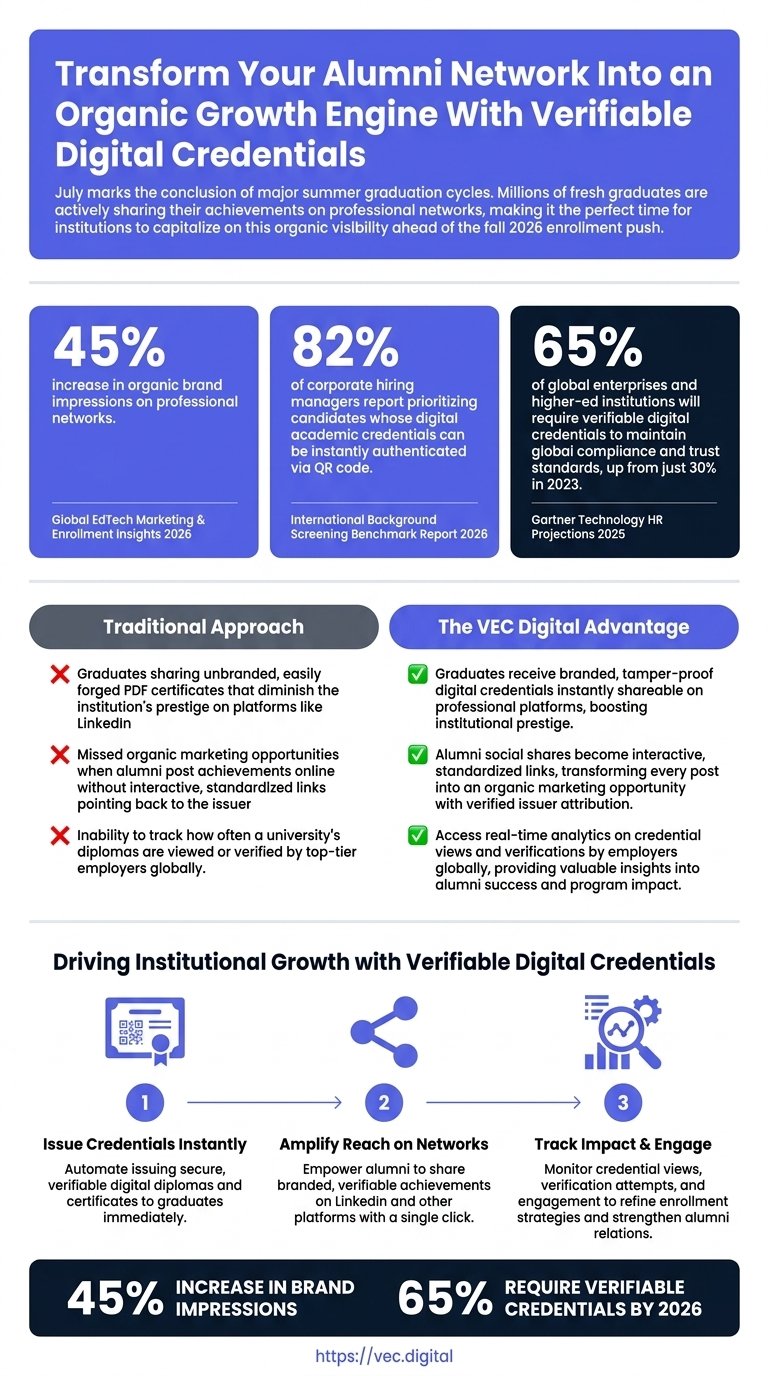
The marketing potential of a modern credentialing system is backed by compelling industry data. According to the Global EdTech Marketing & Enrollment Insights (2026), universities utilizing blockchain-anchored digital diploma platforms see up to a 45% increase in organic brand impressions on professional networks. This surge in visibility is driven by the frictionless sharing experience provided by verifiable digital credentials.
When thousands of students graduate simultaneously and share their tamper-proof credentials online, the resulting wave of digital engagement significantly boosts the institution's algorithmic reach. Prospective students, industry peers, and corporate recruiters are exposed to the university's brand in a context of success and achievement. This organic reach is highly targeted and far more cost-effective than traditional paid advertising campaigns.
Solving EdTech Drop-Offs with Job-Market Ready Certificates
A major challenge for EdTech platforms, bootcamps, and online academies is low course completion rates. Often, high drop-off rates occur because learners do not feel the end-certificate holds tangible, verifiable job-market weight. If a student believes their final credential will not be recognized or easily verified by a future employer, their motivation to finish the rigorous coursework diminishes.
Introducing interactive, socially shareable recognition fundamentally changes this dynamic. The E-Learning Engagement Index (2026) reports that institutions issuing socially shareable digital badges experience a 28% higher completion rate in voluntary online and bootcamp courses. When learners know they will receive a cryptographically secure credential that they can proudly display and employers can instantly trust, their commitment to the educational program increases dramatically.
Tracking Alumni Success and Employer Engagement
Another significant pain point for university registrars and corporate L&D leaders is the inability to track how often a university's diplomas are viewed or verified by top-tier employers globally. Traditional paper certificates and standard PDFs offer zero analytical feedback once they leave the issuer's hands. Institutions are left in the dark regarding the real-world utility of their degrees.
Advanced credential systems solve this by providing comprehensive analytics dashboards. Every time a credential is authenticated, the system logs the interaction. This allows institutions to see which geographic regions are hiring their graduates, which specific degrees are most frequently verified, and how active their alumni are on professional networks. These insights are invaluable for shaping future curriculum, optimizing marketing spend, and proving the ROI of corporate training programs.
The Mechanics of Trust: Security Meets Social Sharing
How Do Employers Authenticate Online Degrees Instantly in 2026?
The hiring landscape has evolved rapidly, demanding faster and more reliable background screening processes. So, how do employers authenticate online degrees instantly in 2026? The solution is the integration of physical-to-digital bridges, specifically through a QR code certificate maker. Every verifiable digital credential generated by a modern platform includes a unique, embedded QR code.
When an employer receives a digital or printed resume, they simply scan the QR code using any smartphone camera. This action instantly routes them to a secure, dedicated certificate URL (e.g., /certificate/[uuid]). The International Background Screening Benchmark Report (2026) reveals that 82% of corporate hiring managers report prioritizing candidates whose digital academic credentials can be instantly authenticated via QR code. This zero-friction verification takes seconds, requires no app installs, and completely bypasses the traditional, weeks-long manual registrar check.
Are QR Code Certificates Safe to Share on Public Professional Networks?
With the rise of data privacy concerns, a common question arises: Are QR code certificates safe to share on public professional networks? The answer is a definitive yes, provided they are built on secure infrastructure. Unlike traditional documents that might expose unnecessary personally identifiable information (PII), modern credentials are designed with privacy in mind.
The verification page accessed via the QR code or share link only displays the essential data required to prove the achievement: the recipient's name, the issuing institution, the date of issuance, and the cryptographic proof of validity. The underlying public-key cryptography ensures that while the certificate's authenticity is publicly verifiable, the underlying database and sensitive student records remain completely secure and compliant with global privacy regulations like GDPR and FERPA.
What is the Difference Between a Standard Digital Badge and a Verifiable Digital Credential?
Understanding the technological distinction between credential types is crucial for institutional leaders. What is the difference between a standard digital badge and a verifiable digital credential? A standard digital badge is often just a high-resolution image file with some basic metadata attached. It can easily be copied, downloaded, and falsely claimed by unauthorized individuals.
Conversely, a verifiable digital credential is anchored to an immutable ledger. It utilizes advanced hashing algorithms to create a unique digital fingerprint of the document at the exact moment of issuance. If even a single pixel or character is altered after issuance, the cryptographic hash breaks, and the credential will immediately display as invalid upon verification. This level of security guarantees absolute authenticity and protects the issuing organization's brand reputation.
Global Standards and the Future of Academic Integrity
Meeting Worldwide Compliance and Trust Standards
The demand for secure digital infrastructure is no longer an isolated trend; it is a global mandate. According to Gartner Technology HR Projections (2025), by 2026, 65% of global enterprises and higher-ed institutions will require verifiable digital credentials to maintain global compliance and trust standards, up from just 30% in 2023. For more insights on enterprise HR trends, you can explore resources from Gartner HR.
This rapid adoption curve means that institutions failing to modernize their credentialing systems will quickly fall behind. Whether managing compliance training certificate automation for a multinational corporation or issuing diplomas for a prestigious university, the ability to provide instant, irrefutable proof of achievement is now a baseline expectation for international students and global employers alike.
Regional Leadership: Blockchain Certificate Solutions UAE and Beyond
In rapidly digitizing hubs like the Middle East, governments have launched ambitious digital transformation mandates. The rise of blockchain certificate solutions UAE is a prime example of how regional technological investments set the pace for global standards. In these markets, verifiable digital credentials are viewed not just as administrative tools, but as essential components of national digital infrastructure.
By adopting these advanced systems, institutions demonstrate cutting-edge technological leadership. This is particularly crucial for universities and corporate academies aiming to attract international talent. When an institution aligns itself with the high standards of global tech hubs, it signals to prospective students and partners that it is forward-thinking, secure, and deeply invested in the long-term success of its graduates.
How Do Blockchain Certificates Prevent Degree Fraud on Social Media?
As social media becomes the primary venue for professional networking, it also becomes a hotspot for exaggerated or entirely fabricated credentials. How do blockchain certificates prevent degree fraud on social media? They do so through the principle of immutability. When a university issues a credential, the data is hashed and anchored to a decentralized blockchain.
If a fraudster attempts to create a fake certificate and posts it to LinkedIn, any employer who clicks the link or scans the QR code will instantly see that the document is not anchored to the university's official blockchain record. The verification system will flag it as invalid. This binary verification process—it is either cryptographically true or it is false—completely eliminates the gray area that fraudsters rely on, allowing organizations to effectively prevent degree fraud at scale.
How Do Verifiable Digital Credentials Improve Institutional Reputation?
Ultimately, institutional leaders want to know: How do verifiable digital credentials improve institutional reputation? Reputation is built on trust, and trust is sustained through consistency and security. By guaranteeing 100% authenticity, an institution proves to the global market that its standards are uncompromising.
Furthermore, when alumni share stunning, high-resolution certificates that feature a "Blockchain Verified" security badge, it visually communicates prestige. Employers learn that hiring from your institution means zero background-check friction. This seamless experience elevates the perceived value of your programs, directly contributing to higher enrollment rates, stronger corporate partnerships, and a fortified global brand presence.
Implementing a Zero-Friction Credential Engine
Designing for Impact with a QR Code Certificate Maker
Transitioning to a modern credentialing system does not require a team of graphic designers or software engineers. Industry-leading systems feature visual, drag-and-drop template editors equipped with alignment guides, custom layers, and access to thousands of fonts. This allows administrators to design professional, high-resolution certificates without writing a single line of code.
A sophisticated QR code certificate maker automatically embeds the unique verification matrix directly into the design layout. You can upload custom background artwork, strategically place dynamic text placeholders (such as recipient names and unique IDs), and map out the exact placement of the QR code. This ensures that the final output is not only highly secure but also aesthetically aligned with your brand's visual identity, ready to impress on any social media feed.
Streamlining Issuance Without Technical Bottlenecks
For organizations dealing with massive graduations or global corporate training cohorts, manual data entry is a critical bottleneck. Implementing a bulk certificate generator completely automates this process. Administrators can simply upload a standard CSV file containing recipient details, which triggers the automated batch generation and delivery of personalized certificates directly to learners' inboxes.
For even deeper integration, robust REST APIs allow for zero-touch automation. When a learner passes an assessment in an LMS or completes a module in a corporate intranet, the system communicates instantly with the credentialing engine. The certificate is generated, blockchain-anchored, and dispatched automatically. To ensure strict administrative governance, organizations can also implement multi-signatory approval sequences, holding certificates in a draft status until designated authorities securely log in to review and electronically sign them. This comprehensive approach guarantees scalability without sacrificing security.
Secure Your Institution’s Future with VEC Digital
The era of static, easily forged PDFs is over. To protect your brand's reputation, accelerate graduate hiring timelines, and transform your alumni network into a powerful organic marketing engine, your institution must adopt a secure, scalable credentialing infrastructure. Verifiable digital credentials provide the unbreakable trust and frictionless sharing capabilities necessary to thrive in the modern educational and corporate landscape.
At VEC Digital, we empower organizations globally to make, manage, and authenticate certificates with absolute confidence. Our blockchain-powered platform offers intuitive drag-and-drop design, seamless CSV bulk uploads, zero-touch API automation, and instant QR code verification—all designed to eliminate credential fraud and maximize your operational efficiency.
Secure your organization’s credentials today and start turning learner achievements into measurable institutional growth. Design your first template in minutes with no setup fees.
Contact our team to get started: Website: https://vec.digital Email: support@vec.digital