
Verifiable Digital Credentials in 2026: The University Guide to Secure Bulk Diplomas
Published on May 14, 2026

With fake degree mills operating as a highly lucrative global industry generating over $7 billion annually, academic institutions face an unprecedented battle to protect their reputations and the value of their degrees. Implementing verifiable digital credentials is no longer a futuristic concept, but an immediate necessity for universities combating global diploma fraud in an increasingly remote world. This transition protects the integrity of academic achievements while simultaneously eliminating the heavy administrative friction of legacy paper processes.
In this comprehensive guide, we draw on our extensive technology expertise at Vec.Digital to provide academic registrars, deans, and administrators with a practical roadmap for modernizing their credential systems. You will learn how to seamlessly transition to an automated issuance process, utilize a bulk certificate generator to issue thousands of records instantly, and deploy blockchain-backed security to ensure your global graduates can prove their qualifications anywhere. By the end of this article, your institution will be equipped to eradicate fraud, reduce operational costs, and empower learners with modern, accessible proof of their achievements.
Key Takeaways
- The financial toll of legacy processes and how a modern digital certificate maker drastically cuts institutional costs.
- Why blockchain certificate verification is the ultimate defense against sophisticated degree forgery and diploma mills.
- The environmental impact of adopting sustainable paperless certificates to meet global sustainability goals.
- Step-by-step methods to deploy a bulk certificate generator without overhauling your existing IT infrastructure.
- How instant QR code certificates enable global employers to authenticate academic achievements instantly without proprietary apps.
1. The Escalating Threat of Global Diploma Fraud
The Billion-Dollar Forgery Industry
The proliferation of sophisticated technology has inadvertently fueled a massive underground economy dedicated to academic forgery. According to a 2025 report by World Education Services, fake degree mills operate as a highly lucrative global industry, generating over $7 billion annually. These illicit organizations directly undermine the value of legitimate university credentials by mass-producing counterfeit diplomas that mimic official watermarks, signatures, and university seals with alarming accuracy. For academic registrars, this represents a critical vulnerability; every forged document that passes a background check dilutes the prestige of the institution it falsely represents.
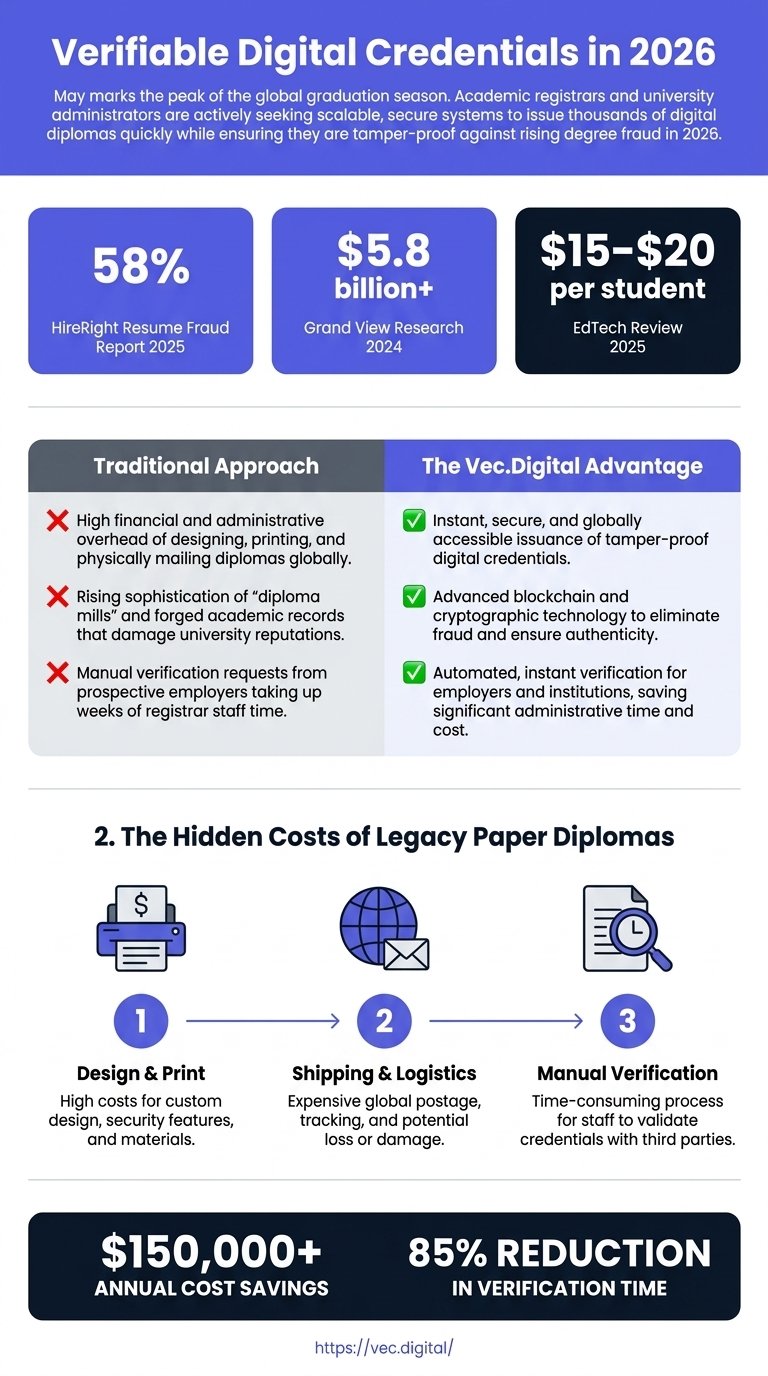
Employers are feeling the impact of this crisis firsthand. The 2025 HireRight Resume Fraud Report revealed that a staggering 58% of hiring managers report catching candidates lying about their academic qualifications or degrees. This high rate of deception places an enormous burden on corporate human resources departments, forcing them to conduct exhaustive, time-consuming manual verifications. When employers cannot trust a piece of paper, they turn to universities for manual confirmation—a process that drains administrative resources and delays critical hiring decisions.
To combat this, forward-thinking institutions are adopting verifiable digital credentials. By transitioning away from easily replicable physical documents to mathematically secured digital assets, universities can instantly neutralize the threat of diploma mills. Digital credentials provide an absolute source of truth that cannot be photoshopped, altered, or fraudulently duplicated, restoring trust to the global hiring ecosystem.
Protecting Institutional Reputation in a Remote World
As remote work and international hiring continue to expand rapidly in 2026, the geographical barriers between candidates and employers have dissolved. However, this globalization has introduced significant friction into the credential verification process. Cross-border background checks are increasingly delayed by slow institutional response times, timezone differences, and language barriers. When a hiring manager in London needs to verify a degree issued by a university in Sydney, relying on traditional mail or manual email correspondence is no longer viable.
Are digital certificates verifiable by employers globally? Absolutely. When universities issue credentials digitally, they provide employers with a mechanism for instant, borderless authentication. This global accessibility is paramount for protecting institutional reputation. An institution that offers seamless, instant verification is perceived as modern, transparent, and authoritative. Conversely, universities that force employers through weeks of manual bureaucratic checks risk frustrating corporate partners and potentially costing their alumni lucrative job opportunities.
Furthermore, protecting an institution's reputation requires proactive defense mechanisms. By utilizing secure digital diplomas for universities, academic leaders send a clear message to the market: their standards are uncompromising. This commitment to security not only deters bad actors from attempting to forge the institution's documents but also increases the perceived value of the degree for prospective students who want their hard-earned qualifications to be universally respected and easily proven.
2. The Hidden Costs of Legacy Paper Diplomas
Financial and Administrative Bottlenecks
The tradition of handing out heavy, ornate paper diplomas at graduation ceremonies is deeply ingrained in academic culture. However, the logistical reality behind this tradition is a massive financial drain. According to a 2025 study by EdTech Review, printing, securing, and mailing physical diplomas costs higher education institutions an average of $15 to $20 per student. For a university graduating 10,000 students annually, this equates to a recurring baseline expense of up to $200,000—a figure that does not account for the hidden costs of administrative labor, secure storage, and international shipping fees.
Beyond the initial issuance, universities face the ongoing administrative nightmare of dealing with lost, stolen, or damaged paper diplomas. Alumni frequently request replacement copies years or even decades after graduation. Processing these requests requires registrar staff to manually dive into archival records, verify identities, print new documents, and coordinate secure mailing. This manual process takes up weeks of staff time, diverting highly trained professionals away from strategic academic initiatives and bogging them down in clerical tasks.
By implementing a robust verifiable digital credentials system, universities can eliminate these financial and administrative bottlenecks entirely. Digital issuance incurs near-zero marginal costs per student. When a graduate loses access to their digital diploma, they simply log into their secure digital locker or request an automated re-issuance link. This self-serve model empowers alumni while freeing up thousands of hours for university administration.
Meeting Global Sustainability Goals
In addition to financial costs, legacy paper processes carry a heavy environmental toll. The production of premium parchment paper, the chemical inks used for official seals, and the carbon emissions associated with global postal logistics contribute significantly to an institution's ecological footprint. As universities worldwide face mounting pressure from students, governments, and regulatory bodies to adopt greener practices, modernizing credentialing is a highly effective step toward compliance.
The environmental benefits of digital transformation are substantial. The Global Sustainability in EdTech Index (2026) reports that replacing physical certificate mailings with cloud-based digital issuance reduces an organization's credentialing carbon footprint by up to 85%. This massive reduction aligns perfectly with the United Nations' sustainability goals, specifically those targeting responsible consumption and climate action. By going paperless, universities demonstrate a tangible commitment to environmental stewardship.
Furthermore, sustainable paperless certificates for NGOs and academic institutions offer a compelling narrative for institutional marketing. Showcasing a commitment to sustainability resonates deeply with the modern, eco-conscious student demographic. Transitioning to a digital certificate maker is not merely an IT upgrade; it is a strategic alignment with the values of the next generation of global leaders.
3. Demystifying Blockchain Certificate Verification for Universities
How Does Blockchain Prevent Diploma Fraud?
While the concept of blockchain is often associated with volatile cryptocurrencies, its underlying technology is fundamentally a highly secure, decentralized ledger. For non-technical university administrators, understanding how this prevents fraud is crucial. When a university issues verifiable digital credentials, the system calculates a unique mathematical representation of that specific diploma—known as a cryptographic hash. This hash, along with the issuer's digital signature, is anchored to a public blockchain.
Once anchored, the record becomes immutable. It cannot be edited, deleted, or tampered with by any party, including the software provider or the student. If a bad actor attempts to alter their digital diploma—for instance, changing a "B.A. in General Studies" to a "B.S. in Computer Science"—the cryptographic hash of the altered document will no longer match the original hash stored on the blockchain. When an employer attempts to verify the altered document, the system will instantly flag it as invalid. This mathematical certainty makes credential fraud functionally impossible.
This level of security is why blockchain certificate verification is becoming the gold standard in higher education. It removes the need for employers to trust the piece of paper or even the software hosting it; instead, they trust the immutable mathematics of the blockchain. By anchoring credentials securely, universities provide an irrefutable layer of truth that protects both their reputation and their graduates' hard work. For further reading on the mechanics of decentralized ledgers, authoritative sources like Wikipedia's overview of Blockchain offer excellent foundational knowledge.
QR Code Certificates: Instant Global Authentication
A common question among academic leaders is: "Can employers verify digital degrees instantly without an app?" The answer lies in the strategic use of dynamic QR codes. While blockchain provides the backend security, QR codes provide the frontend accessibility. Every certificate issued through a modern digital platform is embedded with a unique, scannable QR code that serves as a direct bridge to the credential's authentication page.
The user experience is frictionless. When a hiring manager receives a resume with a QR code certificate, they simply open their standard smartphone camera and scan the code. They are instantly routed to a dedicated, public verification page hosted on a secure domain. This page displays the issuer's details, the recipient's name, the date of issuance, signatory details, and a prominent "blockchain-verified" badge. There is no need for the employer to create an account, download proprietary software, or pay verification fees.
This instant authentication mechanism is a game-changer for the global job market. It eliminates the weeks of waiting typically associated with manual registrar background checks. By providing foolproof, easily shareable proof of authenticity, universities empower their graduates to move through the hiring pipeline faster than candidates from institutions still relying on legacy verification methods.
4. How to Issue Verifiable Digital Credentials in Bulk
Bridging the Gap: Practical Implementation
A significant challenge in the digital credentialing space is the abundance of highly theoretical content that alienates non-technical university staff. Many existing industry articles focus heavily on the complex cryptography behind blockchain technology, leaving academic registrars wondering how to actually implement these systems day-to-day. There is a distinct gap in actionable, step-by-step guidance that shows administrators how to solve their immediate bottlenecks without needing to overhaul their entire legacy IT infrastructure.
The reality is that issuing verifiable digital credentials does not require your staff to become cryptography experts. Modern platforms are designed with intuitive, user-friendly interfaces that abstract the complex backend security. The focus is entirely on the administrative experience: designing beautiful templates, managing student data securely, and automating the distribution process. By treating the technology as an invisible engine, universities can focus on what matters most—recognizing student achievement accurately and efficiently.
Transitioning to an automated process is highly manageable. Institutions can run parallel systems, beginning with a pilot program for a specific graduating class or department before rolling out the digital infrastructure university-wide. This phased approach mitigates risk and allows administrative teams to familiarize themselves with the new digital certificate maker without disrupting ongoing operations.
Step-by-Step with a Bulk Certificate Generator
How do you create verifiable digital credentials in bulk? The process is remarkably straightforward when utilizing a professional bulk certificate generator. The days of manually typing hundreds of student names into a design template are over. Here is how universities issue digital diplomas at scale:
First, the university's design team or registrar uses a drag-and-drop editor to create the official diploma template. This involves uploading high-resolution university seals, setting the official typography, and placing dynamic variable fields (e.g., [Student Name], [Degree Program], [Graduation Date]). These dynamic fields act as placeholders for the data that will be populated later.
Next, the administrative staff exports their graduation roster from their Student Information System (SIS) into a standard CSV file. This file contains rows of student data corresponding to the dynamic fields on the template. The staff then uploads this CSV into the bulk certificate generator. The system's automated process engine instantly maps the data columns to the design template, generating thousands of unique, personalized certificates in a matter of seconds.
Finally, the system automatically anchors each generated credential to the blockchain and dispatches them to the students via secure email links. What previously took a team of administrators weeks of manual labor, printing, and mailing can now be accomplished by a single staff member in less than ten minutes. This level of operational efficiency is transformative for higher education institutions.
Selecting the Best Digital Certificate Maker for Universities
What is the best digital certificate maker for universities? When evaluating potential solutions, academic institutions must look beyond basic design features and prioritize enterprise-grade security, reliability, and scalability. A platform suitable for higher education must offer a guaranteed uptime SLA (Service Level Agreement)—such as 99.98%—ensuring that alumni and employers can access verification pages 24/7 without interruption.
Additionally, the ideal platform will offer robust unified team management features. Universities are complex organizations; the registrar's office, the continuing education department, and the corporate training arm may all need to issue credentials. A centralized dashboard that allows administrators to assign specific team roles, control permissions, and track issuance metrics across the entire institution is critical for maintaining secure and coordinated operations.
Finally, API accessibility is a key differentiator. While CSV uploads are excellent for immediate use, universities looking for long-term digital transformation will want to integrate the credentialing platform directly into their existing Learning Management Systems (LMS) or Student Information Systems via REST API. This allows for fully automated, programmatic issuance the moment a student meets their graduation requirements.
5. Empowering Graduates and Global Employers
The Rise of the Digital Educational Credential Market
The shift toward digital verification is not merely a temporary trend; it is a fundamental restructuring of the global education and employment landscape. According to a 2024 analysis by Grand View Research, the global digital educational credential market is projected to exceed $5.8 billion by 2028. This explosive growth is driven primarily by the rise of remote hiring and the critical need for instantaneous, borderless trust mechanisms.
As corporate HR departments increasingly adopt digital-first workflows, their expectations for academic verification are evolving. Employers no longer have the patience for analog processes. They expect to verify a candidate's qualifications with the click of a button. Universities that fail to adapt to this new reality risk placing their graduates at a distinct disadvantage in a highly competitive, fast-paced global job market. For insights into how human resources trends are shaping technology demands, resources from industry authorities like Gartner's HR Research provide valuable context.
By issuing verifiable digital credentials, universities are directly aligning themselves with the future of work. They are providing a service that transcends the traditional boundaries of the campus, delivering lifelong value to their alumni by ensuring their hard-earned qualifications are always accessible, secure, and ready to be presented to the world.
Seamless Sharing on Professional Networks
One of the most powerful emotional benefits of digital credentials is the pride and empowerment they offer to the recipient. A physical diploma, while beautiful, is typically framed and hung on a wall where only a few people will ever see it. In contrast, a digital diploma is designed for the modern professional ecosystem. It acts as a dynamic, shareable asset that actively works to advance the graduate's career.
Modern credential platforms allow students to instantly share their verified achievements directly to professional networks like LinkedIn with a single click. Instead of a manually typed, unverified claim on their profile, the graduate displays a secure digital badge that links directly back to the university's official verification page. This visibility not only boosts the individual's career prospects but also serves as powerful, organic marketing for the university itself, driving brand awareness across global professional networks.
Furthermore, digital credentials eliminate the anxiety of losing physical proof of achievements. Graduates carry a secure digital locker of their academic victories in their pockets, ready to be deployed at networking events, job interviews, or during immigration processes. This ease of use and permanent accessibility is the ultimate value proposition for the modern learner.
6. Secure Your Organization's Credentials Today
The transition from legacy paper processes to secure, automated digital systems is a critical imperative for higher education in 2026. By embracing modern technology, universities can entirely eradicate the threat of diploma fraud, drastically reduce administrative overhead, and contribute meaningfully to global sustainability goals. Most importantly, they equip their graduates with the irrefutable, instantly verifiable proof they need to succeed in a competitive, borderless job market.
At Vec.Digital, we specialize in providing effortless digital certification and verification at scale. Our comprehensive platform combines an intuitive drag-and-drop design editor, powerful bulk issuance capabilities, and immutable blockchain-backed security to make credential fraud impossible. We empower institutions to issue with confidence, learners to own their achievements, and employers to hire without doubt.
Ready to modernize your institution's credentialing system and protect your academic reputation? Start issuing verifiable certificates in minutes and experience the efficiency of automated, secure digital diplomas.
Contact our team today to learn more:
Website: https://vec.digital/
Email: support@vec.digital