
Verifiable Digital Credentials: The Guide to Certificate Revocation
Published on October 22, 2026

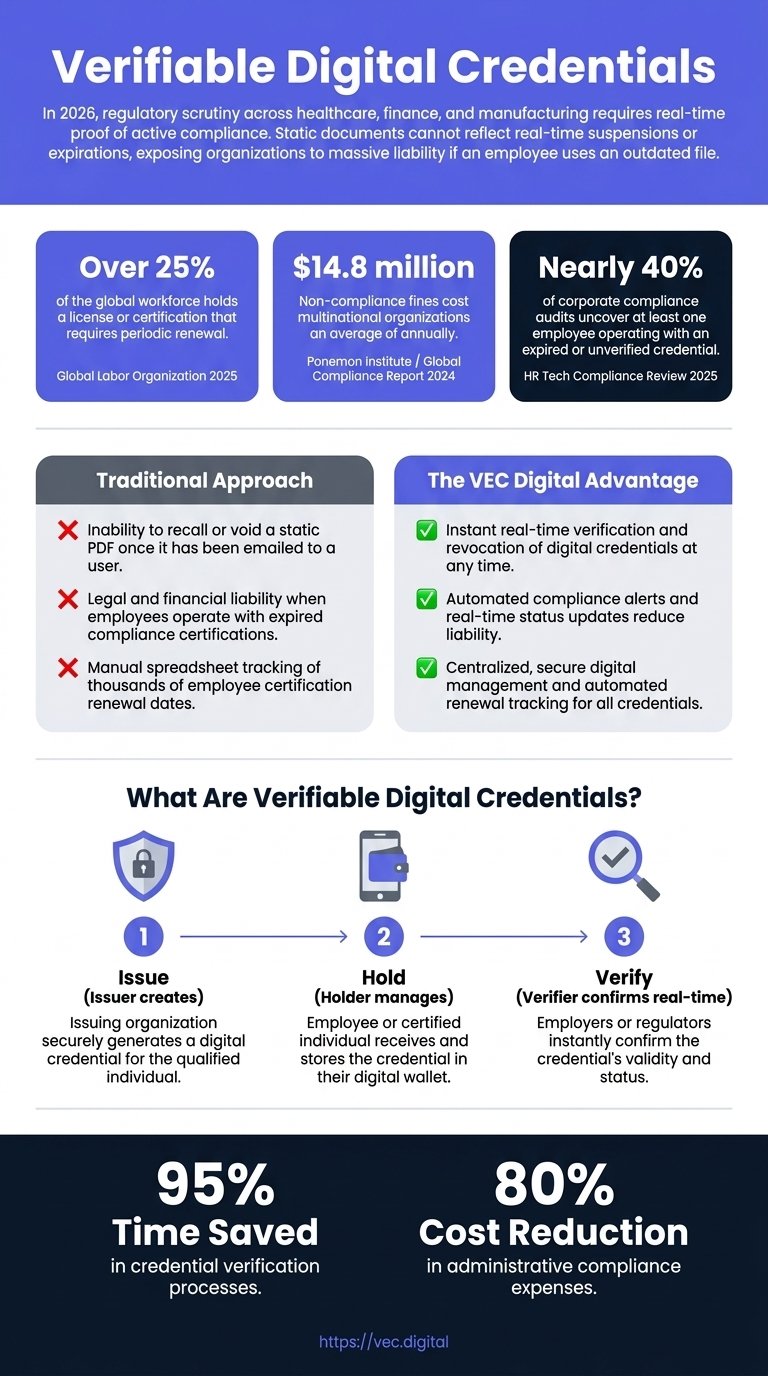
Over 25% of the global workforce holds a license or certification that requires periodic renewal, according to the Global Labor Organization (2025), yet many organizations still rely on static documents that cannot reflect real-time status changes. Relying on outdated files exposes multinational enterprises to massive legal and financial liabilities when employees operate with expired or suspended credentials. Implementing verifiable digital credentials is the only way to ensure real-time compliance and eliminate the dangers of unrevokable paper or PDF records.
In this comprehensive guide, our team at VEC Digital leverages our deep expertise in credentialing technology to demonstrate how modern enterprises can safely manage the lifecycle of time-bound certifications. Readers will learn how to instantly void suspended documents across global borders, automate expiration tracking to eliminate manual spreadsheet errors, and ensure auditors only see real-time, active compliance statuses. By transitioning to dynamic cryptographic verification, your business will drastically reduce administrative overhead while protecting its operational integrity.
Key Takeaways
- Dynamic revocation capabilities instantly render saved PDFs or printed copies useless upon scanning, protecting corporate integrity.
- Verifiable digital credentials eliminate the legal liabilities associated with expired employee certifications and licenses.
- Blockchain certificate verification provides an immutable, real-time audit trail required for strict global compliance standards.
- Compliance training certificate automation reduces audit preparation time by up to 70%, freeing HR teams from administrative burdens.
- Automated expiration tracking replaces manual spreadsheets, ensuring continuous regulatory alignment across all departments.
The Hidden Danger of Static Documents in Global Compliance
The global regulatory landscape is evolving rapidly, demanding strict adherence to continuous compliance. In this environment, relying on outdated methods for tracking employee qualifications is a massive risk. Transitioning to verifiable digital credentials is no longer just a technological upgrade; it is a fundamental requirement for risk mitigation. The financial stakes are simply too high for organizations to trust static, unchangeable documents.
According to the Ponemon Institute / Global Compliance Report (2024), non-compliance fines cost multinational organizations an average of $14.8 million annually. These staggering penalties often stem from simple administrative oversights, such as an employee operating heavy machinery, handling sensitive financial data, or administering medical care with a certification that expired just days prior. When a credential's status changes, the organization must have a mechanism to instantly broadcast that change to any auditor or stakeholder.
Why are PDF certificates not secure for corporate compliance?
The core issue with standard PDF certificates is their static nature. Once a PDF is generated and emailed to a recipient, it permanently leaves the issuer's control. If that employee commits a severe safety violation and their certification is suspended, the PDF sitting in their inbox remains visually identical to a valid document. They can easily forward it to a new employer, a client, or a third-party auditor, completely bypassing the suspension.
This inability to recall or void a static PDF once it has been distributed creates a massive blind spot for human resources and compliance officers. An auditor reviewing a printed or emailed PDF has no way of knowing if the credential was revoked five minutes after it was issued. In highly regulated industries like healthcare, aviation, and manufacturing, this lack of real-time visibility is a critical failure in global regulatory compliance.
The Legal and Financial Liabilities of Expired Credentials
When employees operate with expired compliance certifications, the legal and financial liability falls squarely on the employer. Consider the sweeping global regulations like the EU's Corporate Sustainability Due Diligence Directive (CSDDD) or stricter OSHA enforcement in North America. These frameworks legally mandate that companies prove continuous, active compliance at all times.
If an incident occurs and an investigation reveals that the involved personnel held expired safety credentials, the resulting lawsuits, regulatory fines, and reputational damage can be catastrophic. Third-party auditors or clients accepting visually valid but technically suspended credentials only compound the problem, creating a false sense of security that shatters the moment a real audit or incident investigation takes place.
What Are Verifiable Digital Credentials?
To combat the risks of static documentation, forward-thinking organizations are adopting verifiable digital credentials. Unlike a standard digital file, a verifiable credential is a dynamic, cryptographically secured digital object. It maintains a persistent connection to the issuer's centralized engine or a decentralized blockchain ledger, meaning its validity status can be queried and confirmed in real-time, from anywhere in the world.
The urgency for this technology is highlighted by recent data. A study by the HR Tech Compliance Review (2025) found that nearly 40% of corporate compliance audits uncover at least one employee operating with an expired or unverified credential. This statistic underscores a systemic failure in how organizations manage the post-issuance phase of employee achievements and mandatory training.
The Shift from Issuance to Lifecycle Management
Historically, most industry content and software tools have focused heavily on the initial creation and issuance of certificatesâ-designing a nice template, merging names from a spreadsheet, and hitting send. However, there is a significant lack of resources explaining the post-issuance lifecycle. Modern credentialing is not just about giving someone an award; it is about managing the entire lifespan of that credential.
Lifecycle management encompasses the ability to issue, suspend, reinstate, expire, and permanently revoke a document. When a credential reaches its pre-determined expiration date, the system must automatically flag it. If an employee fails a random drug test or violates a code of conduct, the HR department must be able to instantly suspend the credential, rendering any previously downloaded copy totally useless upon scanning.
How do employers know if a credential has been suspended?
The mechanism for real-time status checks relies heavily on dynamic QR codes and dedicated verification portals. When an organization utilizes a professional QR code certificate maker, every issued document contains a unique, scannable code. This code does not simply link to a static image of the certificate; it links to a live verification page hosted on a secure server or anchored to a blockchain.
When an employer, auditor, or client scans the QR code with their smartphone, the system instantly queries the current database status. If the HR administrator has clicked "Revoke" in their management dashboard, the person scanning the code will immediately see a red "Invalid" or "Suspended" warning on their screen, regardless of how authentic the physical piece of paper looks. This frictionless process ensures absolute certainty.
The Mechanics of Certificate Revocation and Expiration
Understanding the technical mechanics behind verifiable digital credentials demystifies how real-time security is achieved. The process is designed to be incredibly complex under the hood, utilizing advanced cryptography and distributed ledgers, yet remarkably simple and intuitive for the end-user. This balance ensures that HR and compliance teams can enforce strict governance without needing advanced technical skills.
The financial efficiency of this automated approach cannot be overstated. According to Blockchain in Enterprise Education (2025), smart contract-based credentials can reduce manual revocation processing costs to near zero. Instead of spending hours tracking down physical copies, sending legal notices, and updating disparate databases, an administrator can execute a global revocation with a single click.
How do you revoke a digital certificate?
Revoking a digital certificate within a modern credential management system is a seamless administrative action. When an authorized issuer logs into their dashboard, they access a centralized directory of all issued credentials. By locating the specific recipient or document ID, the administrator can change the status from "Active" to "Revoked" or "Suspended."
Once this status change is submitted, the system instantly updates the live verification endpoint. If the credential is anchored to a blockchain, a new transaction is recorded on the immutable ledger, cryptographically proving the exact timestamp and authority of the revocation. From that second forward, any scan of the certificate's QR code or any API query against that credential will return a void status, effectively neutralizing the document worldwide.
Can blockchain certificates expire?
A common misconception is that because blockchains are immutable (meaning data cannot be deleted), blockchain certificates cannot expire. In reality, blockchain certificates can absolutely expire. The immutability of the blockchain simply guarantees the permanent record of the rules and timestamps associated with the credential.
When a time-bound certificate is issued, the expiration date is written into the metadata or governed by a smart contract. Once the current date surpasses the expiration timestamp, the verification protocol automatically reads the credential as expired. The record of the achievement remains permanently on the blockchain, but its active validity status mathematically resolves to "Expired," ensuring compliance with time-sensitive regulatory requirements.
Automating the Compliance Renewal Engine
For multinational corporations managing thousands of employees, manual oversight is a recipe for disaster. Leveraging verifiable digital credentials allows organizations to build an automated compliance engine that operates quietly and flawlessly in the background, ensuring that no renewal date is ever missed and no expired credential goes unnoticed.
The operational relief provided by this automation is profound. Research from Enterprise L&D Trends (2026) indicates that organizations using automated digital credential engines reduce audit preparation time by up to 70%. Instead of scrambling to compile spreadsheets and physical files weeks before an audit, compliance teams can generate real-time, cryptographically verified reports instantly.
How to track employee compliance training expiration?
The traditional method of tracking employee compliance training expiration involves manual spreadsheet tracking of thousands of employee certification renewal dates. This process is highly prone to human error, formatting corruption, and simple forgetfulness. The modern solution relies on compliance training certificate automation.
By connecting your Learning Management System (LMS) or HR Information System (HRIS) to a robust credentialing API, the tracking process becomes entirely automated. The system records the exact issuance date and the predefined validity period. As the expiration date approaches, the automated system can trigger email notifications to the employee and their manager, prompting them to complete their renewal training. If the date passes without renewal, the system automatically updates the credential status to "Expired."
What is the most secure way to issue time-bound certificates?
The most secure way to issue time-bound certificates is through a platform that combines visual design, dynamic QR code generation, and blockchain anchoring. This triple-layered approach ensures that the document is visually appealing for the recipient, instantly verifiable via mobile scan for the auditor, and cryptographically tamper-proof on the backend.
When issuing time-bound credentials, the system must allow administrators to set exact validity windows (e.g., valid for 365 days from issuance). By utilizing a comprehensive digital diploma platform or enterprise credentialing system, organizations ensure that the expiration logic is hardcoded into the verification link. This completely removes human error from the verification process, as the system itself dictates the real-time validity based on the pre-configured timeline.
Building a Future-Proof Digital Credential Management System
As global commerce becomes increasingly interconnected, the systems we use to verify trust and competence must scale accordingly. Adopting verifiable digital credentials is a strategic move toward building a future-proof infrastructure. Whether your organization is a healthcare provider in Dubai, a manufacturing plant in Germany, or a financial institution in New York, the need for instant, reliable verification remains universal.
The transition away from static documents aligns with broader modern HR technology standards, which prioritize data integrity, automation, and seamless user experiences. By investing in the right infrastructure today, organizations protect themselves against the evolving sophistication of credential fraud and the tightening grip of global regulatory bodies.
Integrating Real-Time Verification Across Borders
A credential that was valid yesterday but suspended today must be verifiable in real-time across international borders without relying on physical paperwork. When a professional travels internationally for a contract, border agents, site managers, and local compliance officers need to verify their qualifications instantly.
Blockchain certificate verification excels in this global context. Because the verification ledger is decentralized and accessible via standard internet protocols, an auditor in Tokyo can scan a QR code generated by an issuer in London and receive the exact same real-time status update in milliseconds. There are no time-zone delays, no business-hour restrictions, and no language barriers when the cryptographic proof definitively states "Active" or "Revoked."
Transitioning to Zero-Friction Audits
Ultimately, the goal of managing the lifecycle of time-bound certifications is to achieve zero-friction audits. When a regulatory body requests proof of compliance, the organization should not experience a state of panic. With a centralized, automated credential management system, administrators can instantly export a comprehensive list of all active, suspended, and expired credentials.
This level of transparency builds immense trust with regulatory agencies and clients. It demonstrates that the organization is not merely reacting to compliance requirements, but proactively managing its workforce's qualifications with the highest standard of technological security available.
Secure Your Organizational Compliance with VEC Digital
The era of relying on static PDFs and manual spreadsheets to manage critical corporate compliance is over. As regulatory scrutiny intensifies globally, the inability to instantly revoke or track the expiration of employee certifications poses an unacceptable risk to your business operations and financial stability. Transitioning to dynamic, blockchain-anchored credentials is the definitive solution to these modern challenges.
At VEC Digital, we provide the secure trust infrastructure required to automate, manage, and authenticate your organization's entire credential lifecycle. Our platform empowers HR and compliance leaders to issue tamper-proof certificates, automate expiration tracking, and execute instant global revocations with a single clickâ-ensuring you are always audit-ready.
Protect your organizational integrity and eliminate compliance liabilities today. Learn more about our enterprise solutions by visiting https://vec.digital or contact our specialist team directly at support@vec.digital to secure your credentialing processes.