
Why 2026 is the Year Employers Stopped Trusting Standard PDF Certificates: The Shift to Verifiable Digital Credentials
Published on October 6, 2026

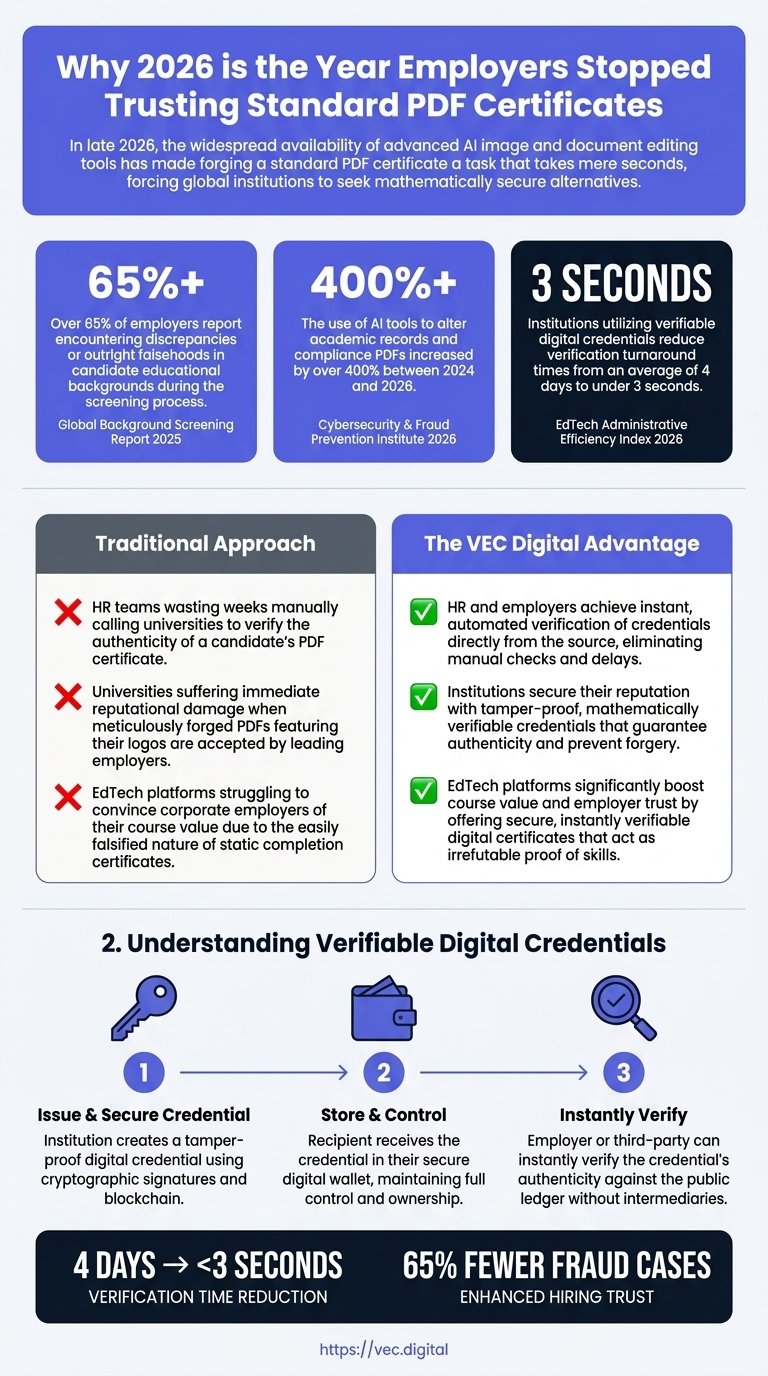
According to the Global Background Screening Report (2025), over 65% of employers report encountering discrepancies or outright falsehoods in candidate educational backgrounds during the screening process. As artificial intelligence makes document manipulation effortless, the traditional static PDF has become a severe liability for global institutions. To combat this rising tide of academic and professional fraud, organizations are rapidly abandoning legacy file formats in favor of mathematically secure verifiable digital credentials.
In this comprehensive guide, our team at VEC Digital will explore the critical structural vulnerabilities of standard PDF certificates and why they can no longer be trusted in high-stakes environments. We will break down the underlying mechanics of blockchain security, demonstrating how cryptographic hashing protects institutional reputation while drastically reducing administrative overhead. By the end of this article, you will understand exactly how to modernize your organizationâ's credentialing systems to ensure absolute authenticity, regulatory compliance, and frictionless verification for employers worldwide.
Key Takeaways
- Verifiable digital credentials provide mathematical certainty of authenticity, replacing easily manipulated static PDFs.
- Advanced AI tools have made preventing degree fraud nearly impossible with legacy paper or standard digital files.
- Implementing blockchain certificate verification reduces administrative audit times from days to seconds.
- A secure digital diploma platform protects institutional reputation by making credential forgery structurally impossible.
- Modernizing with a QR code certificate maker bridges the physical-to-digital gap, allowing instant, frictionless auditing.
1. The Structural Vulnerability of Standard PDFs in an AI-Driven World
For over two decades, the Portable Document Format (PDF) served as the global standard for sharing digital documents. However, the architecture of a standard PDF was designed for visual consistency across different devices, not for cryptographic security. In the era of generative AI, this distinction has become a critical point of failure for universities, corporate training departments, and compliance bodies.
How AI Document Forgery Changed the Game
The barrier to entry for document forgery has plummeted. In the past, altering a digital certificate required advanced graphic design skills and specialized software. Today, generative AI and automated image-editing tools can seamlessly replace names, dates, and grades on a PDF while perfectly matching the original typography, background textures, and institutional logos. In fact, according to the Cybersecurity & Fraud Prevention Institute (2026), the use of AI tools to alter academic records and compliance PDFs increased by over 400% between 2024 and 2026.
This surge in sophisticated forgery leaves employers and auditors asking: How can you tell if a PDF certificate is fake? With standard PDFs, the alarming truth is that you often cannot. Visual inspections are no longer sufficient. While some organizations attempt to use digital signatures on PDFs, these can often be stripped, bypassed, or visually mimicked by bad actors, creating a false sense of security.
The Hidden Flaws: Metadata Stripping and Layer Manipulation
To truly understand why verifiable digital credentials are necessary, one must look at the structural gaps in legacy files. A standard PDF is essentially a container of layersâ-text layers, image layers, and metadata. When a fraudster uses modern software to manipulate a PDF, they can easily isolate the text layer containing a recipient's name, alter it, and flatten the document back into a single, cohesive image.
Furthermore, document metadata (the hidden data detailing when a file was created and modified) is routinely stripped when files are uploaded to cloud drives, sent via email, or compressed. This means the forensic trail of a document is easily erased. Most industry content focuses heavily on the marketing benefits of digital badges, but it is this underlying structural vulnerability of PDFsâ-the lack of an immutable, tamper-evident architectureâ-that makes them fundamentally unsuited for high-stakes credentialing.
Institutional and Corporate Reputational Damage
The consequences of these vulnerabilities are severe. Universities are suffering immediate, highly publicized reputational damage when meticulously forged PDFs featuring their logos are accepted by leading employers. When a company discovers an incompetent or dangerous employee faked their degree, the blame often falls on the institution whose name is on the fraudulent document.
The academic sector is acutely aware of this crisis. The University Registrars Global Survey (2025) revealed that 72% of higher education registrars view credential forgery as a high-risk threat to institutional reputation. Protecting the integrity of an institution's name now requires moving beyond visual documents to systems secured by mathematical certainty.
2. Understanding Verifiable Digital Credentials
As the trust in static files collapses, the global standard is shifting toward cryptographic solutions. But what exactly does this transition entail, and how does the technology work in a practical business context?
What Are Verifiable Digital Credentials?
A common question among administrators is: What are verifiable digital credentials? Simply put, they are digital records of achievement or qualification that are cryptographically sealed and independently verifiable. Unlike a static PDF, a verifiable credential contains structured data that proves exactly who issued the credential, who received it, and that the data has not been altered since the moment of issuance.
It is also vital to understand the difference between a static digital badge and a verifiable credential. A static digital badge is often just an image file (like a PNG) linked to a web page. If the web page goes down, or if someone copies the image, the proof of achievement is lost or easily stolen. A true verifiable credential, however, is anchored by cryptographic proofs that exist independently of the issuing platform's basic web servers, ensuring permanent, tamper-proof verification.
Why Is Blockchain Used for Certificate Verification?
To achieve absolute immutability, modern platforms leverage decentralized ledgers. Why is blockchain used for certificate verification? Because a blockchain provides a public, unchangeable record of transactions. When an institution issues a certificate, the credentialing engine generates a unique mathematical hash (a digital fingerprint) of that specific certificate's data. This hash is then recorded on the blockchain.
If someone attempts to verify the certificate, the system recalculates the hash of the presented document and compares it to the hash permanently stored on the blockchain. If they match, the document is 100% authentic. This process relies on established cryptographic principles, similar to those outlined by global technology authorities like Wikipedia's breakdown of cryptographic hash functions, ensuring that the verification is based on immutable math, not visual inspection.
How Cryptography Protects Against AI Forgery
Administrators frequently ask: How do verifiable credentials protect against AI document forgery? The answer lies in the sensitivity of cryptographic hashes. A hash function takes any amount of data and turns it into a fixed-length string of characters. The most critical feature of a hash is that even the microscopic change of a single pixel, a single letter, or a single space in the document will generate a completely different hash.
If an AI tool perfectly alters a PDF to change the grade from a "B" to an "A", the visual document might look flawless to the human eye. However, when the employer scans the document's QR code to verify it, the system will instantly detect that the underlying data's hash no longer matches the blockchain record. The forgery is flagged immediately. Blockchain certificate verification completely neutralizes the threat of AI image manipulation because it verifies the underlying mathematical data, not the visual pixels.
3. The Business Impact: Eliminating Verification Delays and Fraud
The shift to secure digital records is not merely a defensive security measure; it is a massive operational upgrade. The traditional methods of credential verification are resource-intensive, slow, and increasingly incompatible with modern business speeds.
From Days to Seconds: Accelerating the Audit Process
Currently, the background screening process is a massive bottleneck. HR teams waste weeks manually calling universities, sending emails to registrars, and waiting for physical transcripts to verify the authenticity of a candidate's PDF certificate or paper diploma. This manual process delays hiring timelines and drains administrative resources on both ends.
By implementing a secure digital diploma platform, these delays are entirely eradicated. According to the EdTech Administrative Efficiency Index (2026), institutions utilizing verifiable digital credentials reduce verification turnaround times from an average of 4 days to under 3 seconds. An employer simply scans the embedded QR code, and the cryptographic proof is displayed instantly on their smartphone or desktop, requiring no phone calls, no emails, and no manual database lookups.
Securing Corporate Compliance and Safety
Beyond academia, the corporate sector faces its own credentialing crisis. Compliance officers managing OSHA, GDPR, or specialized safety training often lack a mathematical guarantee that an employee's crucial safety certification hasn't been visually altered or expired without notice. When internal audits occur, presenting a folder of disjointed, easily manipulated PDFs is a significant liability.
By transitioning to an automated, blockchain-secured system, corporate Learning & Development (L&D) and HR leaders can centralize all compliance records. Every safety certification becomes a verifiable digital credential, ensuring that during an audit, the company can prove with absolute certainty that every employee holds valid, unmanipulated qualifications.
Restoring Trust in EdTech and Bootcamps
The rapid rise of online academies, coding bootcamps, and EdTech platforms has democratized education, but these organizations face a unique hurdle: EdTech platforms struggle to convince corporate employers of their course value due to the easily falsified nature of static completion certificates. If an employer knows a bootcamp's PDF certificate can be faked in ten seconds, they will place zero weight on that credential during the hiring process.
To establish market authority and prevent degree fraud, EdTech providers must arm their graduates with credentials that employers can inherently trust. Anchoring course completions to a blockchain provides that trust. It transforms a simple digital award into a mathematically proven asset, directly enhancing the employability of the graduate and, by extension, the market reputation of the educational provider.
4. Global Regulatory Shifts and the Push for Interoperability
The modernization of credentialing is not happening in a vacuum. It is being heavily accelerated by international regulatory frameworks and government-led digital transformation initiatives that demand higher standards of data security and interoperability.
Adapting to Global Standards: eIDAS 2.0 and Beyond
Globally, governments are recognizing the need for secure digital identities and records. In Europe, the expansion of the eIDAS 2.0 regulations is pushing organizations to adopt verifiable digital identity and credential frameworks that cross borders seamlessly. These regulations demand that digital documents be mathematically verifiable and interoperable, effectively rendering the static PDF obsolete for official cross-border professional recognition.
The Middle Eastâ's Digital Transformation
Similarly, the Middle East is aggressively mandating digital transformation. Initiatives such as the UAE's Paperless Strategy compel government entities, universities, and corporations to eliminate paper-based processes entirely. However, moving from paper to standard PDFs does not fulfill the security requirements of these visionary mandates. Organizations worldwide are facing immense regulatory and market pressure to adopt mathematically verifiable systems that align with high-level environmental, social, and governance (ESG) goals by eliminating physical printing without sacrificing security.
Financial Benefits of the Transition
While compliance and security are the primary drivers, the financial incentives are equally compelling. Maintaining legacy systemsâ-printing physical diplomas, paying for secure postage, and funding the administrative staff required to manually answer verification phone callsâ-is incredibly expensive. The Corporate L&D Benchmark Report (2026) highlights that transitioning from legacy paper and static PDF systems to blockchain-anchored platforms saves organizations up to $3 per credential in administrative processing costs. When scaled across thousands of students or employees, the return on investment is undeniable.
5. How to Safely Transition to a Digital Diploma Platform
Recognizing the need for change is the first step, but execution is where many organizations falter. Registrars and IT directors frequently ask: How do universities transition to digital diploma platforms safely? The process requires a strategic approach that prioritizes data privacy, automated efficiency, and seamless verification.
Assessing Your Current Credentialing Infrastructure
The transition begins with a comprehensive audit of your current issuance processes. Identify where your data livesâ-whether in a university Student Information System (SIS), a corporate Human Resources Information System (HRIS), or a Learning Management System (LMS). A modern credentialing engine should not force you to abandon your existing databases; rather, it should integrate seamlessly via robust Developer APIs, allowing for automated data extraction and certificate generation without manual data entry.
Implementing a QR Code Certificate Maker for Instant Trust
To bridge the gap between physical ceremonies and digital security, institutions must adopt a QR code certificate maker. This technology embeds a unique, scannable QR code directly into the visual design of the certificate. Even if the graduate prints the certificate and frames it on their office wall, an auditor can simply point their smartphone camera at the physical paper. The QR code instantly routes the reviewer to the dedicated, blockchain-secured verification URL. This frictionless physical-to-digital link requires no app installs or logins, making the auditing process universally accessible.
Automating Issuance Without Sacrificing Security
Scaling up to issue thousands of credentials simultaneously requires powerful automation, but speed must never compromise governance. When replacing manual tasks, institutions should utilize Bulk Issuance and CSV upload capabilities to handle massive graduating classes or cohort training sessions in minutes.
Crucially, to prevent accidental or rogue issuance, organizations must implement multi-signatory approval pipelines. In these secure systems, certificates are held in a draft status until designated organizational authorities securely log in to review and electronically sign them. This ensures strict administrative governance and maintains high compliance standards, guaranteeing that automation enhances security rather than bypassing it.
6. Secure Your Organizationâ's Credentials Today
The era of trusting static PDFs and paper certificates has ended. With AI forgery tools widely accessible and verification delays costing businesses countless hours, the transition to mathematically secure systems is no longer optionalâ-it is an operational imperative. Verifiable digital credentials protect your institution's reputation, empower your learners with unassailable proof of their achievements, and provide employers with the instant certainty they require.
At VEC Digital, we provide the comprehensive trust infrastructure needed to modernize your credentialing processes. Our platform combines intuitive drag-and-drop design tools, robust API integrations, and immutable blockchain anchoring to make credential fraud impossible.
Ready to eliminate verification delays and secure your organization's legacy? Visit VEC Digital today to design your first template in minutes, or contact our team directly at support@vec.digital to discuss custom enterprise integrations.