
Why a Digital Diploma Platform is Your Best Defense Against the Billion-Dollar Diploma Mill Industry
Published on October 16, 2026

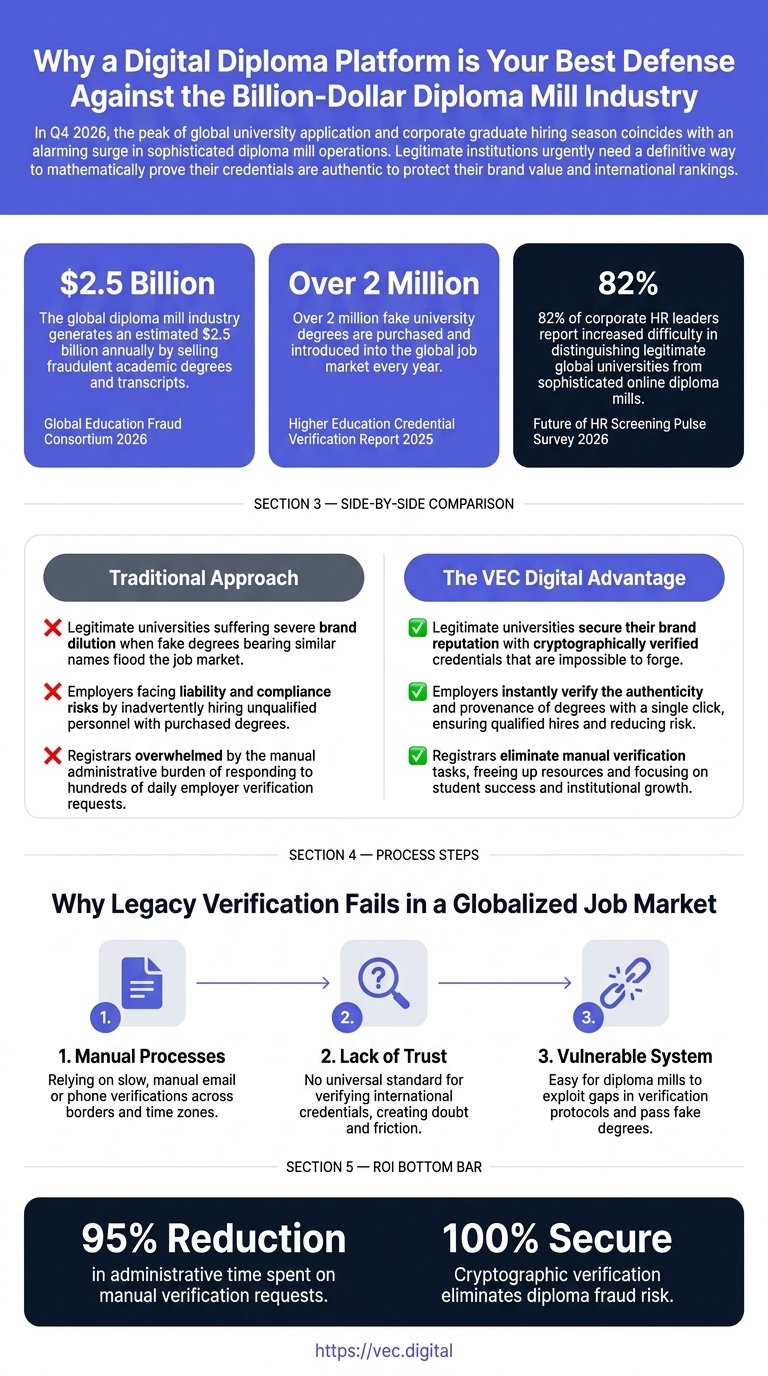
The global diploma mill industry now generates an estimated $2.5 billion annually by selling fraudulent academic degrees and transcripts, directly threatening the reputation of legitimate educational institutions worldwide. To combat this highly organized threat, higher education administrators are turning to a modern digital diploma platform to establish cryptographic proof of their credentials. Failing to adopt these advanced security measures leaves universities vulnerable to severe brand dilution and places their graduates at a distinct disadvantage in the competitive global job market.
In this comprehensive guide, our team at VEC Digital leverages our deep expertise in educational technology to break down the mechanics of modern credential fraud and how to systematically stop it. You will learn how to implement zero-trust verification environments, eliminate the manual administrative burden of background checks, and mathematically guarantee the authenticity of every issued degree using advanced cryptographic systems.
Key Takeaways
- Understand the financial and reputational impact of the $2.5 billion diploma mill industry on global education.
- Discover how a digital diploma platform uses cryptographic identity to outsmart organized fraud rings.
- Learn actionable strategies to prevent degree fraud while reducing manual verification delays from weeks to seconds.
- Explore the operational benefits of a QR code certificate maker for frictionless employer background checks.
- Examine the rising legal recognition of verifiable digital credentials in global business hubs.
The $2.5 Billion Threat: Understanding the Scale of Modern Diploma Mills
The conversation around academic fraud often centers on isolated incidents of individuals using image editing software to alter their grades or graduation dates. However, the true threat to institutional integrity is far more systemic. According to the Global Education Fraud Consortium (2026), the global diploma mill industry generates an estimated $2.5 billion annually by selling fraudulent academic degrees and transcripts. This is no longer a cottage industry; it is a highly sophisticated, globalized criminal enterprise that mass-produces convincing academic records.
To fight back, forward-thinking registrars and academic deans are adopting a robust digital diploma platform. By shifting away from easily forged paper documents and standard PDFs, institutions can mathematically anchor their issued credentials, making it impossible for third-party bad actors to replicate their authoritative digital signature.
The Shift from Photoshopped PDFs to Organized Fraud Rings
Modern diploma mills do not merely print fake certificates; they engineer entire counterfeit institutional ecosystems. The Higher Education Credential Verification Report (2025) reveals that over 2 million fake university degrees are purchased and introduced into the global job market every year. These operations often register web domains that closely mimic legitimate universities, set up automated phone lines to "verify" alumni, and even create fake accreditation bodies to lend an air of legitimacy to their fraudulent documents.
This level of sophistication means that traditional visual inspections of a diploma are completely ineffective. When a fraudulent PDF looks identical to a legitimate oneâ-and is backed by a fake verification websiteâ-employers and background check agencies are easily deceived. The only way to break this cycle is to move beyond visual trust and implement cryptographic proof.
How Can Employers Identify a Diploma Mill?
One of the most common questions from corporate hiring teams is how to identify a diploma mill when the documentation looks flawless. Historically, employers looked for red flags such as rapid degree completion times, lack of physical campus addresses, or accreditation from unrecognized bodies. Today, however, the most definitive way to identify a diploma mill is by the absence of verifiable digital credentials.
If a candidate presents a degree that cannot be instantly authenticated through a secure, cryptographic network, it warrants immediate scrutiny. Legitimate institutions are increasingly relying on blockchain-anchored records, meaning the absence of a digital proof-of-issuance is rapidly becoming the primary indicator of potential credential fraud.
The Cost of Brand Dilution for Legitimate Universities
When diploma mills issue thousands of fake degrees bearing names that sound remarkably similar to prestigious universities, the legitimate institution suffers severe brand dilution. Every time an unqualified individual is hired based on a fake degree associated with a university's brand, the perceived value of that university's actual alumni diminishes in the eyes of corporate recruiters.
Protecting institutional reputation requires proactive defense. By adopting a system that guarantees absolute authenticity, universities protect their brand equity. When employers know that a specific university's credentials can be trusted implicitly, graduates from that institution gain a distinct competitive advantage in the global hiring pool.
Why Legacy Verification Fails in a Globalized Job Market
As remote work and global mobility increase, organizations in hubs like Dubai, London, and New York are routinely screening candidates from thousands of international universities. This globalization of the workforce has stretched legacy verification systems to their breaking point. Relying on phone calls, emails, and physical mail to authenticate a digital diploma platform record is no longer a viable operational strategy.
The friction caused by these outdated manual processes impacts everyone in the ecosystem: universities are overwhelmed with administrative tasks, employers face extended hiring timelines, and qualified graduates suffer through agonizing delays as they wait for their legitimate achievements to be recognized.
The Administrative Burden on University Registrars
University registrars and student records managers bear the brunt of the manual verification burden. Every day, these departments receive hundreds of inquiries from global background screening agencies, corporate HR departments, and government immigration offices. Manually cross-referencing these requests against legacy databases and student information systems consumes thousands of administrative hours annually.
This reactive approach to credential auditing is inefficient and expensive. By automating the verification process through a decentralized digital infrastructure, universities can eliminate this administrative bottleneck entirely, allowing their staff to focus on student success rather than endless paperwork.
Background Check Delays and Lost Global Talent
For corporate HR and compliance leaders, the inability to quickly verify international degrees is a major operational hurdle. The Future of HR Screening Pulse Survey (2026) highlights that 82% of corporate HR leaders report increased difficulty in distinguishing legitimate global universities from sophisticated online diploma mills. This uncertainty forces HR teams to rely on extensive, time-consuming manual background checks.
Consequently, background check delays due to manual academic verification average 7 to 14 days globally, leading to lost talent (International Background Screening Association, 2025). In a competitive talent market, a two-week delay often results in top candidates accepting offers from competing firms. Furthermore, employers face massive liability and compliance risks if they inadvertently hire unqualified personnel for highly regulated rolesâ-such as healthcare, engineering, or financeâ-based on purchased degrees.
How Do You Prevent Academic Degree Fraud?
To effectively prevent degree fraud, institutions must shift from a reactive verification model to a proactive issuance model. This means securing the credential at the exact moment of creation. The most effective strategy is to issue records that are inherently self-verifying.
By embedding cryptographic signatures directly into the digital document, the credential itself carries the mathematical proof of its origin. When a university issues a record this way, they completely sever the diploma mill's ability to spoof the institution's identity, effectively neutralizing the fraud threat at its source.
The Cryptographic Solution: Establishing Zero-Trust Verification
To solve the systemic vulnerabilities of paper and standard PDF certificates, the education sector must adopt a "zero-trust" approach to credentialing. In a zero-trust environment, the visual appearance of a document is irrelevant; the only thing that matters is the mathematical proof of its authenticity. This is precisely what a modern digital diploma platform provides.
By leveraging advanced cryptography, educational institutions can create an immutable, publicly verifiable record of achievement that exists independently of vulnerable internal servers or easily manipulated visual designs.
What is the Best Digital Diploma Platform for Universities?
When evaluating technology partners, universities frequently ask how to identify the best platform for their specific needs. The ideal solution must prioritize three core elements: unbreakable security, frictionless scalability, and global interoperability.
The best platforms go beyond simple visual design tools. They offer automated batch generation via CSV uploads, seamless API integrations with existing Learning Management Systems (LMS) like Canvas or Moodle, and, most importantly, immutable blockchain anchoring. Platforms that require proprietary apps or mandatory account creation for verifiers introduce unnecessary friction. The optimal choice allows anyone, anywhere, to verify a credential instantly through a standard web browser.
Anchoring Institutional Identity on the Blockchain
The cornerstone of modern credential security is blockchain certificate verification. When a university issues a diploma, the platform calculates a unique digital fingerprintâ-known as a cryptographic hashâ-of that specific document. This hash is then anchored to a public blockchain.
Because blockchains are decentralized and immutable, this record can never be altered, backdated, or deleted. When an employer wants to verify the diploma, the system simply recalculates the hash of the presented document and compares it to the hash anchored on the blockchain. If even a single pixel or character has been altered by a diploma mill, the hashes will not match, and the verification will instantly fail. This process mathematically guarantees the absolute authenticity of the issuing organization's identity.
Can Blockchain Technology Stop Fake University Degrees?
Yes, blockchain technology is currently the most effective defense against fake university degrees. While it cannot prevent a diploma mill from printing a piece of paper, it makes it impossible for that fake paper to pass a digital audit.
Because a diploma mill does not possess the private cryptographic keys of the legitimate university, they cannot anchor a matching hash on the blockchain under the university's verified identity. Therefore, when employers demand blockchain-verified credentials as a standard part of the hiring process, the fake degrees produced by diploma mills become entirely useless, effectively destroying the economic incentive behind the fraud.
Empowering Employers and Graduates with Instant Verification
The true power of a comprehensive digital diploma platform lies in its ability to empower the end-users: the graduates who earned the credentials and the employers who need to verify them. By removing friction from the auditing process, universities enhance the marketability of their alumni.
Transitioning to an automated, instant-verification system transforms the credential from a static historical record into a dynamic, highly valuable career asset that facilitates global mobility and rapid employment.
The Role of a QR Code Certificate Maker in Frictionless Auditing
To bridge the gap between physical documents and digital security, institutions are utilizing a QR code certificate maker. By embedding a unique, dynamically generated QR code onto every certificate template, universities provide a direct physical-to-digital link.
This integration enables zero-friction verification. An employer, immigration officer, or compliance auditor simply scans the QR code with any standard smartphone camera. They are immediately routed to a dedicated, secure certificate URL that displays the "Blockchain Verified" security badge, the issuer details, and the recipient's information. No app installations, logins, or specialized software are required, making the audit process entirely frictionless.
Reducing Verification Time from Weeks to Seconds
The impact of this technology on operational efficiency is staggering. According to VEC Digital Internal Metrics (2026), adopting a blockchain-secured credential system reduces academic verification time from weeks to under 3 seconds.
This acceleration completely eliminates the 7 to 14 day delay typically associated with manual background checks. For corporate HR teams, this means faster time-to-hire, reduced administrative overhead, and the absolute certainty that they are maintaining strict compliance standards. For universities, it means zero time spent answering manual verification emails.
Securing Professional Visas and Global Mobility
International students frequently face significant hurdles when attempting to secure professional visas or employment abroad because their legitimate credentials take weeks to manually authenticate across borders. Immigration authorities require absolute proof of educational attainment before granting work authorizations.
By providing graduates with instantly verifiable digital credentials, universities directly support their students' global mobility. When an immigration officer can scan a QR code and instantly view a cryptographically secured academic record, the visa approval process is expedited, allowing graduates to transition smoothly into the international workforce.
Global Compliance and the Legal Recognition of Digital Credentials
As the technological landscape evolves, so too do the regulatory frameworks governing educational and professional records. Governments and corporate compliance bodies worldwide are recognizing the necessity of cryptographic security, moving to mandate the use of a digital diploma platform for high-stakes documentation.
This shift is particularly evident in rapidly developing economic hubs that attract a massive influx of international talent, where the sheer volume of cross-border credential auditing demands a scalable, automated solution.
Are Blockchain Digital Diplomas Legally Recognized?
A frequent concern among academic deans is whether blockchain digital diplomas hold legal weight. Globally, the answer is increasingly yes. Under frameworks such as the European Union's eIDAS regulation and various electronic signature laws in the United States and Asia, cryptographically secured digital documents are granted the same legal status as their physical counterparts.
In fact, because blockchain records provide an immutable audit trail of the exact time, date, and identity of the issuer, they are often considered more legally robust in a court of law or a compliance audit than traditional paper documents, which are susceptible to physical forgery.
Academic Degree Fraud Prevention in the Middle East and Beyond
In regions experiencing hyper-growth, regulatory bodies are taking aggressive steps to combat credential fraud. Specifically, academic degree fraud prevention Middle East initiatives have led to strict regulatory frameworks being adopted in hubs like Dubai and Saudi Arabia. In these jurisdictions, verifiable digital credentials are rapidly becoming a legal necessity for acquiring professional visas, government contracts, and corporate roles.
Institutions that fail to modernize their credentialing systems risk having their graduates blocked from participating in these lucrative global markets. By proactively adopting blockchain verification, universities ensure their degrees remain recognized and respected worldwide.
Integrating Blockchain Certificate Verification into Existing Academic Systems
Modernizing credential issuance does not require tearing down existing IT infrastructure. The best platforms offer robust Developer APIs that seamlessly connect the credentialing engine with third-party software, such as Student Information Systems (SIS), HR intranets, or LMS platforms.
This allows for zero-touch automation. The moment a student completes their final graduation requirement or an employee passes a compliance module, the system automatically triggers the generation, blockchain anchoring, and email delivery of the personalized certificate. This automated system ensures strict administrative governance while operating flawlessly at scale.
Secure Your Institutionâ's Legacy with VEC Digital
The multi-billion-dollar diploma mill industry represents an existential threat to the integrity of global education and corporate compliance. Relying on paper documents and standard PDFs is no longer sufficient in a world where organized fraud rings can replicate visual designs with ease. To protect your institution's brand reputation, ensure compliance, and empower your graduates in the job market, transitioning to a cryptographically secured digital credentialing system is imperative.
At VEC Digital, we provide the trust infrastructure required to make credential fraud impossible. Our comprehensive platform combines a visual drag-and-drop certificate maker, seamless CSV bulk issuance, and immutable blockchain anchoring to deliver absolute certainty to issuers, earners, and employers alike. With instant QR code verification, you can reduce audit times from weeks to seconds, all without requiring any technical setup or app installations from your verifiers.
Stop diploma mills in their tracks and modernize your credentialing operations today. Discover how our automated systems can scale your recognition programs flawlessly.
Ready to secure your credentials?
Visit us at https://vec.digital to design your first template in minutes, or contact our enterprise team at support@vec.digital to discuss custom API integrations and multi-signatory governance for your institution.