
Why Corporate Academies Are Abandoning Native LMS Badges for Verifiable Digital Credentials
Published on November 23, 2026

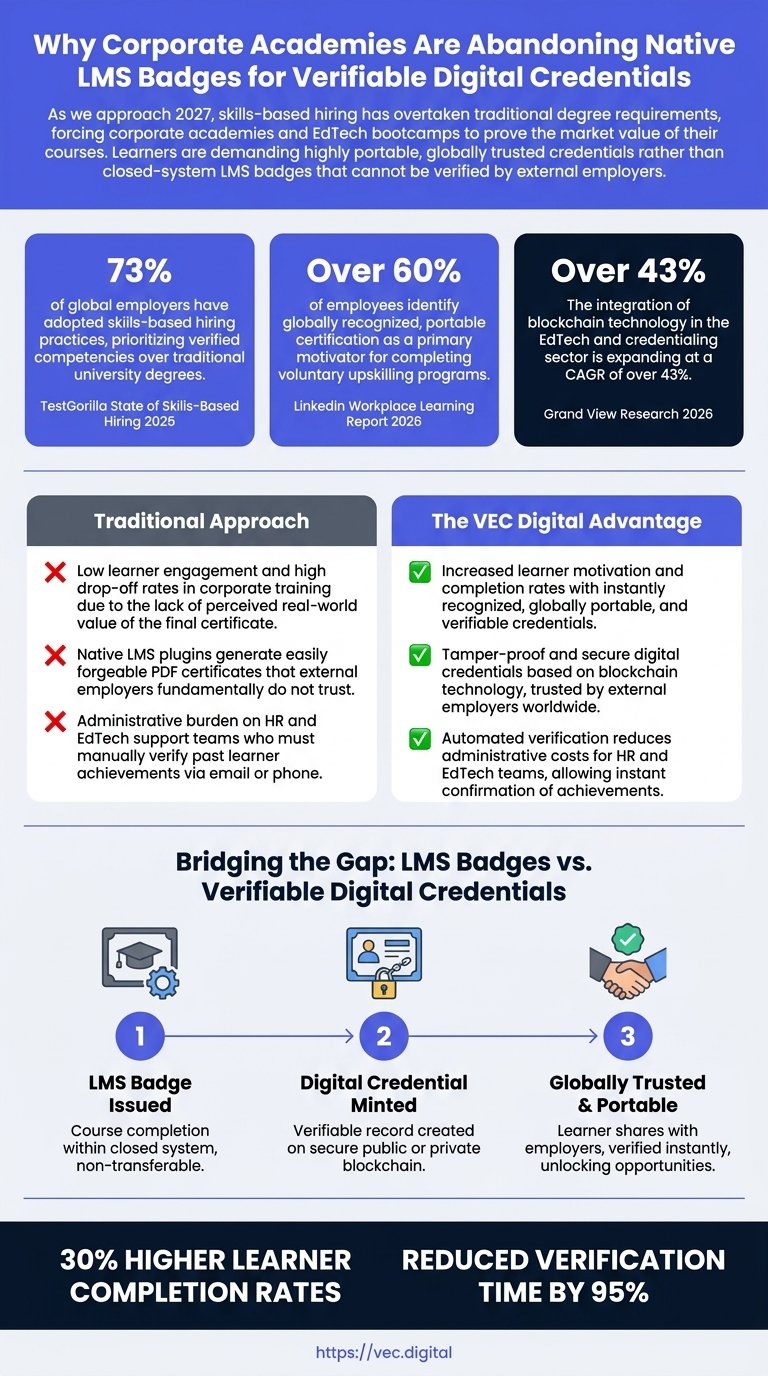
73% of global employers have adopted skills-based hiring practices, prioritizing verified competencies over traditional university degrees according to the 2025 TestGorilla State of Skills-Based Hiring report. As the corporate e-learning market expands rapidly, organizations are realizing that static PDFs and closed LMS badges fail to provide the verifiable digital credentials modern learners demand. This gap between internal training completion and external market recognition is forcing a massive shift in how educational technology leaders approach digital certification.
In this comprehensive guide, our team at VEC Digital leverages our deep expertise in educational technology to explore the strategic transition toward portable, cryptographically secure certificates. Readers will gain actionable insights into eliminating the administrative burden of manual background checks, discover methods to automate credential issuance directly from existing learning management systems, and understand how empowering learners with globally trusted career assets dramatically boosts course completion rates and organizational ROI.
Key Takeaways
- Transitioning to verifiable digital credentials eliminates the risk of easily forgeable PDF certificates generated by native LMS plugins.
- Implementing blockchain certificate verification provides learners with immutable, portable career assets that external employers fundamentally trust.
- Organizations can drastically reduce administrative overhead by utilizing a bulk certificate generator to automate issuance at scale.
- Integrating an LMS certificate API allows for seamless, zero-touch certificate delivery directly from platforms like Canvas or Moodle.
- Deploying compliance training certificate automation centralizes global audits and increases employee engagement in voluntary upskilling programs.
The Hidden Cost of Closed-System LMS Badges
The Illusion of Native PDF Certificates
For years, corporate academies and online bootcamps have relied on built-in tools within their Learning Management Systems (LMS) to reward learners upon course completion. However, these native LMS plugins generate easily forgeable PDF certificates that external employers fundamentally do not trust. Because these documents lack any cryptographic proof of origin, anyone with basic photo-editing software can alter names, dates, and course titles. In a global job market where authenticity is paramount, issuing a static PDF is no longer sufficient to prove a candidate's competency. Organizations must pivot toward **verifiable digital credentials** to ensure the integrity of their educational programs.This lack of security creates a significant ripple effect across the entire employment ecosystem. When an educational institution or corporate training provider issues a certificate that cannot be instantly authenticated, the perceived real-world value of that credential plummets. Learners are highly perceptive; if they realize that the final award for completing a rigorous multi-week training program holds zero weight with prospective employers, their motivation to engage with the material deteriorates. This directly contributes to low learner engagement and high drop-off rates in corporate training, undermining the substantial investments organizations make in their learning and development (L&D) initiatives.
Furthermore, across the European Union and the Middle East, new digital identity frameworks are pushing for standardized, interoperable credentials. Corporate academies that issue static PDFs are finding their certificates rejected by modern Applicant Tracking Systems (ATS) and global hiring platforms that now require cryptographic proof of achievement. The inability for learners to export and permanently own their training records once they leave the company or educational platform leaves them empty-handed, effectively erasing their hard-earned professional development history.
The Administrative Burden of Manual Verifications
The reliance on closed-system LMS badges does not just harm the learner; it imposes a staggering operational tax on the issuing organization. Without a public-facing, automated verification system, the responsibility of confirming a learner's past achievements falls squarely on human administrators. HR departments spend up to 15 hours per week manually responding to background check inquiries and third-party verification requests for past employee training, according to the 2025 Society for Human Resource Management (SHRM) Trends report. This manual intervention is slow, error-prone, and highly inefficient.When an external employer or background screening agency encounters a traditional PDF diploma or LMS badge, their only recourse is to contact the issuing organization's support team via email or phone. For high-volume EdTech platforms and large enterprise HR departments, these inquiries scale exponentially as their alumni networks grow. The administrative burden on support teams distracts from core business objectives and creates a massive bottleneck in the hiring process for the graduate. By failing to adopt modern verification engines, organizations inadvertently penalize their successful learners with delayed employment background checks.
Transitioning away from manual verifications requires a foundational shift in how data is stored and presented. By anchoring certificate data to an immutable ledger, organizations can completely remove themselves from the verification loop. Reviewers can independently confirm the validity of a document in seconds, bypassing the need to contact the issuer entirely. This zero-friction approach not only reclaims hundreds of administrative hours but also projects a highly professional, technologically advanced image of the issuing institution.
Bridging the Gap: LMS Badges vs. Verifiable Digital Credentials
What is the Difference Between an LMS Badge and a Verifiable Digital Credential?
One of the most common questions from EdTech product managers is: What is the difference between an LMS badge and a verifiable digital credential? The distinction lies fundamentally in portability, security, and external trust. An LMS badge is a closed-loop digital image or internal database record that exists solely within the confines of the specific learning platform where it was earned. If the platform shuts down, the user's subscription lapses, or the employee leaves the company, access to the badge is permanently lost. It is a localized reward mechanism with no external utility.Conversely, verifiable digital credentials are decentralized, cryptographically secured assets that belong entirely to the learner. They utilize public-key cryptography and often blockchain anchoring to create a permanent, tamper-proof record of achievement. When a learner shares this credential on a professional network or embeds it in a digital resume, anyone clicking the link or scanning the associated QR code can instantly verify the issuer's identity, the date of issuance, and the exact competencies mastered. The credential survives independently of the issuing LMS, making it a lifelong, portable career asset.
This portability is what transforms a simple participation acknowledgment into a high-stakes, market-ready certification. Modern digital diploma platforms ensure that the metadata embedded within the credential adheres to global open standards. This means that whether the certificate is being reviewed by an employer in Dubai, an academic registrar in London, or an automated ATS in New York, the data is instantly readable, universally understood, and mathematically impossible to forge.
Do External Employers Trust Internal Corporate Academy Certificates?
Another critical inquiry from L&D leaders is: Do external employers trust internal corporate academy certificates? Historically, the answer has been a resounding no. Because internal academies have traditionally lacked standardized accreditation and issued easily manipulated documents, external employers viewed these certificates with extreme skepticism. Without a reliable way to audit the curriculum or prove that the candidate actually earned the certificate, hiring managers largely dismissed them in favor of traditional, accredited university degrees.However, the paradigm shifts entirely when an internal academy upgrades its infrastructure to issue cryptographically secure credentials. When an employer receives a digital certificate that features instant QR-code verification and a verifiable blockchain hash, the trust barrier is immediately shattered. The employer no longer has to trust the PDF file; they trust the underlying mathematical proof. This technological upgrade elevates the perceived prestige of the corporate academy, putting its digital awards on par withâ-and in some cases, ahead ofâ-traditional academic transcripts in terms of immediate verifiability.
By providing an immutable audit trail, corporate academies can definitively prove that a candidate completed specific modules on a specific date. This transparency is highly attractive to modern employers who are desperate for accurate, granular data regarding a candidate's actual capabilities. When an organization utilizes a robust digital diploma platform to issue its awards, it directly increases the employability of its workforce and alumni, turning its educational programs into highly respected talent pipelines.
How Blockchain Certificate Verification Supports Skills-Based Hiring
The Shift Toward Verified Competencies
The global labor market is undergoing a profound transformation, moving away from degree-centric recruitment toward a more equitable, competency-driven model. As noted earlier, 73% of global employers have adopted skills-based hiring practices, prioritizing verified competencies over traditional university degrees (TestGorilla, 2025). This macroeconomic shift demands a new type of infrastructure. Employers no longer want a broad summary of a four-year education; they want granular, immediate proof that a candidate possesses the exact skills required for the job today. This is precisely how **verifiable digital credentials** empower the modern workforce.So, how does blockchain certificate verification support skills-based hiring? It acts as the ultimate trust layer for a decentralized workforce. When a bootcamp or corporate training program issues a credential anchored to the blockchain, it creates a permanent, unalterable record of a specific skill acquisition. If a candidate completes an advanced cybersecurity module or a specialized data science sprint, that achievement is immortalized on a public ledger. Hiring managers can instantly verify this micro-credential, allowing them to make rapid, data-driven hiring decisions without waiting weeks for university registrars to process transcript requests.
The integration of blockchain technology in the EdTech and credentialing sector is expanding at a CAGR of over 43%, according to a 2026 report by Grand View Research. This explosive growth underscores the global urgency to establish trust in digital records. As more organizations adopt skills-based hiring, the demand for immutable proof of those skills will only intensify. Blockchain verification eliminates the friction in the hiring process, ensuring that candidates are evaluated fairly based on proven abilities rather than institutional pedigree alone.
Empowering the Learner with Portable Career Assets
At the heart of the skills-based hiring revolution is the empowerment of the individual learner. Over 60% of employees identify globally recognized, portable certification as a primary motivator for completing voluntary upskilling programs, as highlighted in the 2026 LinkedIn Workplace Learning Report. When learners know that their efforts will result in a permanent, shareable asset that enhances their professional brand, their engagement levels soar. They are no longer just completing a corporate mandate; they are actively building their personal career portfolio.This psychological shift is critical for EdTech platforms and corporate academies struggling with completion rates. By replacing closed LMS badges with portable digital diplomas, organizations provide a tangible, high-value reward. Learners can seamlessly export these credentials to their LinkedIn profiles, personal websites, or digital wallets. The credential acts as a physical-to-digital bridge, often featuring an embedded QR code that anyone can scan with a smartphone camera to view the verified achievement instantly.
Furthermore, this portability solves the historical problem of data lock-in. In traditional systems, when an employee left a company, their record of internal compliance and safety training was left behind, forcing them to retake identical courses at their next employer. With blockchain-anchored credentials, the learner retains ownership of their data. This interoperability not only benefits the learner but also creates a more efficient global workforce, where verified skills can travel seamlessly across borders and industries.
Automating the Credential Engine via LMS Integration
How Can I Automatically Issue Blockchain Certificates from Canvas or Moodle?
For operations directors and IT managers handling thousands of learners, manual certificate generation is an unsustainable bottleneck. The transition to secure digital awards must be accompanied by scalable automation. A frequent question from technical administrators is: How can I automatically issue blockchain certificates from Canvas or Moodle? The answer lies in leveraging a robust Developer API that connects the issuing platform directly to the learning management system, enabling zero-touch operational efficiency.By integrating an LMS certificate API, organizations can establish a seamless trigger-and-action system. The moment a learner achieves a 100% score on a final assessment or completes a designated learning pathway in Canvas, Moodle, or a proprietary corporate intranet, the LMS sends a secure webhook payload to the credentialing engine. The engine then dynamically populates a pre-designed template with the learner's specific dataâ-such as their name, completion date, and unique IDâ-anchors the hash to the blockchain, and instantly dispatches an email delivering the verifiable digital credentials directly to the learner's inbox.
This automation completely eliminates the need for administrators to manually export CSV files, format names, and upload data batches at the end of every week. For massive open online courses (MOOCs) or high-volume corporate onboarding cohorts, this level of automation is transformative. It ensures that learners receive their gratification instantly upon course completion, reinforcing positive learning behaviors while saving the organization hundreds of administrative hours per month.
What is the Most Secure API for Automating Digital Certificate Generation?
When connecting external systems to a central credentialing engine, security and data privacy are paramount. Technical leaders often ask: What is the most secure API for automating digital certificate generation? A secure integration must utilize industry-standard authentication protocols, such as OAuth 2.0 or secure API key management, ensuring that only authorized LMS instances can trigger the generation of a certificate. This prevents rogue actors from issuing fraudulent credentials under the organization's name.Furthermore, a highly secure API will support multi-signatory approval pipelines even in an automated environment. For high-stakes compliance or academic diplomas, the API can be configured to hold the generated certificate in a "draft" or "pending" state until designated organizational authorities log in and provide their cryptographic signatures. This ensures strict administrative governance and maintains high compliance standards, preventing accidental issuance while still automating the heavy lifting of data formatting and generation.
At VEC Digital, we understand that a robust, developer-ready REST API is the backbone of modern educational infrastructure. A secure API should offer comprehensive documentation, webhook events, batch endpoints for bulk issuance, and real-time status callbacks. By prioritizing end-to-end encryption and secure data transmission, organizations can confidently connect their internal HR workflows and LMS platforms to a global verification engine, achieving massive scale without compromising on security or institutional integrity.
Compliance Training Certificate Automation and ROI
How Do Verifiable Digital Credentials Improve Corporate Training Completion Rates?
Corporate e-learning and internal academy markets are projected to surpass $490 billion by 2028, driving the massive need for standardized credentialing (Statista, 2026). Despite this massive investment, many Chief Learning Officers struggle to demonstrate tangible ROI due to low employee engagement in voluntary training programs. How do verifiable digital credentials improve corporate training completion rates? By transforming mandatory compliance and voluntary upskilling into a visually shareable, career-enhancing achievement.When employees know that completing a rigorous data privacy or leadership module yields a verifiable digital credentials asset that they can showcase on their professional profiles, the perceived value of the time invested skyrockets. Traditional LMS badges feel like internal busywork; portable digital diplomas feel like professional development. This intrinsic motivation is critical for driving course completions. Employees actively want to build their digital portfolios to prove their continuous learning mindset to both internal management for promotion opportunities and external networks for long-term career growth.
Additionally, the instant gratification provided by automated issuance plays a significant role in learner psychology. Receiving a beautifully designed, instantly verifiable certificate the second a final exam is passed reinforces the learning loop. This positive feedback mechanism encourages employees to enroll in subsequent modules, creating a culture of continuous learning and significantly boosting the overall ROI of the organization's L&D software investments.
Centralizing Global Compliance Audits
Beyond learner motivation, the operational benefits of compliance training certificate automation are profound, particularly for multinational corporations navigating complex regulatory environments. Compliance officers must constantly ensure that thousands of remote employees are up-to-date on critical safety, OSHA, GDPR, and industry-specific training. When training records are scattered across disjointed legacy systems, physical filing cabinets, or static spreadsheets, preparing for an external audit is a chaotic, high-stress endeavor.By utilizing a centralized digital credentialing platform, HR and compliance leaders create a single, immutable source of truth. Every issued certificate is timestamped, mathematically hashed, and permanently recorded. When an external auditor requests proof of compliance, the organization can simply provide a secure link to the digital registry or the specific QR codes associated with the employee cohort. The auditor can independently verify the authenticity of the training records in minutes, without requiring the HR team to dig through archives or cross-reference manual spreadsheets.
This level of audit readiness not only protects the organization from regulatory fines and reputational damage but also aligns with global environmental, social, and governance (ESG) goals. By digitizing the entire credentialing process, organizations eliminate the carbon footprint associated with printing, mailing, and storing physical paper records, supporting the sustainable, paperless shift while simultaneously achieving bulletproof operational security.
Secure Your Organizationâ's Credentials Today
The era of easily manipulated PDFs and closed-system LMS badges is rapidly coming to an end. As skills-based hiring becomes the global standard, organizations must equip their learners with portable, cryptographically secure assets that hold undeniable weight in the job market. By transitioning to a modern verification engine, you not only protect your institutional reputation from diploma fraud but also reclaim thousands of administrative hours through intelligent automation and API integrations.VEC Digital provides the comprehensive trust infrastructure required to scale your credentialing operations flawlessly. From visual drag-and-drop template editors and bulk CSV issuance to robust developer APIs and immutable blockchain anchoring, our platform empowers you to issue with absolute confidence. Elevate your corporate academy, boost your course completion rates, and provide your learners with the globally recognized credentials they deserve.
Secure your organizationâ's credentials todayâ-design your first template in minutes with no setup fees. Connect with our team to learn how we can automate your digital certification process.
Website: https://vec.digital
Email: support@vec.digital