
Why Native LMS Certificates Fail Modern Corporate Security Audits
Published on October 1, 2026

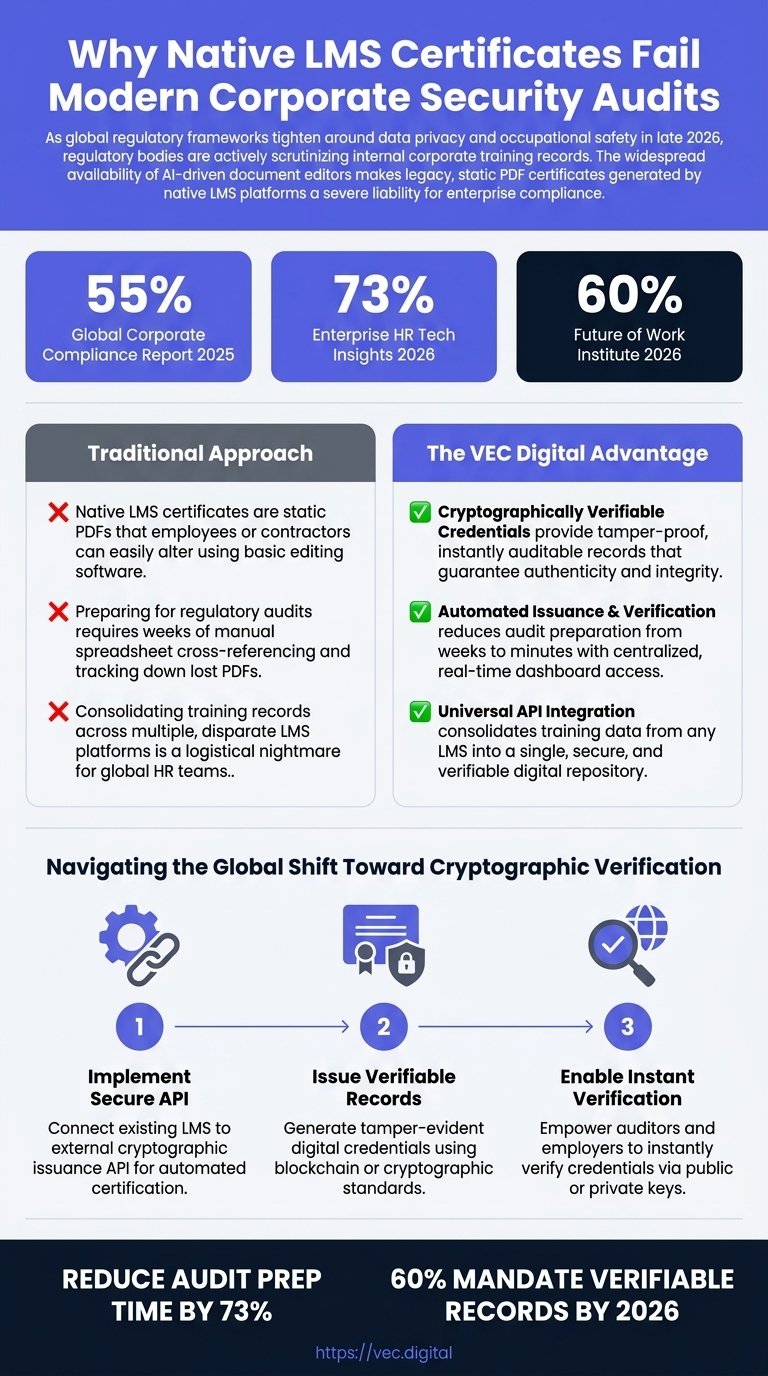
Over 55% of corporate compliance officers report that easily manipulated PDF certificates are their biggest operational vulnerability during external regulatory audits, according to the Global Corporate Compliance Report (2025). As global regulatory frameworks tighten around data privacy and occupational safety, mastering compliance training certificate automation is no longer optional for multinational enterprises. The widespread availability of AI-driven document editors makes legacy, static PDF certificates generated by native LMS platforms a severe liability, exposing organizations to massive compliance risks, failed audits, and reputational damage.
In this comprehensive guide, our team at VEC Digital leverages deep expertise in educational and corporate technology to reveal the hidden liabilities of legacy credentialing systems. You will learn how to transition from vulnerable static documents to cryptographically secure digital credentials, centralize your global training records across disparate platforms, and slash administrative audit preparation time through advanced API integrations. By implementing a modernized credential engine, your business can guarantee absolute authenticity and frictionless verification for every compliance milestone.
Key Takeaways
- Legacy PDF vulnerabilities expose enterprises to severe audit risks due to the ease of digital manipulation.
- Compliance training certificate automation reduces administrative audit-preparation time by up to 73%.
- Blockchain certificate verification provides an immutable, cryptographically secure record of corporate training.
- LMS API integration seamlessly centralizes fragmented data across multiple global learning platforms.
- Instant QR code authentication empowers field inspectors to verify credentials with zero friction.
The Hidden Liability of Native LMS PDF Certificates
Addressing the need for compliance training certificate automation begins with understanding the fundamental flaws in how modern enterprises currently issue training records. For years, organizations have relied on the default certificate generators built into their Learning Management Systems (LMS). These native tools typically output flat, static PDF files. While this was sufficient a decade ago, the landscape of corporate security and digital forgery has evolved dramatically, rendering these legacy files highly vulnerable.
The core issue lies in the architecture of a standard PDF. Because these documents lack inherent cryptographic security, they offer no ongoing proof of authenticity once they leave the LMS environment. When an employee downloads a native LMS certificate, the connection between the achievement and the issuing authority is severed, leaving the document susceptible to unauthorized alterations.
Why are standard PDF certificates considered a security risk?
Standard PDF certificates are considered a severe security risk because they are static files that employees, contractors, or malicious actors can easily alter using basic, widely available editing software. With the rapid advancement of AI-driven image and document manipulation tools, changing a name, an expiration date, or a completion score on a standard PDF takes only seconds. This ease of forgery undermines the entire premise of occupational safety and compliance tracking.During an external audit, inspectors require absolute certainty that the personnel operating heavy machinery, handling sensitive customer data, or managing hazardous materials are genuinely certified. When an organization presents a folder of easily manipulated PDFs, auditors are forced to question the integrity of the entire compliance program. This lack of trust triggers deeper, more invasive audit procedures that drain corporate resources and delay operational timelines.
Are LMS generated PDF certificates legally binding in an audit?
A common question among corporate HR leaders is whether these LMS-generated PDF certificates hold up as legally binding evidence during an official audit. The reality is that their legal weight is rapidly diminishing. While some regional bodies may still accept them as preliminary evidence, stringent regulatory agencies are increasingly rejecting unencrypted PDFs as definitive proof of compliance. Without a verifiable digital signature or an immutable ledger backing the document, a PDF is merely a claim of certification, not a proof of certification.Preparing for regulatory audits using these static files requires weeks of manual spreadsheet cross-referencing and tracking down lost PDFs across various departments. HR teams must manually verify the data on the PDF against internal databases, a process prone to human error. This administrative burden is not only costly but also highly inefficient, exposing the organization to compliance breaches if a single forged or expired document slips through the cracks.
The Logistical Nightmare of Fragmented Learning Platforms
The vulnerability of PDFs is compounded by the complex technological ecosystems of modern multinational corporations. According to the L&D Analytics Hub (2025), the average large enterprise currently utilizes 4 different learning platforms simultaneously, resulting in fragmented and highly disjointed certification records. A global company might use one LMS for cybersecurity training, another for regional safety compliance, and a third for leadership development.Consolidating training records across these multiple, disparate LMS platforms is a logistical nightmare for global HR teams. When an audit occurs, compliance officers must scramble to pull static PDFs from various silos, hoping the data aligns. This fragmentation makes it nearly impossible to maintain a real-time, accurate overview of organizational compliance. By clinging to native LMS PDFs, businesses are essentially operating blind, hoping their disjointed records will survive the scrutiny of a modern regulatory audit.
Navigating the Global Shift Toward Cryptographic Verification
The transition toward compliance training certificate automation is heavily driven by sweeping legislative changes and elevated global standards for data integrity. Regulatory bodies are actively scrutinizing internal corporate training records, demanding higher levels of proof than ever before. To survive in this new regulatory environment, organizations must pivot toward systems that offer immutable, cryptographic verification of every credential issued.
This shift is not a localized trend; it is a global mandate. From the stringent data protection requirements in Europe to advanced digital transformation initiatives in the Middle East, the expectation for corporate compliance is moving from "trust" to "verify." Enterprises that fail to adapt their credentialing infrastructure risk significant fines, operational shutdowns, and severe damage to their brand reputation.
Regulatory Pressures Across the EU, North America, and the UAE
With sweeping new AI safety regulations in the European Union and updated occupational safety mandates across North America, multinational corporations face unprecedented pressure to prove compliance instantly and securely across borders. In the Middle East, initiatives like the UAE's Vision 2030 are heavily pushing for the digitization and cryptographic securing of all official and corporate records. These global frameworks share a common goal: eliminating document fraud and ensuring that corporate compliance data is accurate, transparent, and instantly verifiable.The Future of Work Institute (2026) reports that by 2026, 60% of enterprise organizations have mandated cryptographically verifiable records for all high-stakes safety and regulatory training programs. This statistic highlights a massive paradigm shift. Organizations are realizing that relying on outdated technology to meet modern regulatory standards is a failing strategy. The integration of advanced public key infrastructure (PKI) and blockchain technology into corporate credentialing is becoming the new baseline for operational compliance.
How can external auditors verify internal corporate training records?
One of the most significant pain points in traditional compliance management is the verification process itself. Site inspectors and external auditors cannot instantly verify training credentials in the field without contacting HR directly. If an auditor is inspecting a manufacturing floor and needs to verify a forklift operator's safety certification, a static PDF on a mobile phone provides no real assurance. The auditor must pause the inspection, contact the HR department, and wait for manual verification against the central database.Modern verifiable digital credentials solve this problem through instant, frictionless authentication. By embedding a unique QR code into every certificate, organizations empower auditors to scan the document using any standard smartphone camera. This scan instantly routes the reviewer to a secure, dedicated verification URL that displays the immutable record of the achievement. No app installations, no account creations, and no calls to HR are required. This physical-to-digital link transforms the auditing process from a days-long administrative hurdle into a two-second frictionless interaction.
What is the most secure way to issue regulatory compliance certificates?
When evaluating the most secure way to issue regulatory compliance certificates, the answer lies in decoupling the credential generation from the native LMS and utilizing a dedicated, blockchain-anchored credential engine. By anchoring digital certificates on an immutable, publicly verifiable blockchain, organizations guarantee absolute authenticity. Once a record is hashed and stored on the blockchain, it cannot be altered, deleted, or forged by any partyâ-including the issuing organization itself.This method completely eliminates the possibility of credential fraud. When an auditor scans the QR code and sees a "Blockchain Verified" security badge, they are looking at mathematical proof of compliance. This level of security not only satisfies the most rigorous regulatory requirements but also protects the issuing organization's brand reputation from the fallout of compliance scandals.
Implementing Compliance Training Certificate Automation
At the core of compliance training certificate automation is the ability to remove human intervention from the credential issuance pipeline. Manual generation takes up too much time, introduces the risk of data entry errors, and creates massive bottlenecks during high-volume cohort training sessions. To scale compliance effectively, organizations must deploy intelligent systems that trigger credential creation the exact moment a learner meets the required criteria.
Implementing this automation requires a shift from isolated software platforms to interconnected digital ecosystems. By leveraging robust developer interfaces, HR and L&D leaders can create seamless data flows between their training environments and their credentialing engines, ensuring that every completion is instantly recognized, secured, and delivered without administrative overhead.
How do you automate compliance training certificates securely?
To automate compliance training certificates securely, organizations must establish a direct, encrypted communication channel between their learning platforms and a specialized credentialing platform like VEC Digital. This is achieved through the use of a robust, developer-ready REST API. When a learner successfully passes a compliance module, the LMS automatically sends a secure payload containing the learner's details to the credential engine. The engine then dynamically generates the certificate, anchors it to the blockchain, and dispatches it to the employee's inbox in real-time.This zero-touch automation ensures that certificates are never manually handled, drastically reducing the surface area for errors or malicious alterations. Furthermore, Enterprise HR Tech Insights (2026) reveals that automating credential issuance through an external, dedicated API reduces administrative audit-preparation time by up to 73%. By eliminating the manual data entry, formatting, and emailing of certificates, HR teams can reclaim hundreds of hours previously lost to administrative busywork.
Connecting an Enterprise LMS to a Secure Digital Credential System
Connecting an enterprise LMS to a secure digital credential system is a straightforward process when utilizing a well-documented API. The integration involves configuring the LMS to send webhook events or API calls triggered by specific course completion criteria. The credentialing platform receives this data and maps it to dynamic placeholders within pre-designed, highly professional certificate templates. These placeholders (such as recipient names, unique IDs, and expiration dates) ensure that every certificate is perfectly personalized and formatted without manual design work.For organizations that require strict administrative governance before issuance, the automated process can include multi-signatory verification pipelines. In this scenario, the API triggers the generation of a draft certificate, which is held securely until designated organizational authorities log in to review and electronically sign it. This prevents accidental or rogue issuance for high-stakes compliance programs, ensuring that automation does not come at the expense of internal oversight.
The Role of LMS API Integration in Audit Readiness
LMS API integration is the linchpin of modern audit readiness. By programmatically connecting third-party softwareâ-whether it be an LMS like Canvas or Moodle, a corporate intranet, or a complex HRISâ-organizations create a centralized, automated hub for all compliance data. This connectivity ensures that no matter where an employee completes their training across the globe, their credential is standardized, secured, and stored in a single, easily accessible digital locker.During an audit, this centralized system allows compliance officers to instantly generate comprehensive reports and provide auditors with direct access to verifiable records. There is no more hunting for files across disjointed legacy systems. The automated integration ensures that your organization is perpetually audit-ready, transforming compliance from a reactive scramble into a proactive, highly organized business function aligned with international compliance standards.
The Strategic Advantages of Blockchain Certificate Verification
The ultimate goal of compliance training certificate automation is to create a frictionless environment of absolute trust. Blockchain certificate verification provides the technological foundation for this trust. By moving beyond centralized databases that can be hacked or manipulated, blockchain technology decentralizes the proof of authenticity, making it publicly verifiable yet highly secure. This strategic advantage extends far beyond simple record-keeping; it fundamentally changes how organizations manage risk.
For multinational corporations, the ability to issue verifiable digital credentials means they can standardise their compliance protocols globally. Whether an employee is trained in Dubai, London, or New York, their credential holds the exact same cryptographic weight and can be verified by any local regulatory authority instantly. This global interoperability is a massive competitive advantage in highly regulated industries.
Eliminating Manual Tracking and HR Verification Requests
One of the most immediate benefits of adopting blockchain-secured credentials is the drastic reduction in internal administrative inquiries. According to the Digital Credentialing Association (2025), transitioning from manual tracking to automated blockchain verification cuts internal HR verification requests by more than 80%. When credentials are self-verifying, employees, external contractors, and partner organizations no longer need to contact the HR department to confirm training status.This reduction in verification requests frees up HR personnel to focus on strategic initiatives rather than acting as full-time record clerks. The automated system serves as an always-on, frictionless auditor that provides instant answers to anyone with access to the credential's QR code or verification link. This level of self-service efficiency is essential for scaling corporate operations without proportionately increasing administrative headcount.
How Verifiable Digital Credentials Prevent Document Fraud
While academia has long battled degree fraud, the corporate sector is increasingly facing its own crisis with compliance document forgery. Verifiable digital credentials prevent this fraud by utilizing secure hashing algorithms. When a certificate is generated, the system creates a unique cryptographic hash of the document's data and anchors it to the blockchain. If a single pixel or character on the certificate is altered post-issuance, the hash changes, and the verification page will instantly flag the document as invalid.This tamper-proof architecture completely neutralizes the threat of AI-driven document editors. It guarantees that the credential presented by an employee is exactly the credential issued by the organization. For high-stakes compliance trainingâ-such as OSHA safety certifications, GDPR data handling qualifications, or hazardous materials trainingâ-this absolute certainty is not just a convenience; it is a critical legal safeguard that protects the company from catastrophic liability.
Equipping Field Inspectors with Instant Authentication Tools
The true power of blockchain verification is realized in the field. Scan-to-verify QR code integration serves as a physical-to-digital link for printed certificates or ID badges. When field inspectors, site managers, or external auditors conduct spot checks, they are equipped with the ultimate authentication tool: their own smartphone.By scanning the embedded QR code, the inspector is immediately routed to the dedicated certificate URL. They can instantly see the "Blockchain Verified" badge, the exact timestamp of issuance, the specific modules completed, and the electronic signatures of the authorizing officers. This zero-friction verification in seconds ensures that operations continue smoothly without the delays associated with manual credential checks, thereby maintaining high productivity while ensuring stringent safety compliance.
Building a Future-Proof, Automated Compliance Engine
Deploying compliance training certificate automation allows large-scale enterprises to future-proof their operations against an increasingly complex regulatory landscape. As the volume of required training grows and the global workforce becomes more distributed, relying on manual processes and static PDFs is a guaranteed path to operational failure. Building an automated compliance engine ensures that your organization can scale its training initiatives infinitely without sacrificing security or administrative control.
This future-proof approach requires a platform that is not only technologically advanced but also highly intuitive for the end-users. The system must support bulk issuance via CSV upload flows for massive cohort training sessions, while also providing visual drag-and-drop template editors that allow HR teams to design professional, branded certificates without needing graphic design skills. By combining aesthetic flexibility with cryptographic security, organizations project a modern, trustworthy brand image.
Centralizing Records Across Multiple Disparate LMS Platforms
To overcome the logistical nightmare of fragmented learning platforms, an automated compliance engine must act as the central source of truth. By utilizing robust API integrations, organizations can pipe completion data from all four (or more) of their disparate LMS platforms into a single, unified credentialing dashboard. This centralization is critical for maintaining an organized, holistic view of corporate compliance.When all credentials are generated and stored within a single secure environment, HR leaders can easily track training ROI, monitor expiration dates, and ensure that no employee falls out of compliance. This organized approach transforms compliance training from a disjointed, frustrating obligation into a streamlined, visually trackable asset that drives corporate excellence.
Slashing Administrative Audit-Preparation Time
Ultimately, the most tangible business outcome of upgrading to cryptographically secure digital credentials is the massive reduction in audit-preparation time. When an external regulatory audit is announced, an organization utilizing an automated compliance engine does not panic. There is no frantic searching for lost PDFs, no manual spreadsheet cross-referencing, and no doubt about the integrity of the records.The compliance team simply exports the immutable, blockchain-verified records directly from the centralized dashboard. The data is pristine, perfectly formatted, and mathematically proven to be authentic. This level of audit readiness not only saves hundreds of administrative hours but also projects a profound level of competence and transparency to external regulators, ensuring smooth, successful audits every time.
Secure Your Organizationâ's Credentials Today
The era of relying on easily manipulated, static PDF certificates for high-stakes corporate compliance is over. As global regulations tighten and the tools for digital forgery become more sophisticated, enterprises must adopt robust, cryptographically secure solutions to protect their operations and their reputation. Transitioning to an automated, blockchain-anchored credentialing system is the definitive way to ensure absolute authenticity, frictionless verification, and perpetual audit readiness.
At VEC Digital, we provide the comprehensive trust infrastructure required to modernize your credentialing processes. Our platform seamlessly integrates with your existing LMS, automates the issuance pipeline, and anchors every achievement to an immutable blockchainâ-all without requiring complex technical setup. Stop risking your corporate compliance on vulnerable legacy files and start issuing credentials with absolute confidence.
Secure your organizationâ's credentials todayâ-design your first template in minutes with no setup fees. Learn more about our enterprise solutions and developer APIs by visiting our website at https://vec.digital or contact our expert team directly at support@vec.digital.