
Why Top Universities Are Scrapping Paper Diplomas for Verifiable Digital Credentials in 2026
Published on June 6, 2026

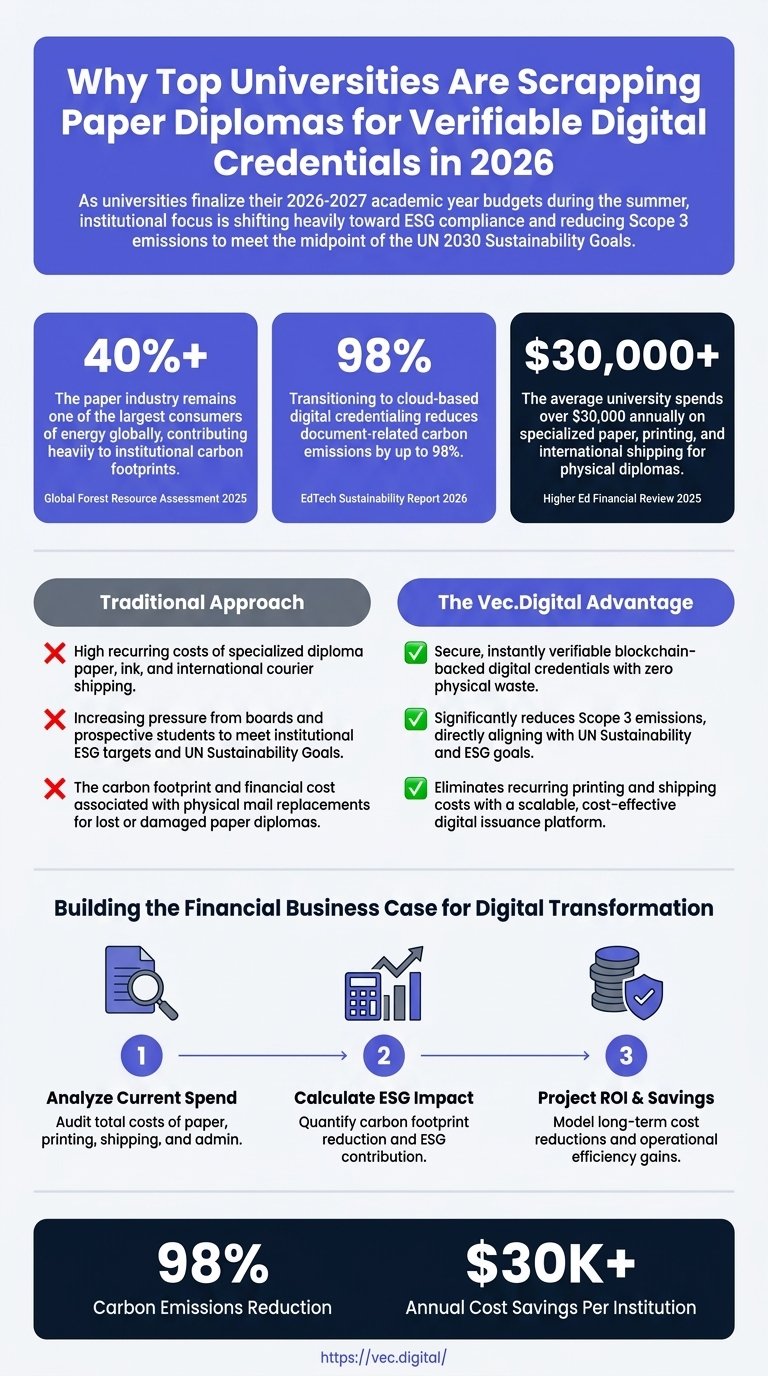
The paper industry remains one of the largest consumers of energy globally, contributing heavily to institutional carbon footprints according to the Global Forest Resource Assessment in 2025. As educational institutions worldwide face mounting pressure to reduce Scope 3 emissions, transitioning to verifiable digital credentials is rapidly becoming an operational mandate rather than a mere technological upgrade. This shift eliminates the massive environmental and financial toll of shipping physical documents while aligning universities with international climate targets.
In this comprehensive guide, you will discover how to build an airtight, ESG-focused business case for digitizing your institution's credentialing processes. Drawing upon Vec.Digital's extensive expertise in global educational Technology, we will explore actionable strategies to drastically cut operational costs, reclaim hundreds of administrative hours, and meet the digital-first expectations of modern students. Ultimately, you will learn how to deploy automated systems that transform regulatory compliance requirements into a competitive, sustainable advantage for your university.
Key Takeaways
- Transitioning to cloud-based systems for sustainable paperless certificates reduces document-related carbon emissions by up to 98%.
- Universities can save over $30,000 annually by eliminating specialized paper, printing, and international shipping logistics.
- Implementing a bulk certificate generator saves an average of 400 administrative hours per graduation cycle.
- Over 65% of Generation Z students now demand digital-first interactions, including instant QR code certificates.
- Modern blockchain certificate verification ensures that digital degrees are tamper-proof, globally accessible, and universally trusted.
The Environmental Imperative for Global Higher Education
For decades, the standard for academic achievement has been a heavily embossed, physically stamped piece of specialized parchment. However, as the global community races toward the midpoint of the UN 2030 Agenda, universities are being forced to reevaluate the environmental cost of their traditions. The transition to verifiable digital credentials is no longer just an IT initiative; it is a core component of institutional sustainability strategies.
Academic registrars and sustainability officers are now collaborating closely to identify areas where administrative processes contribute to the university's overall carbon footprint. By shifting the narrative from purely security-focused benefits to encompassing massive environmental ROI, institutions can secure the necessary budget and board approval for comprehensive digital transformation.
The Hidden Carbon Footprint of Traditional Paper Diplomas
When asking, "How can universities reduce paper waste?" administrators must look beyond daily office printing and examine high-volume, high-impact events like graduation. The production of a single physical diploma involves a complex, carbon-intensive supply chain. It begins with deforestation and the energy-intensive pulping process, moves to specialized printing facilities that utilize metallic foils and chemical inks, and concludes with global logistics networks that transport these documents via air freight and ground couriers to international students.
According to the Global Forest Resource Assessment in 2025, the paper industry remains one of the largest consumers of energy globally, contributing heavily to institutional carbon footprints. For a large university graduating tens of thousands of students annually, the cumulative environmental impact of manufacturing and shipping paper diplomas is staggering. By eliminating this physical supply chain, universities can make immediate, measurable reductions in their Scope 3 emissions.
Aligning with the UN 2030 Agenda and Global Climate Regulations
Higher education institutions operate on a global stage, and international climate regulations are increasingly influencing academic partnerships and funding. The United Nations Sustainable Development Goals (SDGs), specifically Goal 12 (Responsible Consumption and Production) and Goal 13 (Climate Action), demand that large organizations drastically reduce waste generation through prevention, reduction, recycling, and reuse.
Universities are expected to lead by example. Transitioning away from paper-based legacy systems demonstrates a tangible commitment to these global standards. Furthermore, as government grants and private endowments increasingly tie funding to strict ESG (Environmental, Social, and Governance) criteria, a university's ability to prove its sustainability metrics becomes a direct financial asset.
The True Environmental Impact of Digital Certificates
A common question among academic boards is: "What is the environmental impact of digital certificates?" While cloud computing and data storage do require energy, the carbon expenditure is microscopic compared to physical manufacturing and global shipping. Modern data centers are increasingly powered by renewable energy, further minimizing the digital footprint.
The numbers speak for themselves. According to the EdTech Sustainability Report in 2026, transitioning to cloud-based digital credentialing reduces document-related carbon emissions by up to 98%. By adopting sustainable paperless certificates, universities not only eliminate the direct waste of paper and ink but also eradicate the secondary emissions caused by delivery trucks and cargo planes transporting documents around the world.
Building the Financial Business Case for Digital Transformation
While the environmental benefits of verifiable digital credentials are undeniable, the financial return on investment is often the catalyst for immediate action. As universities finalize their budgets for the upcoming academic years, identifying areas to reduce recurring administrative overhead is a top priority for financial directors and deans.
The hidden costs of traditional credentialing extend far beyond the paper itself. The labor, logistics, and error-correction processes associated with physical diplomas drain university resources that could be better allocated to student services or academic research. Digitization offers a clear, rapid path to cost recovery.
Calculating the Cost of Physical Printing and Logistics
When administrators ask, "How much does it cost a university to print diplomas?" the answer often shocks the board of regents. It is not merely the cost of a single sheet of paper. The average university spends over $30,000 annually on specialized paper, printing, and international shipping for physical diplomas, according to the Higher Ed Financial Review in 2025. For massive state university systems or global online universities, this figure can easily exceed six figures.
International shipping is particularly volatile. Courier fees fluctuate based on global fuel prices, and tracking lost packages across international borders requires dedicated staff time. By digitizing this process, the marginal cost of issuing an additional diploma drops to near zero, entirely insulating the university from supply chain disruptions and inflation in the paper and logistics markets.
Eliminating the Overhead of Lost and Damaged Replacements
The financial and carbon costs do not end on graduation day. Alumni frequently lose their physical diplomas in moves, natural disasters, or simply over time. The process of requesting a replacement is notoriously cumbersome, requiring alumni to fill out forms, pay high fees, and wait weeks for a new document to be printed and mailed.
For the university, fulfilling these requests involves a continuous, year-round administrative burden. By issuing credentials digitally, alumni have permanent, instant access to their achievements via a secure digital locker. This entirely eliminates the carbon footprint and financial cost associated with physical mail replacements for lost or damaged paper diplomas, simultaneously vastly improving the alumni experience.
Leveraging a Bulk Certificate Generator to Reclaim Administrative Time
The peak summer graduation months represent an administrative nightmare for registrar offices. The manual process of verifying student data, formatting names correctly, printing thousands of documents, sorting them by degree, and stuffing envelopes creates immense administrative bloat.
Implementing an automated bulk certificate generator radically transforms this timeline. Universities adopting automated digital systems save an average of 400 administrative hours per graduation cycle, according to Digital Transformation in EdTech in 2026. By utilizing simple CSV uploads or API integrations with existing Student Information Systems (SIS), registrars can issue tens of thousands of personalized, secure credentials in a matter of minutes, freeing staff to focus on higher-value student interactions.
Understanding the Shift to Verifiable Digital Credentials
To successfully champion this digital transformation, university leaders must be able to clearly articulate what the technology is and why it represents a fundamental upgrade over the status quo. It is essential to demystify the technology for non-technical stakeholders, proving that digital diplomas are not just PDFs, but highly secure, cryptographically backed assets.
Education is a global currency, and the credentials that represent it must be universally recognized, instantly verifiable, and immune to forgery. This requires a standard of technology that goes far beyond traditional digital documents.
What Are Verifiable Digital Credentials?
A frequent question from faculty and students alike is: "What are verifiable digital credentials?" Unlike a standard PDF or a scanned image of a paper diploma—which can be easily altered using basic photo-editing software—a verifiable digital credential is a cryptographically secure data package. It contains the recipient's information, the issuing institution's details, and proof of the exact time and date of issuance.
These credentials adhere to global data models, such as the W3C Verifiable Credentials standard, ensuring they can be read and authenticated by any compatible system worldwide. When an employer receives one of these credentials, they do not need to call the university registrar to verify its authenticity; the cryptographic signature embedded within the file provides mathematical proof that the document was issued by the claimed university and has not been tampered with since.
Are Paper Certificates Becoming Obsolete in 2026?
With the rapid acceleration of digital transformation, many ask: "Are paper certificates becoming obsolete in 2026?" The short answer is yes. Just as physical airline tickets and paper bank statements have largely vanished in favor of secure digital alternatives, the paper diploma is entering its twilight phase.
While some institutions may still offer ceremonial paper copies for framing, the official, functional record of achievement is moving entirely to the digital realm. Employers increasingly demand instant, automated verification during the hiring process. A physical piece of paper cannot be integrated into modern Applicant Tracking Systems (ATS) or HR software, making it an antiquated tool for modern job seekers.
Are Digital Degrees Legally Binding and Universally Accepted?
Another critical concern for university legal departments is: "Are digital degrees legally binding and universally accepted?" Yes. When issued through a compliant digital certificate maker, these credentials utilize advanced digital signatures that comply with international electronic signature laws, such as eIDAS in the European Union and the ESIGN Act in the United States.
Because these credentials provide a higher level of security and immutability than paper—which is highly susceptible to the multi-million dollar diploma mill industry—governments, multinational corporations, and global academic bodies not only accept them but actively prefer them. They represent the gold standard of authentic academic achievement.
Meeting Gen Z Demands with Modern Technology
Universities are service providers, and their primary demographic—Generation Z—has vastly different expectations than previous generations. This cohort has grown up entirely in the digital age. They manage their finances, social lives, and education through their smartphones. Consequently, forcing them to interact with legacy paper systems causes immense friction and dissatisfaction.
Furthermore, this generation is acutely aware of the climate crisis. They actively evaluate institutions based on their commitment to sustainability. Providing a modern, eco-friendly credentialing experience is a powerful tool for student satisfaction and brand loyalty.
The Digital-First Expectations of Modern Learners
According to the Student Experience Survey in 2026, over 65% of Generation Z students prefer digital-first interactions and highly value their institution's commitment to environmental sustainability. When a student completes a grueling four-year degree, they want to celebrate and share that achievement instantly with their network, not wait six weeks for a cardboard tube to arrive in the mail.
Digital credentials empower students to take immediate ownership of their achievements. With one click, they can add their verified degrees to their LinkedIn profiles, embed them in digital portfolios, and share them across social media platforms. This not only benefits the student but acts as organic, high-value marketing for the university, driving visibility among prospective applicants.
Instant Authentication via QR Code Certificates
One of the most user-friendly innovations in this space is the implementation of QR code certificates. Every digital diploma can be generated with a unique, embedded QR code. When an employer, auditor, or academic peer scans this code with any standard smartphone camera, they are instantly routed to a secure, university-branded public verification page.
This page displays the issuer, recipient, and signatory details in real-time. It provides foolproof, easily shareable proof of authenticity without requiring the verifier to download a specific app or create a registered account. This frictionless verification process drastically reduces the background check timeline for recent graduates entering the competitive job market.
Securing the Future with Blockchain Certificate Verification
To provide the ultimate layer of trust, leading universities are turning to blockchain certificate verification. By anchoring issued certificates to an immutable, decentralized ledger, universities create a permanent, tamper-proof record of the credential. Even if the university's internal servers were to experience an outage, the cryptographic proof of the degree remains universally accessible and verifiable.
This advanced security measure results in a unique "verified badge" displayed on the authentication page, signaling to employers that the credential offers unparalleled security. For high-stakes credentials like academic diplomas, medical degrees, and corporate compliance records, blockchain technology entirely eradicates the risk of credential fraud, protecting the institution's prestigious reputation.
Implementing a Sustainable Paperless Certificates System
Recognizing the need for change is only the first step; executing a seamless transition requires the right technology partner and a strategic approach. Universities must select platforms that are powerful enough to handle massive data volumes securely, yet intuitive enough for administrative staff to use without extensive IT training.
The goal is to implement an automated engine that operates quietly in the background, transforming complex data sets into beautiful, branded, and secure digital assets.
Choosing the Right Digital Certificate Maker
Selecting the appropriate digital certificate maker is crucial. Universities require a comprehensive design editor that allows them to maintain their strict brand guidelines. The platform should offer a drag-and-drop interface, support for custom dynamic fields, and the ability to upload high-resolution university seals and signatures.
Beyond aesthetics, the platform must be robust. It should guarantee high uptime, provide end-to-end encryption, and offer seamless integration capabilities. A unified team management dashboard is also essential, allowing the registrar's office to assign specific roles and permissions, ensuring secure and coordinated operations across different academic departments.
Integrating with Existing University Architectures
A successful digital credentialing platform must not create data silos. It must integrate fluidly with the university's existing infrastructure. Through robust REST APIs, institutions can connect the credentialing engine directly to their Student Information Systems, Learning Management Systems (LMS), and even their HR employee certification platform (as universities must also manage compliance and training for thousands of faculty and staff members).
By establishing these automated connections, the issuance process becomes entirely hands-off. Once a student's final grades are approved in the SIS, the system can automatically trigger the generation and secure delivery of the digital diploma, eliminating manual data entry entirely and ensuring zero errors.
Ensuring Long-Term University ESG Compliance
Finally, the chosen system must provide robust reporting tools to help the university track its sustainability metrics. By quantifying the exact number of paper documents eliminated, the volume of shipping miles avoided, and the subsequent reduction in carbon emissions, sustainability officers can easily compile data for annual ESG reports.
This data is invaluable for maintaining university ESG compliance, securing eco-focused grants, and demonstrating a genuine commitment to the UN 2030 Sustainability Goals to prospective students and global regulatory bodies.
Partner with Vec.Digital to Achieve Your Sustainability Goals
The transition from traditional paper diplomas to verifiable digital credentials represents a profound opportunity for universities to modernize their operations, eradicate credential fraud, and make a massive, measurable impact on global sustainability goals. By eliminating the administrative bloat and environmental devastation of physical printing and shipping, your institution can lead the charge into the future of global education.
At Vec.Digital, we provide the comprehensive, automated technology engine required to make this transition effortless. Our platform combines an intuitive design editor, instant QR code authentication, and immutable blockchain security to deliver universally trusted credentials at scale. With a 99.98% uptime guarantee and seamless API integrations, we empower academic registrars and HR teams to issue thousands of secure certificates in minutes, entirely paper-free.
Secure your organization's credentials today, streamline your administrative processes, and take a definitive step toward your institutional ESG targets.
Contact our team to begin your digital transformation: Website: https://vec.digital/ Email: support@vec.digital WhatsApp: +971521373078