
Why Universities Need a Centralized Bulk Certificate Generator
Published on June 24, 2026

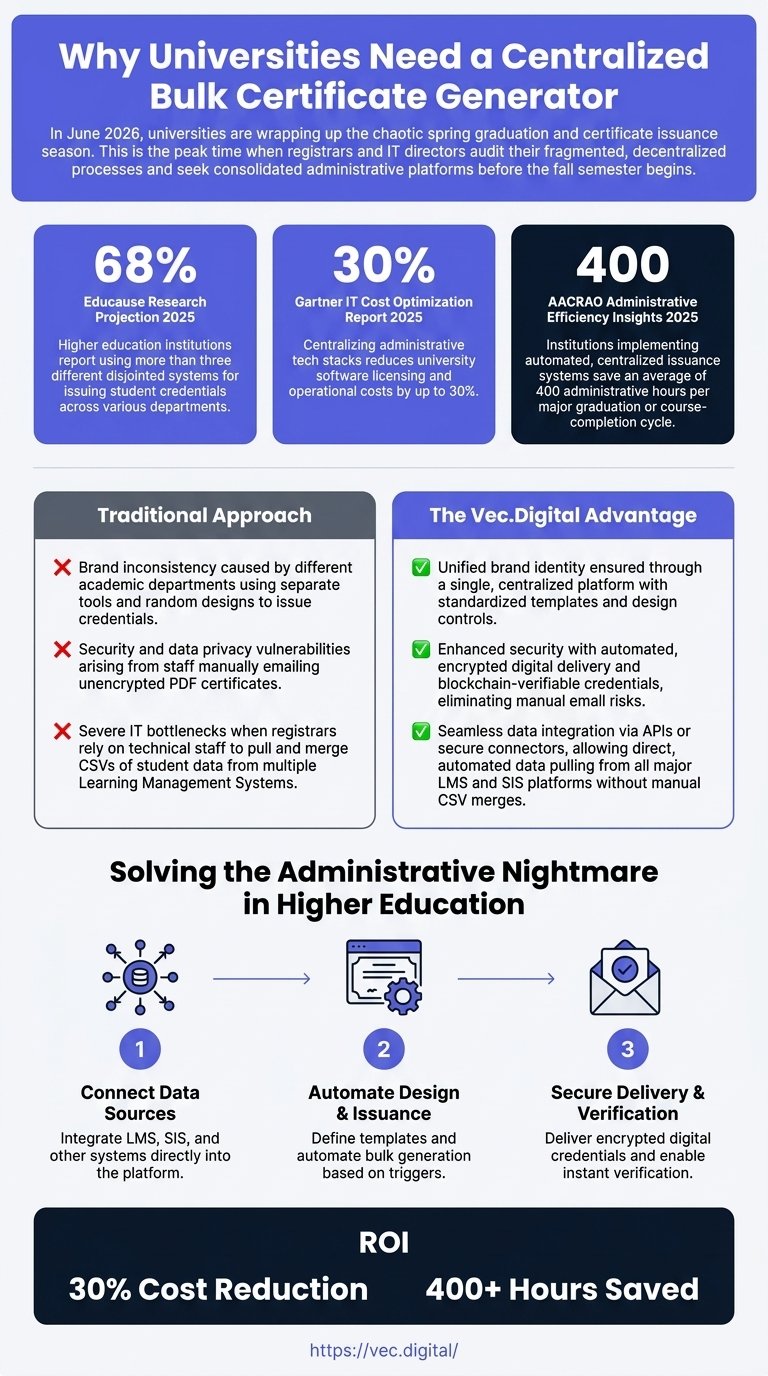
An alarming 68% of higher education institutions report using more than three disjointed systems for issuing student credentials across various departments, according to a 2025 Educause Research Projection. This fragmented approach creates massive internal operational chaos, driving up costs and compromising data security on a global scale. By implementing a centralized bulk certificate generator, academic registrars and IT directors can finally unify their administrative processes under one secure, efficient roof.
In this comprehensive guide, our team at Vec.Digital leverages deep expertise in educational technology to explore how consolidating your credentialing systems transforms institutional efficiency. Readers will discover actionable strategies to eliminate duplicate software costs, ensure strict global data privacy compliance, and automate high-volume credential issuance without overburdening IT staff. Ultimately, transitioning to a unified system guarantees brand consistency while saving hundreds of administrative hours per graduation cycle.
Key Takeaways
- Eliminate fragmented systems to reduce administrative bottlenecks across diverse university departments.
- Ensure brand consistency by controlling all credential designs from a single, unified dashboard.
- Reduce operational costs by up to 30% through the consolidation of overlapping software subscriptions.
- Enhance global data privacy and minimize compliance risks associated with decentralized student data exports.
- Automate high-volume issuance seamlessly using a centralized bulk certificate generator integrated with your LMS.
The Hidden Cost of Decentralized Credentialing
The Problem with Siloed Issuance
When asking the question, "How do universities manage digital certificates across different departments?", the reality is often far less organized than one might expect. In many large-scale global institutions, the Business School might utilize one software platform for its executive education programs, while the Nursing Program relies on an entirely different tool, and the Continuing Education department manually generates documents using basic word processors. This phenomenon, known as siloed issuance, is a silent drain on institutional resources.
While much of the industry dialogue focuses heavily on external fraud prevention and the end-user benefits of digital credentials—such as sharing achievements on professional networks—there is a significant gap in addressing the internal B2B administrative nightmare. Operating multiple uncoordinated systems means that institutional data is inherently fractured. Administrators cannot gain a holistic view of learner achievements, and the institution cannot guarantee the security or uniformity of the credentials bearing its name.
By shifting to a unified bulk certificate generator, universities can collapse these silos. A centralized administrative engine allows every department to operate autonomously within specific, permission-based boundaries while utilizing the same underlying technology infrastructure. This ensures that whether a student is completing a short-term coding bootcamp or a multi-year medical degree, the administrative process remains identical, scalable, and secure.
Wasted Budgets and Overlapping Subscriptions
The financial implications of decentralized credentialing are profound. When academic departments independently procure their own software solutions, it leads to a phenomenon known in the technology sector as "shadow IT." Departments end up paying premium, single-user or small-team licensing fees for overlapping services, entirely bypassing the economies of scale that a university should command.
According to the Gartner IT Cost Optimization Report of 2025, centralizing administrative tech stacks reduces university software licensing and operational costs by up to 30%. This is a staggering figure for institutions operating with multi-million dollar technology budgets. When university leadership audits these fragmented tools, they frequently discover that they are paying for redundant features across three or four different platforms, none of which communicate with one another.
Consolidating these tools into a single, enterprise-grade digital certificate maker eliminates these redundant expenses. Instead of managing dozens of disparate vendor contracts, the institution negotiates a single, highly efficient agreement. This centralized approach not only frees up critical budget for other educational initiatives but also drastically reduces the vendor management burden placed on the university's procurement and legal teams.
Solving the Administrative Nightmare in Higher Education
Overcoming IT Bottlenecks and Manual Data Entry
One of the most severe pain points during peak graduation seasons is the immense pressure placed on university IT departments. Registrars and academic administrators often lack the technical tools to issue credentials independently at scale. As a result, they are forced to rely on technical staff to pull, clean, and merge complex CSV files of student data from various distinct Learning Management Systems (LMS) and Student Information Systems (SIS).
This reliance creates a severe operational bottleneck. IT departments, already stretched thin managing campus cybersecurity and network infrastructure, are suddenly tasked with administrative data entry and formatting. If a single column in a spreadsheet is misaligned, hundreds of certificates could be generated with errors, requiring the entire process to be halted, corrected, and restarted. This manual, error-prone cycle delays the delivery of crucial documents to eager graduates entering the global workforce.
A robust automated certificate system fundamentally shifts this dynamic. By providing intuitive, no-code interfaces and dynamic data mapping, these systems empower administrative staff to handle high-volume issuance independently. Registrars can seamlessly upload data or trigger generation directly from their existing dashboards, completely removing the IT department from the routine administrative sequence.
The Power of Automated Certificate Systems
So, "How can universities automate certificate issuance?" The answer lies in deploying technology that bridges the gap between student data repositories and the final credential output. Modern automation engines allow institutions to set up rules-based triggers. For example, the moment a student's final grade is marked as "Pass" within the university's LMS, the system can instantly generate and distribute the corresponding credential without a single human click.
The efficiency gains from this level of automation are transformative. The AACRAO Administrative Efficiency Insights from 2025 revealed that institutions implementing automated, centralized issuance systems save an average of 400 administrative hours per major graduation or course-completion cycle. That represents weeks of manual labor returned to the institution, allowing staff to focus on higher-value student advising and strategic planning rather than pushing digital paper.
Furthermore, an automated bulk certificate generator operates with flawless precision. By mapping dynamic fields—such as Student Name, Course Title, and Issue Date—directly to the source data, the risk of human typographical errors is entirely eradicated. This ensures that every credential issued is perfectly accurate, further protecting the institution's reputation for excellence.
How to Ensure Brand Consistency in Digital Credentials
The Impact of Inconsistent Designs on Employer Trust
A university's brand is one of its most valuable global assets. It represents centuries of academic rigor, prestige, and trust. However, brand inconsistency caused by different academic departments using separate tools and random designs to issue credentials severely dilutes this value. When a global employer receives three different certificates from the same university—each featuring different fonts, varying logo placements, and completely different verification methods—it immediately raises red flags regarding authenticity.
This is not merely an aesthetic issue; it is a critical barrier to student employability. According to the SHRM Skills-Based Hiring Report of 2026, 82% of employers state that inconsistent credential designs and formats from the same institution make it harder to verify candidate skills quickly. In a fast-paced global hiring market, any friction in the verification process can result in a candidate being passed over for a role.
Employers rely on visual consistency as a primary indicator of legitimacy. If the engineering department issues a highly secure, dynamically generated digital badge, but the arts faculty issues a flat, poorly formatted PDF, the institution appears disorganized. Unifying the visual output is essential for maintaining the global authority and prestige of the university's name.
Centralizing Design with a Digital Certificate Maker
To answer the question, "How do you ensure brand consistency in digital credentials?", institutions must centralize their design assets. A professional-grade digital certificate maker provides a unified environment where the university's core marketing or communications team can establish locked, master templates. These templates strictly adhere to the institution's brand guidelines, ensuring the correct use of official seals, typography, and color palettes.
Once these master templates are established, individual departments can be granted restricted access. The Nursing department, for example, can input their specific student data and course names, but they cannot alter the fundamental design, change the university logo, or modify the placement of the official cryptographic signatures. This controlled autonomy empowers departments to act quickly while safeguarding the overarching brand.
Moreover, centralized design platforms ensure that every credential issued carries the exact same high-level security features, such as standardized QR codes for instant authentication. This uniform approach trains global employers on exactly what to look for when verifying a document from your institution, streamlining the hiring process for your alumni.
Global Compliance and Data Privacy in Credential Issuance
Mitigating Security Risks of Unencrypted PDFs
One of the most alarming pain points in decentralized university administration is the security and data privacy vulnerabilities arising from staff manually emailing unencrypted PDF certificates. When departments use basic, unvetted software to generate awards, the resulting documents are often static files with no inherent security. Emailing these documents exposes sensitive student data—such as full names, academic performance, and identification numbers—to interception, spoofing, and unauthorized access.
Furthermore, static PDFs are notoriously easy to forge. In an era where sophisticated digital editing tools are universally accessible, bad actors can easily alter a name or a grade on an unencrypted document. When a university relies on these outdated methods, they inadvertently contribute to the global credential fraud epidemic, which costs institutions millions in reputational damage and legal liabilities.
Transitioning to a centralized verifiable digital credentials system completely eliminates this vulnerability. Instead of sending an easily alterable file, the system generates a secure, cryptographic record. The recipient is granted access to a unique, hosted verification page that cannot be altered by the student or intercepted by a third party. This guarantees the absolute integrity of the document from the moment of issuance to the moment of employer verification.
Meeting Global Standards with Verifiable Digital Credentials
The global regulatory landscape governing student data is becoming increasingly stringent. Strict data privacy regulations, such as GDPR in Europe and equivalent frameworks emerging globally in 2026, demand that institutions practice strict data minimization. Allowing multiple, uncoordinated university departments to export raw student data into fragmented, unvetted third-party certificate apps creates massive compliance risks.
Every time a CSV file of student data is downloaded to a local desktop and uploaded to an unapproved "freemium" certificate generator, the university breaches core data governance protocols. A centralized university administration software platform solves this by keeping all data within a single, highly secure, deeply audited environment. Data never leaves the institution's approved technology ecosystem.
Centralized platforms are built from the ground up to comply with global privacy standards, featuring end-to-end encryption, automated data retention policies, and comprehensive audit logs. By mandating that all departments use a single, vetted system, the university's Chief Information Security Officer (CISO) can confidently attest to the institution's compliance, shielding the university from devastating regulatory fines.
Integrating University Tech Stacks for Seamless Operations
What Software Do Registrars Use for Digital Diplomas?
When investigating "What software do registrars use for digital diplomas?", the trend is rapidly moving away from legacy printing software and toward modern, cloud-based credentialing platforms. Historically, registrars relied on on-premise solutions that required heavy maintenance and offered no digital verification capabilities. Today, the demand is for agile SaaS platforms that offer high availability, seamless updates, and robust API capabilities.
According to the HolonIQ Higher Ed Digital Transformation Trends report of 2026, over 50% of top-tier universities and enterprise EdTech platforms plan to unify their digital credentialing under a single administrative dashboard by 2027. This massive shift underscores the realization that credentialing is no longer just a printing task; it is a critical data management and student success initiative.
The most effective platforms utilized by modern registrars combine design capabilities with advanced cryptographic security. They provide comprehensive dashboards where administrators can track issuance metrics, revoke credentials if necessary, and monitor how frequently employers are verifying the institution's documents globally. This level of insight transforms the registrar's office from a purely administrative function into a strategic asset for the university.
How to Integrate an LMS With a Digital Certificate Maker
To fully realize the benefits of automation, institutions must understand "How to integrate an LMS with a digital certificate maker." The most powerful bulk certificate generator platforms are designed with open architecture, offering robust REST APIs that allow them to communicate seamlessly with global LMS giants like Canvas, Blackboard, or Moodle.
Integration typically involves establishing secure webhooks between the two systems. When a specific event occurs within the LMS—such as a student completing a final module or a faculty member submitting final grades—the LMS sends a secure data packet to the credentialing platform. The platform's automated engine then processes this data, applies it to the correct departmental template, generates the verifiable credential, and automatically emails the secure link to the student.
This seamless integration creates a zero-touch administrative environment. It ensures that data remains perfectly synchronized across the university's tech stack, eliminating the need for manual data reconciliation and ensuring that students receive their hard-earned credentials the instant they qualify for them.
Choosing the Best Bulk Certificate Generator for Large Organizations
When determining "What is the best bulk certificate generator for large organizations?", IT directors must evaluate platforms based on scalability, security, and ease of use. A solution designed for a small online course will fail under the weight of a major university's graduation cycle. Enterprise-grade platforms must guarantee exceptionally high uptime—such as a 99.98% SLA—to ensure that verification portals are always accessible to global employers.
Furthermore, the best systems offer granular role-based access control (RBAC). This allows the central IT or registrar's office to act as the super-administrator, granting specific, limited permissions to the heads of various academic faculties. This hierarchical approach maintains central oversight while distributing the actual workload, representing the pinnacle of administrative efficiency.
Finally, the platform must support advanced verification methods, such as blockchain technology and dynamic QR codes. These features ensure that the credentials issued today will remain secure, verifiable, and technologically relevant for the entire duration of the graduate's career.
Secure Your University's Future With Vec.Digital
The era of fragmented, decentralized credential issuance is rapidly coming to an end. As universities and global EdTech platforms face mounting pressure to reduce costs, improve data security, and elevate their brand presence, centralizing administrative operations is no longer optional—it is a strategic imperative. By adopting a unified bulk certificate generator, institutions can eliminate the chaos of shadow IT, relieve the burden on their technical staff, and provide a flawless, secure experience for their graduates.
At Vec.Digital, we provide the ultimate technology infrastructure for large-scale credential management. Our platform seamlessly combines an intuitive digital certificate maker with enterprise-grade automation, robust API integrations, and immutable verification technology. We empower your university to issue thousands of secure, brand-consistent credentials with absolute confidence, all from a single, unified dashboard.
Stop letting decentralized processes dilute your institution's prestige and drain your budget. Transition to a smarter, centralized system today and ensure your credentials are as globally respected as your academic programs.
Ready to transform your university's credentialing process? Visit our website to learn more: https://vec.digital/ Contact our technology experts: support@vec.digital