
Winning Corporate Contracts With Verifiable Digital Credentials
Published on June 11, 2026

The global executive education and corporate upskilling market surpassed $45 billion in 2025, signaling a massive shift in how universities generate sustainable B2B revenue. To capture this unprecedented growth, academic institutions must upgrade from legacy paper processes to verifiable digital credentials that enterprise clients now strictly demand. The days of mailing physical documents are rapidly ending as human resources departments globally require instant, cryptographically secure proof of learning to justify their training budgets.
In this comprehensive guide, our team at Vec.Digital leverages our extensive expertise in educational technology to reveal how modern institutions are securing lucrative corporate partnerships. You will learn how to deploy a robust automated system to issue credentials at scale, integrate seamlessly with enterprise compliance trackers, and drastically reduce administrative overhead. By adopting these modern digital systems, your organization can transform credentialing from a costly administrative burden into a powerful driver of alumni referrals and enterprise contract renewals.
Key Takeaways
- Verifiable digital credentials are now a strict baseline requirement for securing enterprise-level executive education contracts.
- A professional digital certificate maker ensures brand consistency across multiple academic departments and corporate cohorts.
- Implementing a bulk certificate generator eliminates the hidden costs and human errors associated with manual data entry.
- QR code certificates provide instant, app-free authentication, directly solving HR compliance tracking challenges.
- Connecting academic records to an HR employee certification platform via API drastically improves B2B client retention.
The Shift in Executive Education Credentials
The $45 Billion Upskilling Market
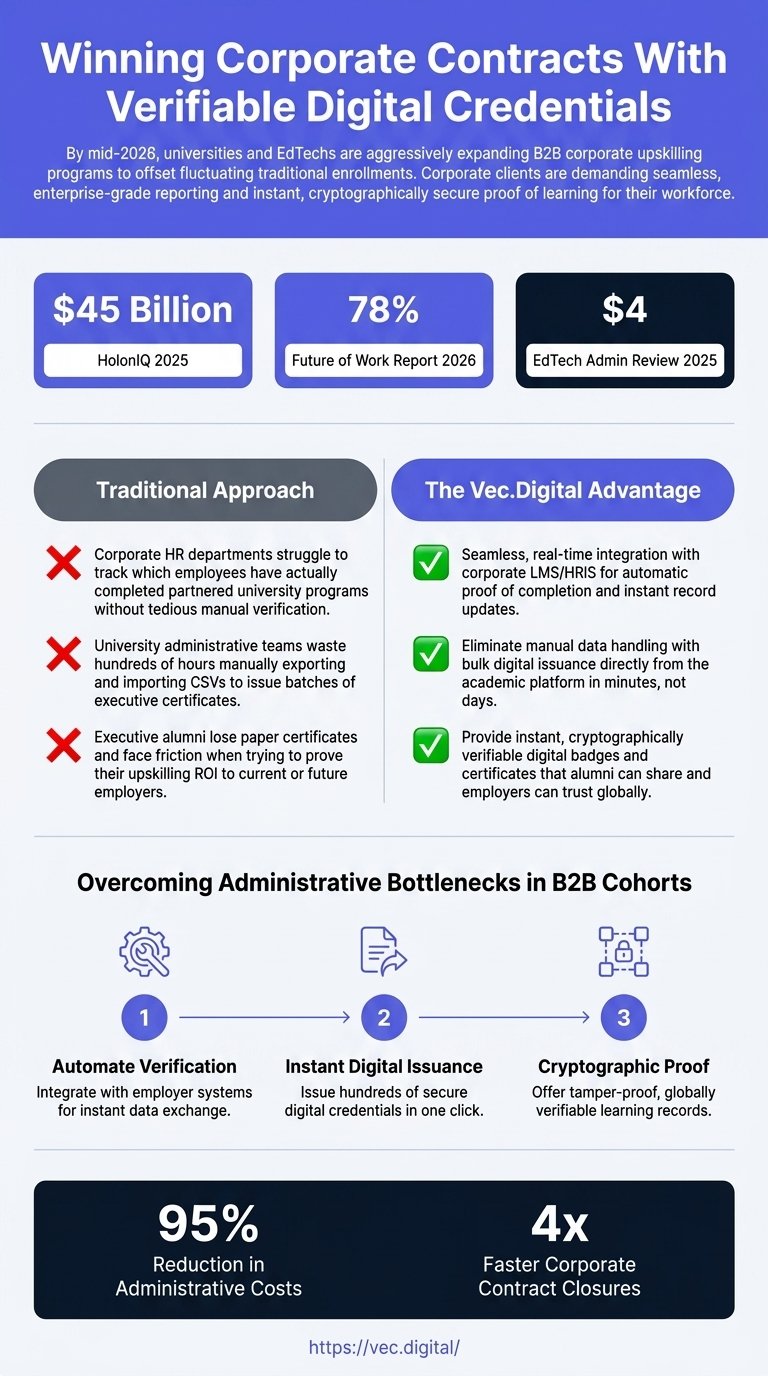
By mid-2026, universities and EdTech platforms are aggressively expanding their B2B corporate upskilling programs to offset fluctuating traditional undergraduate enrollments. According to HolonIQ (2025), the global executive education and corporate upskilling market surpassed $45 billion. This massive influx of capital is fundamentally changing the relationship between higher education and the corporate sector. Universities are no longer just teaching students; they are acting as critical learning and development (L&D) partners for multinational enterprises.However, tapping into this lucrative market requires more than just world-class curriculum. Globally, lifelong learning and corporate upskilling have become critical as artificial intelligence displaces traditional roles. In regions like the European Union and the UAE, strict government mandates for continuous professional development (CPD) mean that corporate training providers and universities must issue verifiable digital credentials that meet immediate, rigorous verification standards. Legacy paper diplomas simply cannot move at the speed of modern global business.
Why Corporate Partners Demand API Integrations
When an enterprise sponsors a cohort of 500 executives for a leadership program, their primary concern post-completion is data integration. Corporate clients are demanding seamless, enterprise-grade reporting and instant, cryptographically secure proof of learning for their workforce. In fact, according to the Global Learning Council (2026), 62% of enterprise clients prefer academic partners that provide API integrations directly to their internal Learning Management Systems (LMS) or HR compliance systems.This preference is driving a wedge between institutions that have modernized their digital infrastructure and those that have not. When an academic institution can automatically push a verified completion record directly into an enterprise's centralized database, they eliminate hours of manual data entry for the client. This level of technological sophistication is rapidly becoming a primary deciding factor in the RFP (Request for Proposal) process for multi-million dollar corporate training contracts.
Overcoming Administrative Bottlenecks in B2B Cohorts
The Hidden Costs of Manual Processing
One of the most significant barriers to scaling executive education is the sheer administrative friction of credential issuance. University administrative teams waste hundreds of hours manually exporting and importing CSVs to issue batches of executive certificates. This manual process is not only soul-crushing for staff but also highly prone to data entry errors, resulting in misspelled names, incorrect dates, and frustrated corporate clients.The financial impact of these inefficiencies is staggering. According to the EdTech Admin Review (2025), manual certificate processing costs academic institutions an average of $4 per credential in administrative overhead. When an institution is processing tens of thousands of upskilling certificates annually, this represents a massive drain on resources. Transitioning to a modern digital certificate maker is no longer just about aesthetics; it is a critical cost-saving measure that protects the profit margins of B2B programs.
How Do You Automate Bulk Certificate Issuance for B2B Cohorts?
Many academic deans and program directors frequently ask: how do you automate bulk certificate issuance for B2B cohorts without sacrificing quality or security? The answer lies in deploying a centralized **bulk certificate generator** designed specifically for high-volume operations. Instead of treating each certificate as a bespoke design project, modern systems allow institutions to create dynamic, variable-driven templates.Through an automated system, administrators can connect their student information systems directly to the credentialing platform. Once a corporate cohort completes their final module, the system automatically pulls the verified data—names, course titles, completion dates, and custom corporate branding—and generates thousands of secure certificates in seconds. This eliminates the tedious manual export/import cycle, ensuring that executives receive their awards instantly upon program completion.
Maintaining Brand Consistency Across Departments
A common pain point in large universities is that institutions struggle to maintain brand consistency when multiple departments independently issue bespoke awards for different corporate cohorts. The Business School might use one design, while the School of Engineering uses another, diluting the university's overall brand equity in the corporate market.Implementing a unified team management dashboard solves this issue entirely. By centralizing the credentialing process, university leadership can lock down brand assets, typography, and official signatory blocks. Individual department heads are granted role-based access to issue credentials using only pre-approved templates. This ensures that every certificate sent to a corporate partner looks professional, authoritative, and unmistakably tied to the university's master brand.
Bridging the Gap Between Academia and Corporate HR
Tracking Compliance Without the Friction
From the perspective of the enterprise client, the most frustrating aspect of sponsored education is the aftermath. Corporate HR departments struggle to track which employees have actually completed partnered university programs without tedious manual verification. When an employee claims to have finished a six-month executive data science bootcamp, HR typically has to email the university registrar and wait days for a manual confirmation.This friction threatens the perceived value of the partnership. According to the Future of Work Report (2026), 78% of corporate human resources leaders require verifiable proof of learning from their academic partners to justify L&D budgets. If the university cannot provide this proof instantly and securely, the enterprise will simply find a different training provider who can.
How to Integrate Verifiable Digital Credentials With Corporate HR Systems?
To secure long-term renewals, academic institutions must understand how to integrate verifiable digital credentials with corporate HR systems. The most effective method is utilizing an **HR employee certification platform** architecture that supports REST API webhooks. When a university issues a credential, the system can automatically trigger a webhook that pings the corporate client's internal HR software.This automated data exchange updates the employee's internal file instantly, marking them as compliant or upskilled without a single human touchpoint. For highly regulated industries like finance, healthcare, and aviation, this automated compliance tracking is invaluable. It transforms the university from a mere vendor into a deeply integrated, indispensable operational partner.
How Do Universities Issue Certificates for Corporate Training?
Historically, universities issued certificates for corporate training by printing them on heavy cardstock and shipping them in bulk to the corporate headquarters, leaving the HR team to distribute them manually. Today, forward-thinking universities issue these awards through secure digital lockers.Upon completion, the system automatically emails the executive a secure link to their dedicated, public-facing verification page. This page contains all the metadata regarding the course, the issuing institution, and the recipient. It provides a seamless, modern user experience that reflects the premium nature of executive education, while completely eliminating postal logistics and physical distribution costs.
Empowering Alumni and Driving Referral Growth
The ROI of Digital Credentials in Executive Education
When evaluating new technology, academic leadership often asks: what is the ROI of digital credentials in executive education? Beyond the immediate administrative savings, the true return on investment lies in organic marketing and lead generation. Every issued credential acts as a digital billboard for the university's programs.When an executive completes a prestigious program, their immediate impulse is to share that success with their professional network. Traditional paper certificates sit on office walls, seen by only a handful of colleagues. Digital credentials, however, are designed for the modern digital ecosystem, turning every successful graduate into a highly visible brand ambassador for your institution.
Eliminating the Friction of Paper Certificates
A major ongoing pain point for professionals is that executive alumni lose paper certificates and face friction when trying to prove their upskilling ROI to current or future employers. A lost paper diploma requires a cumbersome, often costly re-issuance process that leaves a negative final impression on the alumni.Digital credentials solve this permanently. Stored securely in the cloud with 99.98% guaranteed uptime, these records are accessible to the alumni from anywhere in the world, at any time. They never degrade, they cannot be lost in a move, and they provide permanent, irrefutable proof of the individual's hard work and newly acquired competencies.
Maximizing Visibility on Professional Networks
The marketing power of seamless social sharing cannot be overstated. Programs offering one-click LinkedIn digital credential sharing see a 35% increase in alumni-driven referral enrollments, according to LinkedIn Higher Ed Trends (2025). When an executive shares their verified badge to their LinkedIn feed, it is broadcast to hundreds or thousands of their peers—individuals who share similar demographics, income levels, and professional aspirations.This organic visibility drives high-intent traffic directly back to the university's executive education landing pages. By making it effortless for alumni to celebrate their achievements online, universities effectively crowdsource their marketing efforts, lowering their customer acquisition costs (CAC) for future corporate cohorts.
Implementing Secure and Instant Verification
Can Employers Verify University Executive Certificates Instantly?
A critical question for both alumni and their employers is: can employers verify university executive certificates instantly? With legacy systems, the answer was a resounding no. However, modern digital infrastructure has revolutionized document authentication.By utilizing QR code certificates, the verification process is reduced to seconds. Every credential generated features a unique, scannable QR code embedded directly into the design. Any employer, auditor, or HR manager can simply scan the code with their standard smartphone camera. They are instantly routed to a dedicated, secure verification page hosted by the university, confirming the document's authenticity without requiring any specialized apps, registered accounts, or phone calls to the registrar.
The Role of QR Code Certificates and Blockchain
To make credential fraud mathematically impossible, industry leaders are turning to **blockchain certificate verification**. When a digital diploma is issued, its unique cryptographic hash is anchored to an immutable public blockchain. This creates a permanent, tamper-proof record of the achievement.If a bad actor attempts to alter the name, date, or grade on a downloaded PDF of the certificate, the QR code scan will immediately flag the document as invalid because the altered file will no longer match the secure blockchain record. This level of advanced cryptographic security provides absolute certainty to enterprise clients that the skills they are paying for have been legitimately earned, completely protecting the university's academic integrity.
What Are the Best Digital Credential Platforms for Executive Education?
When searching for the best digital credential platforms for executive education, institutions must look beyond basic design tools. The ideal platform must offer a comprehensive suite of enterprise-grade features tailored to high-volume B2B operations.Key requirements include a robust REST API for LMS/HR integration, a high-capacity bulk generation engine capable of processing thousands of records via CSV, role-based unified team management to ensure brand compliance, and patented blockchain anchoring for immutable security. A platform that combines these technical capabilities with an intuitive, drag-and-drop design interface ensures that universities can scale their corporate partnerships without exponentially increasing their IT overhead.
Secure Your Executive Education Growth Today
The landscape of corporate upskilling is evolving rapidly, and academic institutions that fail to modernize their credentialing systems risk losing lucrative B2B contracts to more technologically agile competitors. Enterprise HR departments demand efficiency, instant verification, and seamless data integration. By transitioning to verifiable digital credentials backed by blockchain security and automated issuance engines, your university can position itself as an indispensable, forward-thinking partner to the world's leading corporations.
At Vec.Digital, we provide the comprehensive infrastructure required to effortlessly create, manage, publish, and authenticate credentials at scale. Our platform is built to support the rigorous demands of higher education and enterprise compliance, ensuring your institution can issue with confidence and your alumni can share with pride.
Ready to automate your executive education credentialing and win more corporate contracts? Connect with our team today to explore how our enterprise solutions can transform your operations.
Website: https://vec.digital/ Email: support@vec.digital