
Winning the Audit: A Guide to Compliance Training Certificate Automation
Published on July 13, 2026

Inadequate compliance record-keeping contributed to over $30 billion in global corporate fines over the last two years, according to the Financial Times (2024). For modern global enterprises, implementing compliance training certificate automation is no longer an optional technological upgrade, but a critical shield against catastrophic regulatory penalties. Relying on scattered PDF files and decentralized records creates massive vulnerabilities during surprise regulatory checks, leaving organizations exposed to severe financial and reputational damage.
This comprehensive guide will equip your business with the technical and strategic knowledge needed to transition from manual data entry to a fully automated, API-driven credentialing engine. Drawing on our deep expertise in enterprise technology at VEC Digital, we will outline how to eliminate human error, streamline your internal systems, and implement strict multi-signatory approvals. By adopting these advanced digital strategies, your HR and learning departments will ensure perfect audit readiness while saving hundreds of administrative hours.
Key Takeaways
- Compliance training certificate automation eliminates the panic of surprise audits by centralizing securely encrypted employee records.
- Using a bulk certificate generator saves hundreds of administrative hours when processing massive corporate cohorts via simple CSV uploads.
- Implementing multi level signature approvals prevents rogue issuance and ensures strict administrative governance over highly regulated safety documents.
- Seamless LMS integrations via robust developer APIs trigger instant credential delivery, significantly boosting mandatory course completion rates.
- Adopting verifiable digital credentials provides third-party external auditors with the ability to instantly and independently verify employee training statuses globally.
Understanding Compliance Training Certificate Automation
What is Compliance Training Certificate Automation?
When organizations ask, "What is **compliance training certificate automation**?", they are often looking for a way to escape the endless cycle of manual document creation. In enterprise terms, this automation refers to a centralized, programmatic system that automatically generates, securely stores, and distributes official training records the moment an employee meets specific regulatory requirements. It removes the human element from the data entry process, ensuring that every document is generated with absolute precision and stored in an instantly accessible digital format.This automated system is far more advanced than simply generating a digital image. It involves mapping complex data fields from your Human Resources Information System (HRIS) directly into a secure template. Once the data is mapped, the system can anchor the credential to an immutable ledger, generating a unique cryptographic hash. This ensures that the resulting document is not just a picture, but a highly secure, tamper-proof asset that holds up under the strictest legal scrutiny.
By shifting to an automated model, companies can seamlessly automate employee training certificates across borders and time zones. Whether an employee finishes a cybersecurity module in London or a heavy machinery safety course in Tokyo, the underlying system operates flawlessly 24/7, ensuring that the global workforce remains fully compliant without requiring constant administrative oversight.
The True Cost of Manual Record-Keeping
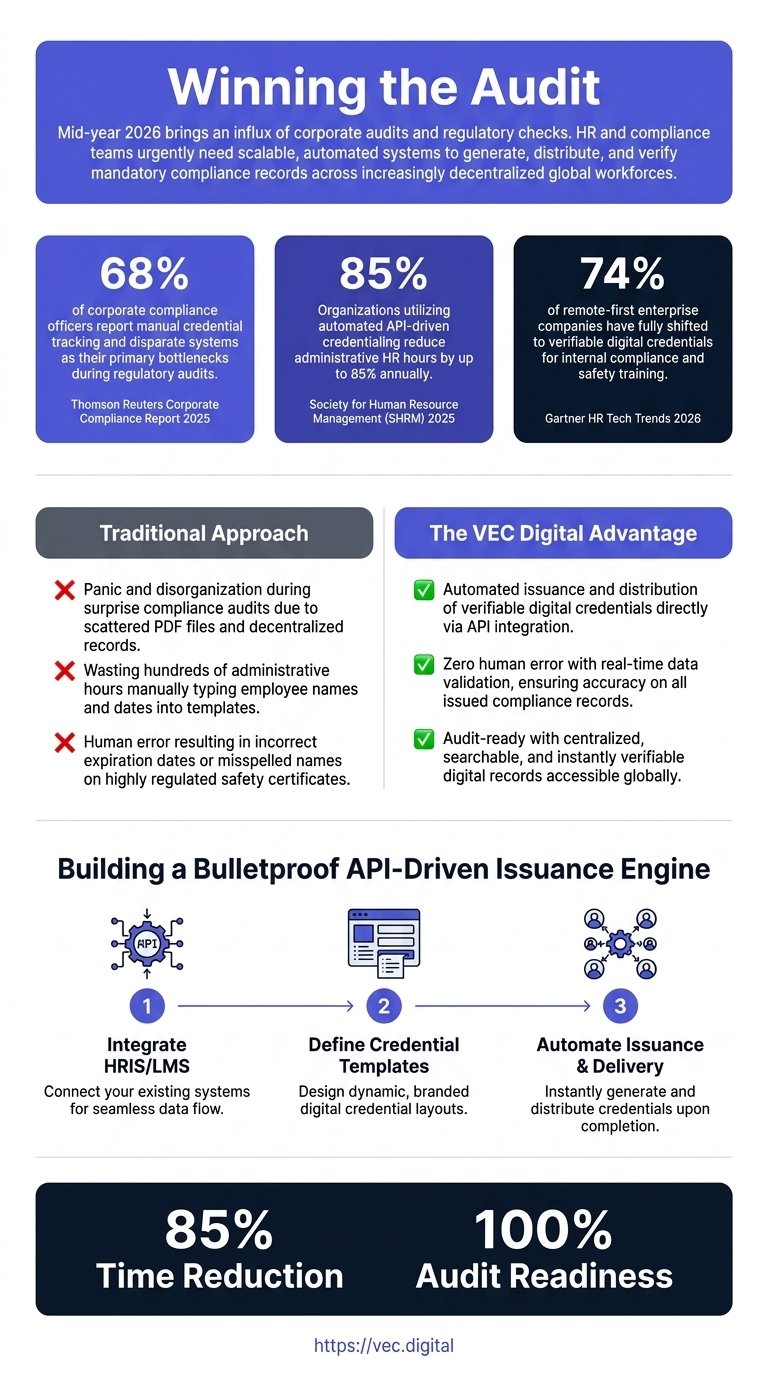
The financial and operational drain of manual credential management is staggering. HR departments and Learning & Development (L&D) teams often find themselves wasting hundreds of administrative hours manually typing employee names, completion dates, and course IDs into static templates. This repetitive task not only demoralizes staff but also diverts highly paid professionals away from strategic organizational initiatives.Research confirms the massive efficiency gains achievable through modernization. According to the Society for Human Resource Management (SHRM, 2025), organizations utilizing automated API-driven credentialing reduce administrative HR hours by up to 85% annually. This dramatic reduction in administrative overhead allows HR teams to refocus their budgets and energy on actual talent development rather than tedious data entry.
Furthermore, the cost of manual processing extends beyond just hourly wages. Delaying the issuance of mandatory compliance certificates can prevent employees from legally performing their duties. If a logistics driver or a factory operator cannot prove they have completed their annual safety refresher because their certificate is stuck in an HR backlog, the company faces immediate operational downtime.
Overcoming Panic During Surprise Audits
Panic and disorganization during surprise compliance audits are common symptoms of decentralized records. When an external auditor demands immediate proof of compliance, scrambling to locate scattered PDF files across various local hard drives, email threads, and disjointed legacy systems is a recipe for disaster. This chaotic environment almost guarantees that some records will be missing, expired, or improperly formatted.The data highlights the severity of this issue. A staggering 68% of corporate compliance officers report manual credential tracking and disparate systems as their primary bottlenecks during regulatory audits (Thomson Reuters Corporate Compliance Report, 2025). When auditors encounter disorganized systems, they naturally scrutinize the organization more aggressively, increasing the likelihood of uncovering actionable compliance violations.
By implementing a unified, automated credentialing engine, organizations transform their audit posture from reactive to proactive. Instead of digging through filing cabinets, compliance officers can instantly present a dashboard of verifiable digital credentials. Every certificate is logically organized, instantly searchable, and cryptographically secured, ensuring that audits proceed smoothly and conclude rapidly.
Building a Bulletproof API-Driven Issuance Engine
How Do You Automate Certificate Generation in an LMS?
A common question among corporate L&D leaders is: "How do you automate certificate generation in an LMS?" The answer lies in leveraging robust developer APIs that allow your Learning Management System (such as Canvas, Moodle, or a proprietary corporate platform) to communicate directly with a dedicated credentialing engine. When an employee achieves a passing score on a mandatory module, the LMS automatically sends a secure web request containing the learner's data.This seamless machine-to-machine communication happens in milliseconds. The credentialing system receives the data payload, applies it to the pre-approved corporate template, generates a secure QR code, and instantly dispatches the finalized certificate to the employee's inbox. There is zero human intervention required, ensuring that the recognition is immediate and accurate.
The psychological impact of this instant recognition is profound. According to the Brandon Hall Group (2025), connecting a bulk certificate generator directly to an LMS increases mandatory course completion rates by 22% due to instant digital recognition. Employees are highly motivated by immediate, shareable proof of their achievements, which drives higher engagement across all corporate training initiatives.
How to Connect a Bulk Certificate Generator API to Enterprise HR Software
Understanding how to connect a bulk certificate generator API to enterprise HR software is essential for IT and operations directors. The process begins with establishing secure authentication, typically using OAuth 2.0, to ensure that only authorized systems can trigger certificate generation. Once authenticated, developers map the specific data fields—such as employee ID, department, and course expiration date—from the HRIS to the API endpoints.This integration enables zero-touch automation. For example, if an employee's CPR certification is set to expire, the HR software can automatically enroll them in a refresher course. Upon completion, the API automatically updates the employee's internal file and issues a new, secure digital certificate. To learn more about modern HR software capabilities, you can explore insights on Human Resource Management Systems.
For developers, utilizing a platform that offers comprehensive REST API documentation, webhook events, and real-time status callbacks is crucial. This technical foundation allows businesses to build highly customized, scalable solutions that perfectly align with their unique organizational architecture, ensuring that the credentialing system grows alongside the enterprise.
Can I Generate Certificates in Bulk from a CSV File?
Even in highly automated environments, there are scenarios where API integrations are not the immediate solution, prompting the question: "Can I generate certificates in bulk from a CSV file?" The answer is a definitive yes. For massive post-event wrap-ups, legacy data migrations, or offline training cohorts, utilizing a CSV upload feature is an indispensable operational tool.The process is incredibly straightforward. An administrator downloads a standardized template, populates it with hundreds or thousands of recipient details, and uploads the file to the platform. The system's CSV bulk-parser instantly reads the data, maps it to the dynamic placeholders on the certificate design, and begins generating personalized documents at scale.
This method is particularly valuable for event organizers and competition coordinators who need rapid administrative turnaround. The best bulk certificate generator with API capabilities will always include a robust CSV fallback option, ensuring that no matter how the data is collected, the organization can issue thousands of secure certificates in a matter of minutes.
Enforcing Governance with Multi-Level Signature Approvals
The Critical Role of Multi-Signatory Governance
While automation provides incredible speed, speed without control is dangerous in the realm of corporate compliance. This is where **multi level signature approvals** become vital. A formal internal security pipeline ensures that certificates are held in a secure draft status until designated organizational authorities securely log in to review and electronically sign them.This governance model prevents accidental or rogue issuance. In large enterprises, the person administering the training is rarely the same person authorized to certify compliance. By instituting a mandatory review process, organizations guarantee that every issued credential has been independently verified by the appropriate compliance officers or department heads.
Furthermore, this digital approval system completely replaces the archaic, time-consuming process of chasing down executives for physical signatures. Stakeholders receive automated notifications, log into a secure dashboard, review the pending cohort, and apply their cryptographic signatures with a single click, maintaining velocity while enforcing strict accountability.
Eliminating Human Error on Regulated Documents
Human error resulting in incorrect expiration dates or misspelled names on highly regulated safety certificates can lead to severe legal liabilities. If an employee is audited on a construction site and their safety credential contains a typo in their identification number, the inspector may deem the certificate invalid, resulting in immediate stop-work orders and hefty fines.By combining API data extraction with multi-signatory review, companies drastically reduce the margin for error. The data is pulled directly from the verified HR database, ensuring perfect spelling and accurate dates. The subsequent review by a compliance officer acts as a final fail-safe before the document is permanently anchored to the blockchain.
This rigorous approach is essential for preventing academic and corporate fraud. Whether you are looking to prevent degree fraud at a university or secure OSHA compliance records on a job site, eliminating human error through structured digital governance is the most effective strategy for protecting institutional integrity.
Ensuring Accountability Across Global Teams
For multinational corporations, ensuring consistent compliance standards across disparate global teams is a massive logistical challenge. A regional office in one country might have different internal protocols than the corporate headquarters. Implementing a unified, multi-signatory approval system standardizes this process globally.Every action within the credentialing system is logged meticulously. If an auditor asks who authorized a specific safety certificate, the system can instantly produce an immutable audit trail showing exactly which executive signed off, at what time, and from which IP address. This level of transparency is invaluable during high-stakes regulatory investigations.
This global standardization also supports regional specificities. For instance, companies operating in the Middle East seeking academic degree fraud prevention Middle East solutions can utilize the same underlying technology to comply with local regulatory frameworks, ensuring that their global operations remain perfectly synchronized.
Modernizing the Audit Process with Verifiable Digital Credentials
How Companies Verify Employee Training Records During an Audit
A frequent inquiry from HR professionals is: "How do companies verify employee training records during an audit?" Historically, this involved presenting physical binders or searching through isolated software databases. Today, the modern standard relies entirely on **blockchain certificate verification** and instant cryptographic proof.When an auditor requests proof of compliance, the HR manager simply provides a digital link or a physical printout featuring a unique QR code. The auditor scans the code using any standard smartphone camera. They are instantly routed to a secure, dedicated URL that displays the "Blockchain Verified" security badge, the recipient's details, and the immutable hash proving the document's authenticity.
This frictionless process takes less than two seconds and requires no app installations or account logins from the auditor. It completely shifts the burden of proof away from the organization and onto the immutable mathematics of the blockchain, providing absolute certainty that the document has not been tampered with.
Enabling Instant Third-Party Verification
The inability of third-party external auditors to instantly and independently verify employee training statuses has long been a major pain point. In industries like healthcare, finance, and heavy manufacturing, external inspectors must have absolute confidence in the qualifications of the personnel on site. Delays in verification can halt operations entirely.The global shift toward secure digital solutions is accelerating. According to Gartner HR Tech Trends (2026), 74% of remote-first enterprise companies have fully shifted to verifiable digital credentials for internal compliance and safety training. This massive adoption highlights the critical need for systems that allow independent parties to verify records without navigating corporate red tape.
By utilizing a QR code certificate maker, organizations bridge the gap between physical and digital environments. An employee can wear a printed badge with their unique QR code on the factory floor. Any inspector can scan it and instantly verify their safety certifications, ensuring seamless, zero-friction compliance checks in real-time.
What is the Best Software for Tracking Employee Compliance Training?
When determining "What is the best software for tracking employee compliance training?", organizations must look beyond basic aesthetic design tools. The ideal solution must function as a comprehensive trust infrastructure. It needs to offer robust API connectivity, CSV bulk issuance, multi-signatory governance, and unbreakable blockchain anchoring.The market is flooded with platforms that generate simple PDFs, but these fail to provide the cryptographic security required for modern enterprise audits. To truly protect your organization, you need a digital diploma platform or corporate credentialing engine that treats every certificate as a highly secure data asset rather than just a visual graphic.
Furthermore, the best software will offer transparent, scalable pricing and exceptional uptime reliability. When your global workforce relies on instant credential verification to perform their duties, you cannot afford system outages or hidden fees based on verification volume. For a deeper understanding of global compliance frameworks, review the principles of regulatory compliance.
Navigating Global Regulatory Pressures
Adapting to Stringent International Mandates
The global regulatory landscape is becoming increasingly complex and punitive. With the aggressive enforcement of the EU's updated AI Act and stringent GDPR data regulations, enterprises face intense pressure to prove that their data handling and employee certifications meet the highest international standards. **Compliance training certificate automation** ensures that all records are processed securely, respecting user privacy while maintaining strict audit trails.Failure to adapt to these mandates is no longer an option. Regulators are actively seeking out organizations that rely on outdated, easily forged documentation. By adopting cryptographically secured credentials, companies demonstrate a proactive commitment to data integrity and regulatory adherence, significantly lowering their risk profile.
This requirement for high-security credentialing is particularly relevant when considering how to issue blockchain certificates for universities and corporations globally. The underlying technology must be robust enough to satisfy European privacy laws while providing the immutable proof required by international auditing bodies.
Meeting Regional Standards and Localization Mandates
In addition to global frameworks, multinational companies must navigate strict regional localization mandates. For example, workforce localization initiatives in the Middle East, such as Saudization in Saudi Arabia and Emiratization in the UAE, require instant, undeniable proof that local employees possess the required certifications and training to meet government quotas.Utilizing a bulk certificate generator Saudi Arabia tailored for enterprise scale, or seeking blockchain certificate solutions UAE, allows regional HR directors to rapidly issue and verify compliance records for local authorities. When a government inspector demands proof of local workforce training, having an instantly scannable, blockchain-verified credential system ensures immediate compliance and prevents costly operational delays.
These regional tools also support broader initiatives like verifiable digital credentials Dubai, positioning organizations as forward-thinking leaders in technological adoption and corporate governance within highly competitive global markets.
Supporting Corporate Sustainability Initiatives
Beyond security and efficiency, transitioning to automated digital credentials plays a crucial role in supporting corporate Environmental, Social, and Governance (ESG) goals. **Eco friendly credential management systems** completely eliminate the carbon footprint associated with printing, mailing, and physically storing thousands of paper certificates annually.By digitizing student and employee records, organizations contribute directly to global sustainability targets. The "paperless campus" and the "green HR department" are no longer just marketing buzzwords; they are measurable operational realities. Reducing paper waste while simultaneously increasing security is a rare win-win scenario for modern enterprises.
When employees and stakeholders ask how do employers verify digital certificates, the answer highlights a commitment to both cutting-edge technology and environmental responsibility. Scanning a QR code is not only faster and more secure than mailing a physical document; it is fundamentally better for the planet.
Secure Your Next HR Audit with VEC Digital
The era of managing corporate compliance through scattered spreadsheets and easily forged PDF files is definitively over. As global regulatory pressures mount and the cost of human error skyrockets, enterprises must adopt robust, automated systems to protect their operations. Compliance training certificate automation is the ultimate strategic advantage for HR and L&D leaders who demand efficiency, security, and perfect audit readiness.
At VEC Digital, we provide the comprehensive trust infrastructure required to modernize your credentialing process. From frictionless API integrations and high-volume CSV uploads to strict multi-signatory approvals and immutable blockchain anchoring, our platform is designed to make credential fraud impossible and audits effortless. We empower your organization to issue with confidence and scale without limitations.
Stop wasting hundreds of administrative hours and eliminate the panic of surprise audits. Secure your organization’s credentials today by implementing a system built for the future of global compliance. Visit us at https://vec.digital to learn more, or reach out to our expert team directly at support@vec.digital to discuss your enterprise integration needs.