
Zero-Delay Commencements: How to Batch Issue 5,000+ Records Instantly with a Digital Diploma Platform
Published on November 17, 2026

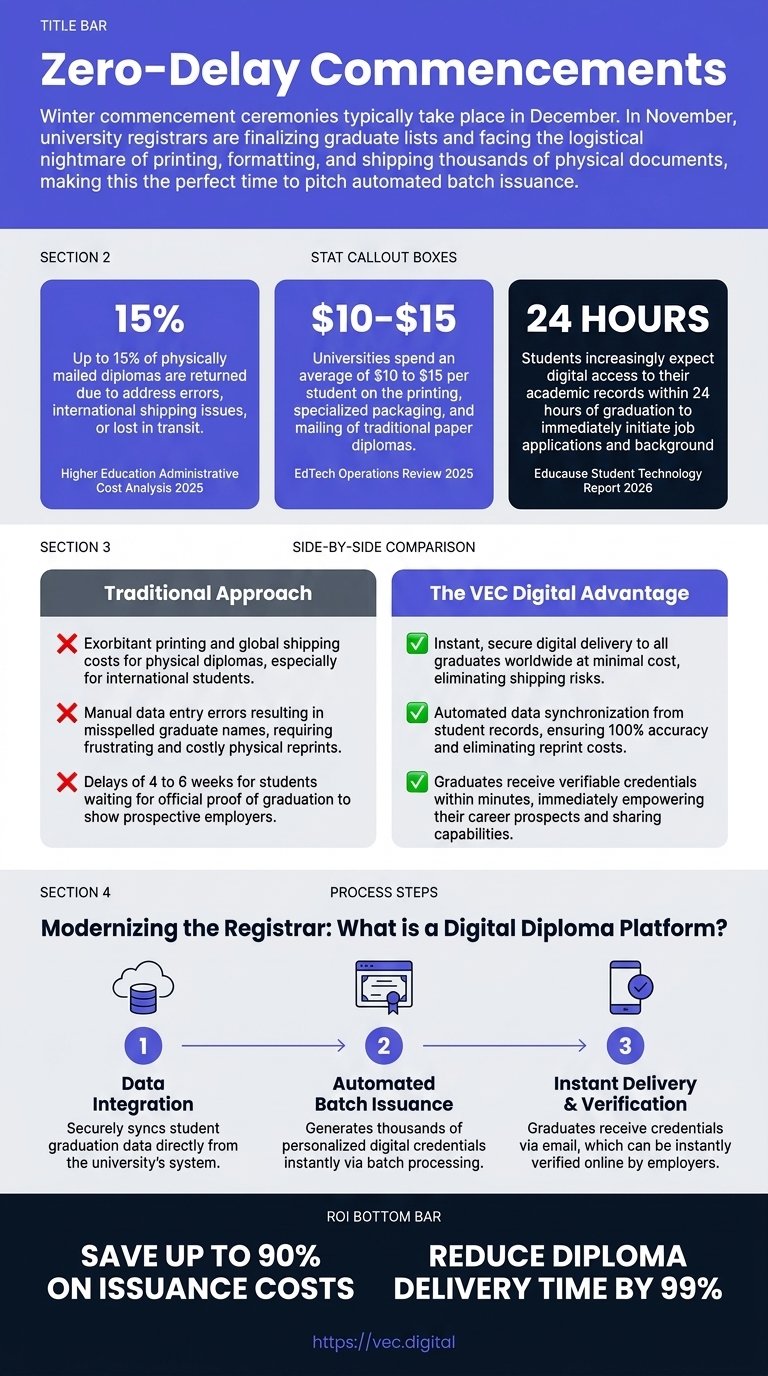
Up to 15% of physically mailed diplomas are returned due to address errors, international shipping issues, or getting lost in transit, creating an immediate administrative nightmare for university registrars following commencement. By transitioning to a robust digital diploma platform, higher education institutions can bypass the exorbitant costs and logistical friction of traditional printing. This operational shift instantly delivers verifiable academic records to global graduates while eliminating the manual data entry errors that plague graduation season.
Drawing on our extensive expertise in educational technology and secure credentialing systems, we designed this operational playbook to help academic administrators modernize their commencement logistics. In this guide, you will learn how to eliminate the manual bottleneck of physical diploma processing, seamlessly generate thousands of credentials using automated CSV batch issuance, and provide your alumni with instantly verifiable records that modern employers demand.
Key Takeaways
- Transitioning to an automated system reduces credential issuance administrative time by over 90% compared to legacy manual data entry.
- A modern digital diploma platform eliminates the $10 to $15 per student cost associated with printing, specialized packaging, and global mailing.
- Utilizing a bulk certificate generator ensures instant delivery of academic records, meeting the 24-hour turnaround expectation of today's graduates.
- Anchoring academic achievements with blockchain certificate verification provides permanent, tamper-proof security to prevent degree fraud.
- Issuing verifiable digital credentials empowers alumni to instantly prove their qualifications to the 40% of employers who now require primary-source verified records during initial hiring screenings.
The Hidden Costs and Logistical Nightmares of Traditional Commencements
Winter and spring commencement ceremonies are the pinnacle of the academic calendar, celebrating the hard work of thousands of students. However, behind the scenes, university registrars and IT directors face a monumental logistical challenge. The traditional process of issuing academic degrees relies on an antiquated physical supply chain that is slow, expensive, and highly prone to human error. To truly understand the necessity of digital transformation in higher education, we must first analyze the severe operational limitations of the paper-based credentialing model.
How much does it cost to print and mail college diplomas?
The financial burden of maintaining a physical credentialing system is staggering when viewed at scale. According to the EdTech Operations Review (2025), universities spend an average of $10 to $15 per student on the printing, specialized packaging, and mailing of traditional paper diplomas. For a mid-sized university graduating 5,000 students in a single semester, this equates to an immediate hard cost of $50,000 to $75,000 just for the final fulfillment phase. This figure does not even account for the hundreds of administrative hours spent coordinating with third-party printing presses, proofreading proofs, and managing postage meters.
Furthermore, this baseline cost skyrockets when dealing with international students. Shipping a rigid, oversized document across borders requires expensive international couriers, customs declarations, and specialized tracking. When universities are forced to absorb these exorbitant printing and global shipping costs, funds are diverted away from critical student services and technological advancements.
Managing Manual Data Entry Errors and Reprints
Beyond the direct financial costs, the manual data entry required for physical diplomas introduces a high margin of error. Transcribing thousands of names, degree classifications, and honors designations from a student information system into a format suitable for a printing press often results in misspelled names or incorrect degree titles. When a student receives a physical diploma with a typo, the university must initiate a frustrating and costly reprint process. This damages the institution's reputation and creates unnecessary friction for the graduate.
By shifting to automated student records, institutions can pull data directly from their centralized databases, mapping exact variables to the final credential. This eliminates the middleman of manual transcription, ensuring that the name printed on the credential matches the university's official database with absolute precision.
The Cost of Administrative Delays and Returned Mail
Perhaps the most taxing element of the physical credentialing process occurs in the weeks following commencement. According to the Higher Education Administrative Cost Analysis (2025), up to 15% of physically mailed diplomas are returned due to address errors, international shipping issues, or getting lost in transit. Managing this massive influx of returned, damaged, or undeliverable mail creates an overwhelming administrative burden.
Registrar staff must spend countless hours contacting alumni, verifying new addresses, and initiating secondary shipments. In a globalized educational landscape where students frequently relocate immediately after graduation for employment, relying on physical mail is no longer a viable strategy for delivering highly sensitive, time-critical academic documents.
Modernizing the Registrar: What is a Digital Diploma Platform?
To overcome the limitations of physical printing, forward-thinking institutions are adopting comprehensive digital solutions. A digital diploma platform is a centralized software engine designed to create, manage, issue, and authenticate academic credentials at scale. Unlike simple PDF generators, a true enterprise-grade platform integrates seamlessly into a university's existing data infrastructure, providing end-to-end automation from the moment a student's final grades are approved to the instant they receive their verifiable credential.
Defining the Modern Standard for Academic Records
The modern standard for academic records goes far beyond a digitized image of a piece of paper. Today's digital diplomas are dynamic, interactive data containers. They are designed to be easily shared on professional networks like LinkedIn, instantly verified by third-party auditors, and permanently secured against forgery. This is achieved through a combination of cryptographic hashing, embedded QR codes, and cloud-based verification portals.
For more context on how educational institutions globally are standardizing digital records, you can explore the evolution of the academic certificate. The transition from parchment to encrypted digital assets represents a fundamental shift in how society values and verifies educational attainment.
How long does it take for a university to issue a digital diploma?
One of the most common questions from both students and administrators is regarding the timeline of issuance. In the traditional physical model, graduates often face delays of 4 to 6 weeks while waiting for official proof of graduation. This delay can severely hinder a graduate's ability to secure employment, apply for advanced degree programs, or obtain necessary work visas.
With a robust digital system, the timeline is compressed from weeks to seconds. Once the final graduation roster is approved and formatted into a standard CSV file, the platform can process and issue thousands of credentials simultaneously. The moment the batch process is executed, students receive an automated email containing a secure link to their digital diploma. This zero-delay commencement strategy ensures that graduates have immediate access to their credentials the very day their degree is conferred.
Evaluating the Best Digital Diploma Platform for Universities
When academic IT directors and registrars evaluate potential solutions, they must look for platforms that offer a specific set of enterprise capabilities. The best platforms provide a completely frictionless experience for both the issuer and the recipient. Key features to look for include a visual drag-and-drop template editor that allows universities to maintain their prestigious branding, robust APIs for deep integration with Learning Management Systems (LMS), and strict multi-signatory approval pipelines to ensure governance.
Furthermore, the platform must not require the end-user (the student or the verifying employer) to download specialized apps or create cumbersome accounts. The verification process must be instantaneous and universally accessible via standard web browsers and smartphone cameras.
Automating Graduation Week with a Bulk Certificate Generator
The true operational power of a modern credentialing system lies in its ability to handle massive volume without breaking a sweat. For universities graduating thousands of students across multiple colleges and disciplines, manual generation of digital files is just as inefficient as physical printing. This is where a bulk certificate generator becomes an indispensable tool for the modern registrar.
How do you bulk issue certificates from a CSV file?
The process of bulk issuing credentials via a CSV (Comma-Separated Values) upload is designed to be highly intuitive, allowing non-technical administrative staff to execute massive batch operations flawlessly. The process generally follows these streamlined steps:
- Data Export: The registrar exports the finalized list of graduates from the university's Student Information System (SIS) into a standard CSV format.
- Template Selection: The administrator selects the pre-designed, branded certificate template within the digital platform.
- Data Mapping: The system automatically maps the column headers in the CSV (e.g., FirstName, LastName, DegreeName, Honors, IssueDate, StudentEmail) to the corresponding dynamic placeholders on the visual template.
- Preview and Validation: The platform runs a validation check to ensure there are no missing fields or formatting errors, allowing the administrator to preview a sample of the generated credentials.
- Execution: With a single click, the platform's engine generates all 5,000+ individual credentials, anchors them securely, and automatically dispatches personalized delivery emails to every student on the list.
Eliminating Formatting Errors Through Dynamic Placeholders
Dynamic placeholders are the secret to scalable personalization. By using variables like {{RecipientName}} and {{DegreeTitle}} within the design template, the platform ensures that every single credential is uniquely tailored to the individual student without requiring any manual design work. This completely eliminates the risk of human transcription errors.
If a student's name is spelled correctly in the university's master database, it will be spelled correctly on the final credential. According to the Global Academic Technology Journal (2026), migrating to CSV batch processing and automated generation reduces credential issuance administrative time by over 90% compared to legacy manual data entry. This massive reclamation of time allows registrar staff to focus on higher-level student support rather than tedious administrative paperwork.
Scaling Issuance Without System Lag
During peak commencement seasons in May and December, credentialing platforms must process an extraordinary volume of data. A high-performance bulk generation engine is built to scale dynamically, allocating server resources to process thousands of high-resolution digital files and cryptographic hashes in parallel. This ensures that whether a university is issuing 50 certificates for a specialized cohort or 10,000 diplomas for a university-wide commencement, the system performs flawlessly without lagging, crashing, or timing out.
Empowering Global Alumni with Verifiable Digital Credentials
While the operational benefits for the university are profound, the ultimate end-user of an academic credential is the graduate. In today's highly competitive, fast-paced global job market, the way a student presents their qualifications can significantly impact their career trajectory. Issuing verifiable digital credentials is no longer just an administrative upgrade; it is a critical component of student success and alumni empowerment.
Meeting the 24-Hour Digital Access Expectation
Modern students are digital natives who manage their finances, social lives, and professional networking entirely online. Consequently, their expectations for institutional service delivery have evolved. According to the Educause Student Technology Report (2026), students increasingly expect digital access to their academic records within 24 hours of graduation to immediately initiate job applications and background checks.
When a university fails to meet this expectation, relying instead on weeks-long physical mailing processes, it actively hinders its graduates' ability to compete in the job market. Instant digital delivery ensures that alumni can immediately attach their verified credentials to digital resumes, embed them in personal portfolios, and share them across professional networks to maximize their visibility to recruiters.
Are digital diplomas verifiable by employers?
The primary function of an academic diploma is to serve as proof of qualification to a third party. Therefore, the question of verifiability is paramount. Yes, modern digital diplomas are highly verifiable by employers, and the process is vastly superior to traditional background checks.
Every credential generated by a leading platform includes an embedded, unique QR code and a dedicated cryptographic URL. When an employer or auditor wishes to verify a candidate's degree, they simply scan the QR code with their smartphone camera or click the provided link. They are instantly routed to a secure, public verification page hosted by the platform (e.g., /certificate/[uuid]). This page displays the issuing institution, the recipient's verified details, the date of issuance, and the status of the cryptographic signature. This zero-friction verification happens in seconds, requiring no app installs, logins, or tedious phone calls to the university registrar.
Supporting Cross-Border Employment and International Mobility
With international student mobility and cross-border employment reaching new highs globally, the geographic limitations of physical paper are more apparent than ever. A graduate from a university in Dubai may be applying for a role in London, while an Australian alumnus might be seeking a visa in the United States. In these scenarios, mailing physical degrees globally involves exorbitant courier fees, customs delays, and high loss rates.
Instant digital delivery is now a critical competitive advantage for universities looking to support their global alumni networks. According to SHRM Talent Acquisition Trends (2026), over 40% of modern employers now require primary-source verified digital credentials during the initial hiring screening phase. By providing instantly accessible, universally verifiable digital records, universities directly facilitate the global mobility and employability of their graduates.
Securing Institutional Integrity via Blockchain Certificate Verification
As the value of higher education remains high, so too does the incentive for credential fraud. The proliferation of sophisticated AI design tools and online "diploma mills" has made it incredibly easy for malicious actors to forge highly convincing physical diplomas and standard PDF documents. To protect the institutional brand and ensure the absolute integrity of academic records, universities must adopt advanced cryptographic security measures.
How do digital diploma platforms prevent degree fraud?
To effectively prevent degree fraud, modern platforms utilize blockchain certificate verification. When a batch of digital diplomas is generated, the platform calculates a unique cryptographic hash (a digital fingerprint) for each individual credential. This hash, along with the issuance metadata, is anchored to an immutable, publicly verifiable blockchain network.
If a malicious actor attempts to alter the digital credential in any wayâ-such as changing the degree classification from a Bachelor of Arts to a Master of Science, or altering the graduate's nameâ-the underlying cryptographic hash is broken. When an employer attempts to verify the altered document, the platform's verification engine will check the file against the permanent blockchain record. Recognizing the mismatch, the system will instantly flag the document as invalid and fraudulent. This mechanism guarantees absolute authenticity and completely eliminates the possibility of undetected forgery.
The Shift from Vulnerable PDFs to Cryptographic Proofs
It is crucial to understand that a standard PDF is not a secure digital credential. Standard PDFs can be easily edited using basic software, making them highly vulnerable to manipulation. By anchoring credentials to a blockchain, universities upgrade their records from simple digital images to cryptographic proofs.
For a deeper understanding of how decentralized ledgers provide immutable security for digital assets, you can review the fundamental principles of blockchain technology. This technology ensures that the record of issuance exists independently of any single localized server, providing permanent, tamper-proof verification that outlasts physical paper and standard databases.
Implementing Multi-Signatory Governance for Academic Issuance
Security is not just about preventing external forgery; it is also about ensuring strict internal governance. Before thousands of official university degrees are released into the world, they must undergo rigorous authorization. A premium digital credentialing platform facilitates this through a multi-signatory verification process.
In this system, certificates are held in a secure "pending" status after the initial CSV upload. The system then automatically notifies designated organizational authoritiesâ-such as the Academic Dean and the University Registrarâ-to securely log in, review the batch, and apply their electronic signatures. The credentials are only generated, blockchain-anchored, and dispatched to the students once all required signatures have been successfully gathered. This automated governance pipeline prevents accidental or unauthorized issuance, ensuring that the institution maintains the highest standards of academic compliance.
Streamline Your Next Commencement with VEC Digital
The logistical nightmare of printing, formatting, and shipping thousands of physical diplomas is an outdated burden that universities no longer need to bear. By embracing a comprehensive digital credentialing platform, academic institutions can eliminate manual data entry errors, eradicate exorbitant shipping costs, and deliver instantly verifiable, tamper-proof records to their global alumni network.
At VEC Digital, we provide the ultimate trust infrastructure for global institutions. Our frictionless platform combines intuitive CSV batch issuance with unbreakable blockchain security and seamless multi-signatory governance. Empower your graduates with the verifiable digital credentials modern employers demand, and reclaim hundreds of administrative hours this commencement season.
Secure your organizationâ's credentials todayâ-design your first template in minutes with no setup fees. For personalized support or to discuss enterprise integration, contact our team at support@vec.digital or visit our website to learn more.