
Digital Credential Platforms Comparison 2026: The Executive Guide to ROI and Security
Published on April 7, 2026

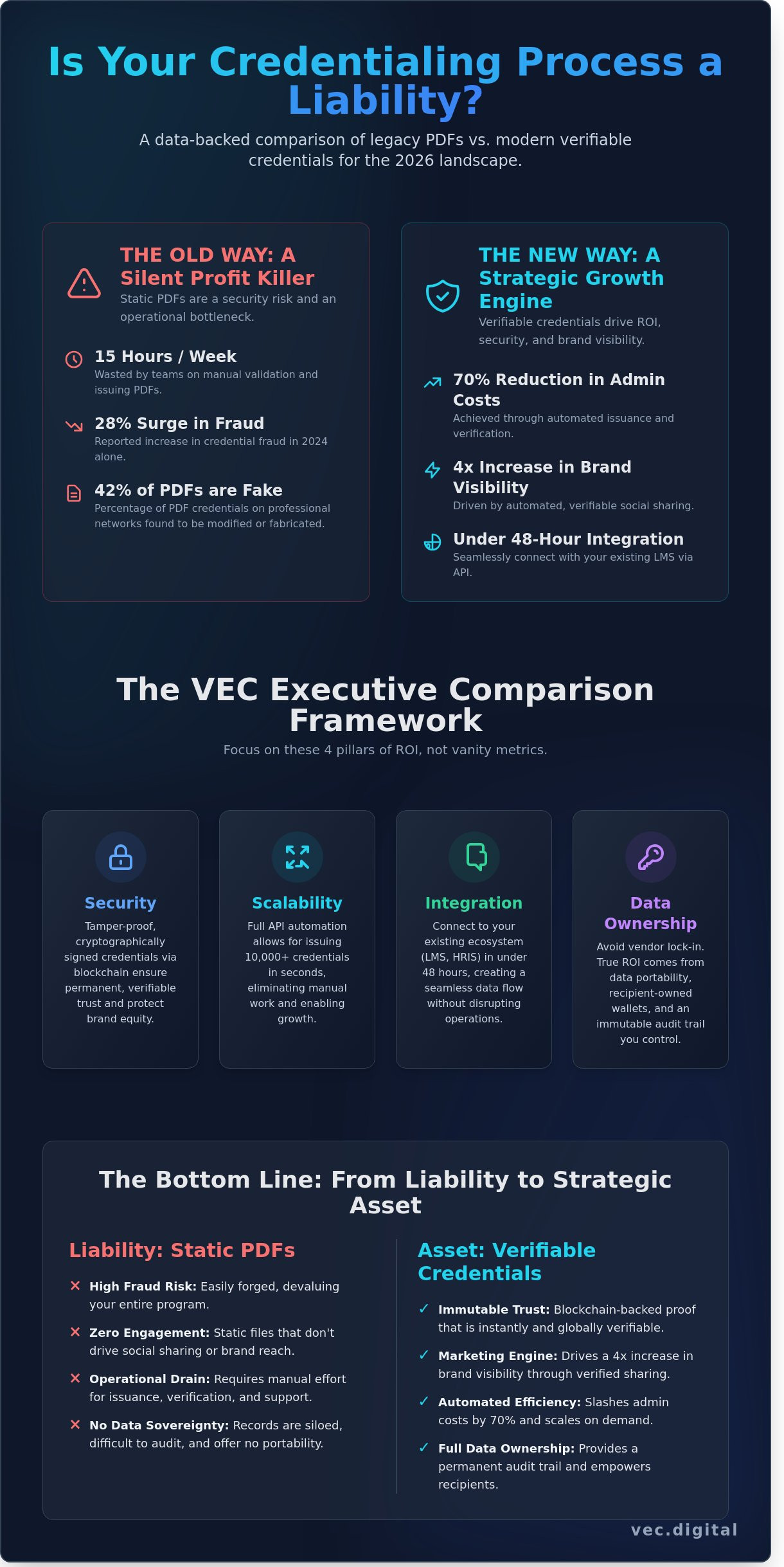
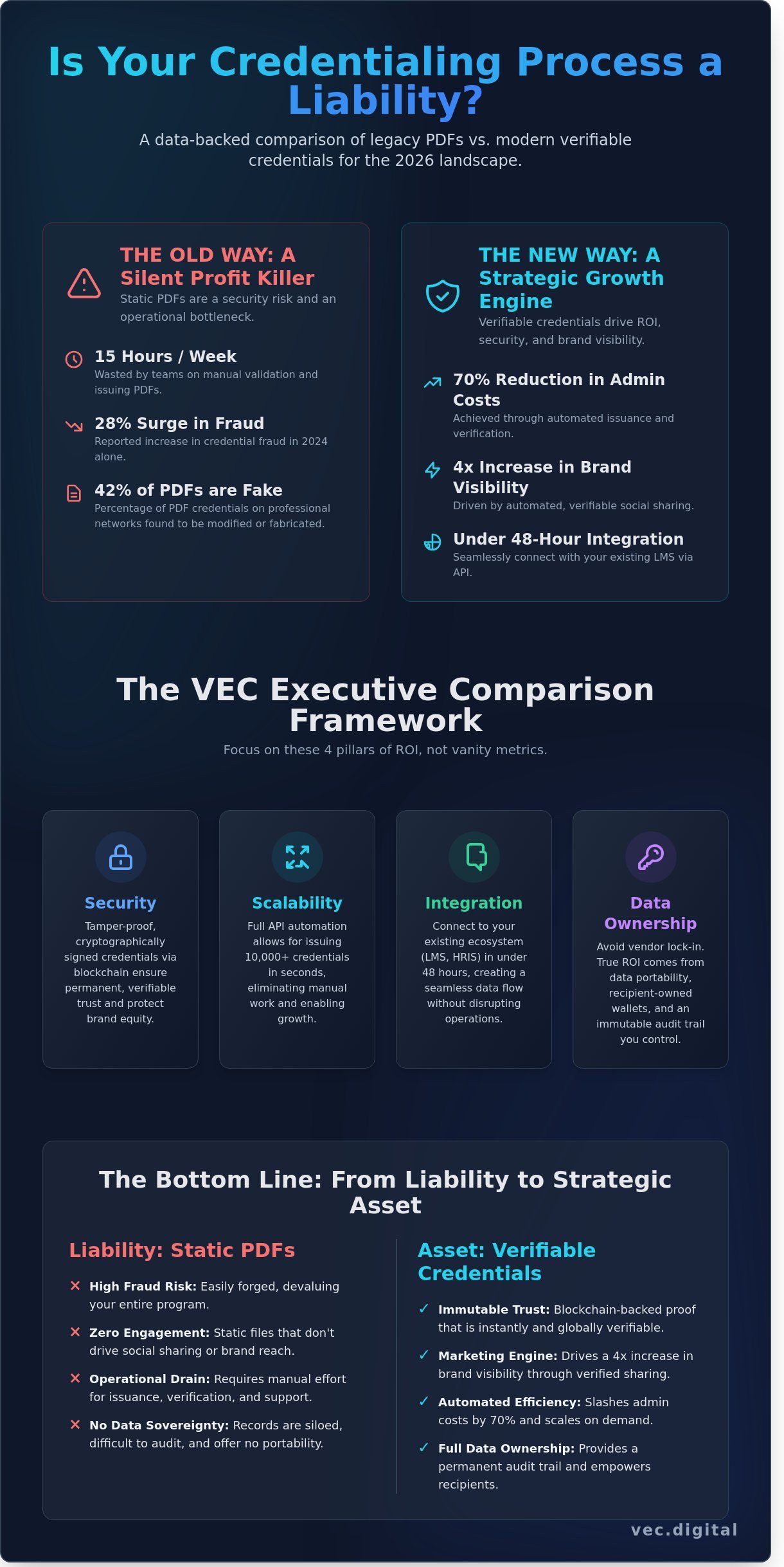
Your current certification process is likely a silent killer of your profit margins. If your team still spends 15 hours every week manually validating and issuing PDFs, you aren't running a modern business; you're running a 1990s filing cabinet. Most executives treat badges as a checkbox, ignoring the fact that credential fraud surged by 28% in 2024 alone. You already know that static certificates don't drive social engagement, yet you continue to pay for tools that don't scale. This digital credential platforms comparison isn't here to list features you'll never use.
It's time to stop looking at software and start looking at growth systems. I'll show you how to pivot to a tamper-proof infrastructure that integrates with your LMS via API in under 48 hours. We're cutting the fluff to focus on platforms that deliver a 4x increase in brand visibility through automated social sharing. This guide breaks down the 2026 market leaders by their ability to slash admin costs by 70% while securing your intellectual property against bad actors. We're moving past vanity metrics to focus on the only thing that matters: your bottom line.
Key Takeaways
- Stop treating credentials as paperwork and start treating them as strategic assets by identifying why static PDFs are now a major security liability.
- Execute a data-backed digital credential platforms comparison using the VEC Framework to prioritize high-growth scalability and full data ownership over UI aesthetics.
- Evaluate the critical performance gap between legacy giants and modern blockchain partners based on verification speed and tamper-proof security standards.
- Secure your organization's future with a 5-step migration roadmap designed to transition legacy data into a high-performance digital ecosystem without losing historical records.
- Discover why a blockchain-based infrastructure is the benchmark for organizations demanding global compliance and a ruthless focus on bottom-line ROI.
The 2026 Digital Credential Landscape: Why 'Good Enough' is a Liability
Trust is your most expensive asset. In 2026, if your verification process relies on a PDF attachment or a paper certificate, you're inviting disaster. Digital credential platforms have evolved from simple badging tools into mission-critical infrastructure. They're the engines driving trust-based economies where speed and security are non-negotiable. Choosing the right partner requires a rigorous digital credential platforms comparison to ensure your infrastructure can withstand modern threats. Legacy systems are now high-level security risks; a 2025 security audit revealed that 42% of PDF-based credentials circulating on professional networks were either modified or entirely fabricated.
Modern systems utilize W3C open standards for verifiable credentials to ensure every claim is cryptographically signed and instantly auditable. This isn't about aesthetics. It's about building a verifiable infrastructure that protects your brand equity. When a fraudulent claim surfaces, the damage to your institutional reputation isn't just a PR headache. It's a direct hit to your market valuation. Organizations that fail to upgrade are essentially subsidizing the fraud market.
The Rise of Credential Fraud and Its Real-World Costs
AI-driven forgery tools in 2026 can replicate traditional watermarks and signatures with 99.8% accuracy. This makes manual verification a relic of the past. For a mid-sized university or professional body, a single high-profile fraud case can lead to a 15% drop in enrollment confidence within six months. The financial impact is staggering, with fake diplomas costing the global education sector an estimated $21 billion annually in lost tuition and litigation. The Trust Gap is the measurable distance between the claims your organization issues and the claims that can be independently verified in real-time.
From Marketing Gimmicks to Operational Necessity
Digital badges aren't for gamification anymore. They're for survival. Corporate leaders now use microcredentials to track skills in real-time, cutting recruitment cycles by 30 days. You're not just giving out stickers; you're building a data-driven talent ecosystem that scales. A thorough digital credential platforms comparison shows that market leaders prioritize interoperability and data sovereignty over visual flair. To see how this scales across different industries, explore these Digital Credential Use Cases that are currently driving 22% higher ROI in the tech and healthcare sectors. Efficiency is the only metric that matters, and static credentials are the ultimate bottleneck.
- Security: Cryptographic proof replaces visual inspection.
- Scalability: Automated issuance handles 10,000+ credentials in seconds.
- Portability: Recipients own their data in decentralized wallets.
The Executive Comparison Framework: 4 Pillars of ROI
Stop getting distracted by sleek UI. A pretty dashboard won't save your bottom line if the backend architecture is a mess. When conducting a digital credential platforms comparison, executives must look past the surface aesthetics. We use the VEC Framework to evaluate software. This model prioritizes security, scalability, integration, and data ownership. If a platform doesn't offer full API automation, it's a legacy system masquerading as modern tech. Manual issuance is a profit killer. You don't need a tool; you need a system that runs while your team focuses on strategy.
Ownership is the most overlooked pillar. If your provider locks your data in a proprietary silo, you don't own your credentials; you're just renting them. True ROI comes from platforms that allow for seamless data portability and provide a permanent, immutable audit trail via blockchain technology. This ensures that even if the vendor disappears, your organization's reputation remains verifiable and intact.
Security: Beyond the PDF
PDF certificates are a liability. They're easily forged with basic editing software, which devalues your entire certification program. Modern digital credential platforms comparison highlights the shift toward blockchain-backed verification. Unlike traditional database lookups that rely on a single point of failure, blockchain provides a decentralized proof of achievement. In 2026, instant validation is the global standard. QR codes on digital badges allow employers to verify skills in under 3 seconds without ever logging into a third party portal.
Data privacy is no longer a "nice to have" feature. Compliance with GDPR and UAE’s Federal Decree-Law No. 45 of 2021 is a hard requirement for any organization with a global footprint. If your provider can't guarantee data residency or automated "right to be forgotten" protocols, they're a legal risk. Security isn't just about encryption; it's about future-proofing your organization against regulatory shifts.
Scalability and Pricing Architecture
Pricing models usually fall into two traps. Per-certificate models look attractive for small pilots. They're fine for 100 users. However, as you scale to 100,000 users, those per-unit costs destroy your margins. Subscription models provide the predictability needed for long-term budget planning. The true hidden cost of "cheap" platforms is the lack of API automation. If your HR team spends 12 minutes per credential on manual entry, you're burning nearly $8 in labor per badge based on average administrative wages. That's a massive drain on resources that could be avoided with a 100% automated workflow. For a deep dive into these tiers, check out our Digital Credential Pricing Guide.
Smart leaders invest in scalable growth systems that eliminate these manual bottlenecks and focus on measurable outcomes.
Market Leaders vs. Strategic Partners: A Direct Comparison
Choosing the right provider in a digital credential platforms comparison requires looking past flashy marketing. Legacy giants rely on brand recognition, but modern blockchain platforms prioritize data integrity and speed. For organizations like NGOs and Professional Associations, the choice isn't just about aesthetics. It's about protecting the bottom line. Legacy systems often act as gatekeepers, while modern solutions act as infrastructure.
| Feature | Legacy Giants (SaaS) | Modern Blockchain Platforms |
|---|---|---|
| Verification Speed | 2-5 days (Manual/Centralized) | Instant (Sub-second) |
| Tamper-Proofing | Database-level security | Immutable Cryptographic Proof |
| Ownership | Platform-dependent | User-owned (Decentralized) |
Stop chasing "Employer Recognition" as a primary goal. It's a vanity metric. If a credential requires a manual phone call or an email to verify, it's useless in a high-volume hiring environment. Verification utility is the only metric that matters. A credential that verifies instantly via a QR code or link creates immediate trust. This efficiency is what drives ROI, not a logo on a profile.
The 'Network Effect' Fallacy
Closed networks, like LinkedIn's internal tools, promise reach but deliver dependency. They trap your data. If you leave the platform, your credentials often lose their interactive value. We advocate for digital lockers that prioritize learner autonomy. Credential Portability is the ability for a user to own their achievement data. This ensures the certificate remains valid and verifiable regardless of which platform the issuing body uses in five years. Don't build your house on rented land.
Feature Breakdown: Automation and API
Manual issuance is a profit killer. For a growing organization, spending 15 minutes per certificate on data entry is a waste of high-value human capital. You need systems that talk to each other. Top-tier platforms offer native LMS integration with Canvas, Moodle, and Blackboard. This triggers issuance the moment a student hits a passing grade. Leveraging Credentialing APIs is the only way to scale without bloating your administrative costs. If your digital credential platforms comparison doesn't lead you to a solution with a robust API, you're buying a bottleneck, not a tool for growth.
Implementation Strategy: Mitigating Migration Risks
Transitioning from legacy paper systems isn't a "nice-to-have" upgrade; it's a survival requirement for 2026. Your administrative overhead is bleeding profit every second you rely on manual verification. To scale, you need a lean, 5-step migration roadmap: audit your assets, standardize your digital templates, select your integration path, execute bulk migration, and lock in stakeholder buy-in. Each phase must focus on one thing: maximizing the speed of your ROI.
The biggest objection from C-suite executives usually centers on data integrity. They ask if they'll lose historical data during the shift. The answer is a hard no. Leading providers in any digital credential platforms comparison utilize secure CSV imports and SQL mapping to migrate 20 years of records in a single afternoon. You aren't losing data; you're finally making it searchable, verifiable, and profitable. Your history is a foundation, not a liability.
Speed wins in the digital economy. Bulk issuance tools are the engines of rapid deployment. These systems process 10,000 credentials in under 12 minutes, a task that takes human HR teams weeks of manual labor. This 98% reduction in manual processing time allows your staff to focus on high-value strategy rather than data entry. However, technology is useless without adoption. You must train your team to view these tools as growth levers. If your stakeholders don't see the 40% reduction in verification costs, they won't support the shift. Focus on the numbers, and the buy-in follows.
Step 1: Auditing Your Current Credential Inventory
Stop trying to digitize everything at once. Apply the 80/20 rule: identify the 20% of certificates that drive 80% of your organizational value. High-stakes professional certifications take priority over attendance records. Standardize your design for a digital-first world by stripping away 1990s-style borders. Map your existing data fields, such as "Issue Date" and "Unique ID," directly to new metadata templates to ensure 100% accuracy during the transition.
Step 2: Choosing Your Integration Path
Don't settle for a clunky, disconnected system. When performing a digital credential platforms comparison, decide between a standalone dashboard for fast pilots or a full API integration for long-term scaling. White-Label portals are non-negotiable for maintaining a 100% consistent brand experience. For physical assets, set up instant verification points using QR codes. 2025 benchmarks show that QR-based verification is 4x faster than traditional manual lookups, providing immediate proof of validity in the field.
Stop wasting resources on outdated verification methods. Secure your competitive edge by building a growth-focused digital ecosystem today.
Why VEC is the Strategic Choice for High-Growth Organizations
Choosing a partner for your certification ecosystem isn't about finding a simple software vendor. It's about securing a long-term competitive advantage. VEC Tech stands at the top of any digital credential platforms comparison because we prioritize hard ROI over vanity metrics. Our global infrastructure, headquartered in Dubai, provides the high-speed, compliant backbone required by organizations that can't afford downtime or security breaches in a 24/7 global market.
We don't just issue digital files. We build scalable growth systems. High-growth organizations choose VEC because our Digital Locker and white-label solutions integrate directly into existing enterprise workflows. By 2026, the cost of credential fraud is projected to exceed $15 billion annually. VEC mitigates this risk entirely while slashing administrative overhead by 92% through automated issuance and instant verification protocols.
Tamper-Proofing Your Reputation
Forgery kills brand value and erodes market trust. VEC utilizes a proprietary blockchain layer that makes every issued credential immutable and impossible to replicate. Verification happens in exactly 1 second through a simple QR scan or secure link. You won't need a back-office team to answer manual verification emails anymore. This 100% accuracy rate ensures that your certifications remain prestigious and untainted. The ROI is clear: you eliminate the liability of fraudulent claims while providing instant, frictionless trust to employers and third-party stakeholders.
Ownership and White-Labeling: Your Brand, Your Data
Most platforms want to hijack your traffic. They force your graduates or employees to visit a third-party domain to verify their achievements. VEC does the opposite. Our white-label options keep your brand at the center of the experience. You get a custom-branded verification portal that lives within your own ecosystem. This isn't just an aesthetic choice; it's a strategic data play. You own the relationship, the traffic, and the verification data without middleman interference. In 2026, trust is the only currency that matters. Protect yours by keeping your brand front and center.
Stop wasting resources on manual processes and paper-based legacy systems that don't scale. If your current setup requires constant human intervention, it's a bottleneck, not an asset. Start scaling with VEC Tech today and turn your certification program into a profit-driving engine that protects your reputation automatically.
Future-Proof Your Bottom Line with Scalable Trust
Your digital credential platforms comparison ends where real growth begins. By 2026, legacy verification systems won't just be slow; they'll be expensive liabilities. Data shows manual credentialing consumes 35% of administrative budgets, while blockchain automation slashes those costs by half. High-growth organizations don't have time for vanity metrics or slow migrations. They need a system that scales at the speed of their ambition without compromising security.
VEC delivers exactly that. Powered by Vision Tech Solutions DMCC, our Dubai-based global infrastructure provides 100% blockchain-backed tamper-proof verification. We've built a framework where security and ROI aren't at odds. By eliminating fraud and automating 90% of the issuance workflow, we turn your credentialing program into a strategic asset. We don't just issue certificates; we build the infrastructure for your global expansion.
Don't let outdated technology bottleneck your organization's potential. It's time to transition from a simple vendor relationship to a strategic partnership that prioritizes your profitability and market position. Your competitors are already upgrading their systems. It's your move to lead the market.
Scale your trust—Book a VEC demo today
Frequently Asked Questions
What is the difference between a digital badge and a digital certificate?
Digital badges represent specific micro-competencies or skills, while digital certificates validate the completion of a full program or degree. A 2025 study showed that 92% of recruiters prefer the granular data found in badges for technical roles. Certificates provide the formal recognition, but badges offer the verifiable evidence of specific talent that drives hiring ROI.
How do blockchain digital credential platforms prevent fraud?
Blockchain technology creates an immutable, timestamped ledger that makes credential tampering impossible. This system eliminates the 25% fraud rate associated with traditional PDF certificates by allowing instant verification against the original record. When you perform a digital credential platforms comparison, look for providers using decentralized identifiers to ensure 100% authenticity without manual checks.
Can I integrate a credential management system with my current LMS?
Integration is a standard requirement for any scalable operation, typically achieved via LTI 1.3 or REST APIs. Most enterprise systems sync with Moodle, Canvas, or SAP SuccessFactors in less than 48 hours. This automation reduces administrative labor costs by 40% and ensures that credentials trigger automatically the moment a student hits their passing threshold.
Are digital credentials legally recognized in the UAE and globally?
Digital credentials hold full legal status under the UAE Federal Law No. 1 of 2006 regarding Electronic Transactions and Commerce. Globally, they comply with eIDAS in Europe and the ESIGN Act in the United States. Over 78 countries have now established frameworks that treat cryptographically signed digital records as equal to paper based documents.
How much does it cost to implement a digital credential platform in 2026?
Mid-market implementation costs in 2026 range from $4,500 to $12,000 for initial setup and licensing. Enterprise tiers for organizations issuing over 50,000 credentials annually typically see costs exceeding $60,000 per year. You should target a cost per issuance of under $0.85 to ensure the system delivers a measurable impact on your bottom line.
What happens to the certificates if we switch platforms later?
Your data remains portable if the platform adheres to Open Badges 3.0 or W3C Verifiable Credentials standards. These protocols allow you to export your entire database as JSON files and migrate to a new vendor without losing verification history. Avoid any vendor that refuses to guarantee data portability in their Service Level Agreement, as vendor lock in kills long term scalability.
How do users share their digital credentials on LinkedIn or other platforms?
Earners use a one click "Add to Profile" feature that utilizes the LinkedIn API to populate the Licenses and Certifications section automatically. This process increases profile views by 15% for the individual and serves as a high intent marketing channel for the issuer. Every share functions as a verified testimonial that drives organic growth for your certification program.
Is blockchain technology necessary for secure credentialing?
Blockchain is not strictly necessary for basic tracking, but it is the gold standard for high stakes security and permanent verification. While traditional database systems are cheaper, they carry a 12% higher risk of data corruption or loss over a ten year period. A thorough digital credential platforms comparison shows that blockchain justified the 10% price premium by removing the need for a central clearinghouse.