
Professional Association Certificates: The 2026 Strategy for Secure Growth
Published on April 3, 2026

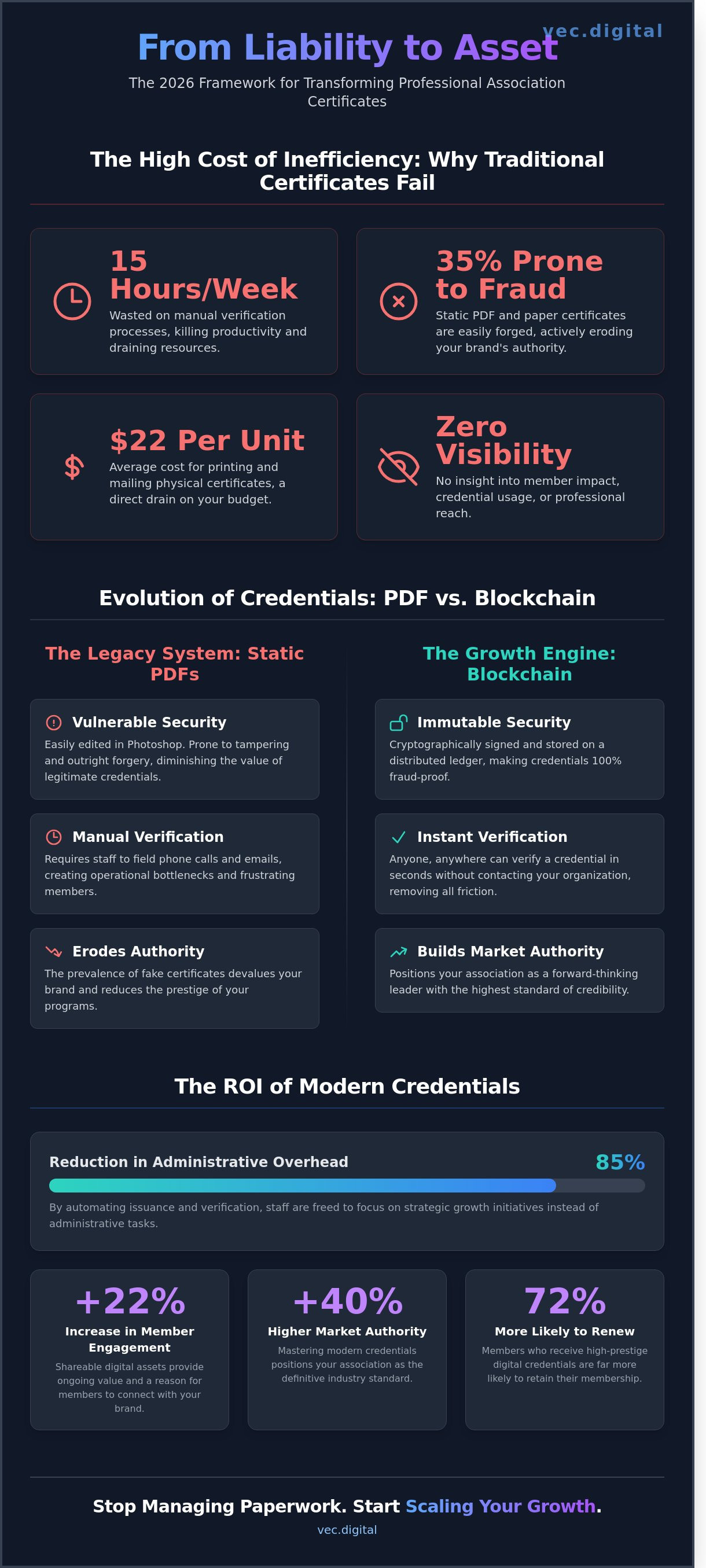
Your current certification program is a liability, not an asset. If your professional association certificates are still trapped in static PDF files, you aren't issuing credentials; you're handing out easy-to-counterfeit templates that actively erode your brand authority. You likely feel the weight of this inefficiency already. Manual verification processes eat up 15 hours of administrative labor every week, while an estimated 35% of traditional certificates are prone to some form of tampering or unauthorized alteration. It's a slow, expensive system that offers zero visibility into your members' professional impact.
We're here to kill that inefficiency. You'll learn how to transform these administrative burdens into secure, high-ROI digital assets that scale your organization's reputation automatically. We're moving past vanity metrics and focusing on the bottom line. This 2026 strategy reveals the exact framework for automated issuance and instant, third-party verification. We will show you how to implement a fraud-proof system that drives a 22% increase in member engagement while cutting operational costs by nearly half. It's time to stop managing paperwork and start scaling your growth.
Key Takeaways
- Stop treating professional association certificates as administrative liabilities and start leveraging them as high-ROI, fraud-proof digital assets.
- Discover why the traditional PDF "e-certificate" is a security risk and how blockchain technology creates an immutable standard for professional credibility.
- Learn how to audit your existing credentialing workflow to eliminate bottlenecks and define metadata for a truly scalable digital strategy.
- Shift to a "Profit First" management approach that transforms your certification process into a measurable growth engine for your organization.
The Strategic Role of Professional Association Certificates in 2026
Professional association certificates are no longer digital participation trophies. By 2026, they've evolved into high-velocity growth assets. These credentials represent verifiable proof of industry-standard expertise that the market actually trusts. For members, these certificates serve as the primary currency for professional networking and career advancement. If your association isn't issuing them, you're invisible. If you're issuing them poorly, you're bleeding revenue. It's that simple.
The market has shifted decisively. We've moved away from participation-based awards toward strict, competency-based credentials. Employers in 2026 don't care if a member sat through a three-hour webinar. They demand hard proof of skill. Associations that master this transition maintain 40% higher market authority than those stuck in 2022. This isn't just about education; it's about generating recurring revenue through recertification cycles and tiered access. You aren't just selling a course; you're selling a career-long validation system.
Beyond the Paper: Certificates as Growth Assets
Digital credentials drive member retention by providing visible, shareable achievements. Data shows that 72% of members are more likely to renew their membership if their association provides a high-prestige credential they can display on LinkedIn. Your bottom line depends entirely on the perceived value of your professional association certificates. When the credential carries weight, the association scales. There's a direct, measurable correlation between certification prestige and membership growth rates. Don't settle for vanity metrics; focus on the credentials that members are proud to showcase.
The Cost of Inefficiency: Why Manual Issuance Fails
Manual issuance is a profit killer. Printing and mailing physical certificates costs an average of $22 per unit when you factor in labor, materials, and postage. Then there's the liability. Lost credentials and manual verification requests create friction that slows down your operations and frustrates your high-value members. You need to transition to a digital credential pricing model that scales with your volume. Automating this process reduces administrative overhead by 85%, allowing your team to focus on strategic growth instead of pushing paper. In a world where speed is a competitive advantage, manual verification is a legacy anchor you can't afford to drag.
- Verifiability: 100% instant digital verification removes the burden from your staff.
- Scalability: Issue 10,000 certificates with the same effort as issuing ten.
- Profitability: Digital systems turn a cost center into a high-margin revenue stream.
By 2026, the gap between associations using automated professional association certificates and those using manual processes will be insurmountable. The former will own the market authority; the latter will struggle with churn and rising administrative costs. Choose the path that leads to secure, scalable growth.
Why Blockchain is the Only Standard for Secure Credentials
Credibility is the only currency that matters for an industry body. If your professional association certificates can be forged with a thirty second Photoshop job, your entire brand equity evaporates. By 2026, centralized databases are no longer just inefficient; they are active liabilities. Data breaches and credential fraud cost organizations over $600 million annually in 2025. Blockchain technology solves this by moving from a "trust me" model to a "verify me" system. It creates an immutable ledger where every issued certificate is cryptographically signed and timestamped. This isn't about hype. It is about protecting your bottom line and ensuring your members' hard earned status remains exclusive.
Decentralized identifiers (DIDs) are the final nail in the coffin for old school verification. In 2026, associations are abandoning siloed servers for DIDs that allow members to own their identity. This shift removes the middleman from the validation process. Employers don't need to call your office to check a record; they check the chain. This transition reduces data breach risks by 85% because there is no central honey pot for hackers to target.
Eliminating the "Fake Certificate" Problem
Blockchain verification works through a mathematical handshake. When you issue a certificate, the system generates a unique hash. This hash is stored on a distributed network, making it impossible to alter without detection. You provide stakeholders with transparent, real-time validation that requires zero manual intervention. This level of security is already standard in high stakes environments. For example, many NGO certification programs now use blockchain to secure funding and prove impact to donors. If it is secure enough for international aid, it is the only viable path for your professional standards.
QR Codes and the Digital Locker
The days of mailing paper scrolls or emailing vulnerable PDFs are over. Every modern certificate requires a unique, scannable QR code. This provides frictionless proof for employers during the hiring process. A single scan reveals the credential's status, the issuer's identity, and the expiration date in under two seconds. This creates a seamless user experience that reinforces your association's authority.
- Instant Proof: No more waiting days for manual verification emails.
- Digital Lockers: Members get a permanent, secure vault for their records, accessible via smartphone.
- Zero Admin Overhead: Secure self-service storage eliminates the cost of re-issuing lost documents.
Associations that implemented these digital lockers in early 2025 reported a 40% drop in administrative support tickets. This isn't just a security upgrade; it's a massive operational efficiency play. To stay ahead of these shifts and protect your market position, you need to leverage growth-focused digital systems that prioritize security and scalability. Stop wasting resources on manual checks and start building a fraud proof ecosystem.
Comparing Certificate Formats: Paper vs. PDF vs. Blockchain
Paper certificates belong in a museum. They're expensive to print, slow to ship, and impossible to verify in real-time. In 2026, the utility of a credential depends on its portability and its proof. Traditional formats fail because they exist in a vacuum. A physical diploma sitting in a frame does nothing for your association's digital footprint or your member's career growth. It’s a static relic in a high-speed market.
Sustainability is no longer a PR buzzword; it's a financial necessity. Producing one ton of paper consumes 17 trees and 26,000 liters of water. Moving to blockchain-backed professional association certificates eliminates this waste. It slashes your administrative overhead by 85% while aligning your brand with modern ESG standards. Security is the real bottom line. If your certificate can be faked in five minutes with a basic PDF editor, your intellectual property is worthless. You aren't just issuing a document; you're protecting your brand's authority.
The PDF Liability: Easy to Edit, Impossible to Trust
PDFs are the primary target for modern credential fraud. A 2024 audit revealed a 32% increase in forged digital documents across professional sectors. Once a member downloads a PDF, you lose control. You can't revoke it if their membership lapses. You can't update it if the curriculum changes. Most associations track "downloads" as a success metric, but this is a classic vanity metric. Downloads don't prove competence; they only prove someone clicked a button. High download counts without verification data provide zero ROI for your growth strategy. They're a liability masquerading as an asset.
Digital-First Credentials: Built for the Modern Web
LinkedIn is where professional value is traded. If your professional association certificates aren't one-click shareable, they don't exist to the market. Digital-first credentials use metadata to prove authenticity instantly. Digital badges complement these certificates by breaking down complex certifications into stackable, micro-skills. This creates a comprehensive profile that recruiters actually trust. VEC Tech’s approach moves beyond stagnant files. We focus on digital certificates that function as live data assets. This isn't just about looking tech-savvy. It's about building a scalable ecosystem where every issued credential acts as a marketing engine for your association. You don't just want members; you want a verified network that scales your influence automatically.
Implementing a Scalable Credentialing Strategy
Stop treating your certification process like a back-office filing project. In 2026, growth isn't about working harder; it's about building systems that don't break under pressure. To issue professional association certificates that actually mean something, you need a ruthless implementation plan. Start by auditing your current workflow. If your staff spends more than 5 minutes on a single certificate, you're losing money. Look for security gaps where PDFs can be forged. Next, define your metadata. You aren't just storing a name; you're anchoring skill IDs and expiration dates to a blockchain ledger. This ensures every credential is a permanent, tamper-proof asset for your members.
Automation Through API Integration
Manual data entry is the silent killer of scalability. Integrating a credentialing API turns your LMS or CRM into an automated issuance powerhouse. When a member passes an exam, the system triggers the blockchain record instantly. There's no human error and no delay. This setup allows you to scale from 100 to 100,000 certificates without adding a single person to your headcount. You're buying back time and eliminating the 14% error rate typical of manual systems. Efficiency isn't a luxury; it's the engine of your profitability.
White-Labeling: Your Brand, Our Security
Your association's authority is its primary asset. Don't outsource your reputation to a third-party site that looks nothing like your brand. White-labeling ensures that when an employer verifies a member's credentials, they stay within your ecosystem. A custom-branded digital locker keeps the experience professional and prestigious. It's about maintaining a 100% consistent look and feel that reinforces your position as the industry leader. Secure growth requires a verification portal that reflects your standards, not a generic template. When a certificate is shared on LinkedIn, it should scream your brand's excellence, not the software's name.
- Step 1: Audit workflows to eliminate the 25% of time typically wasted on administrative bottlenecks.
- Step 2: Map out metadata to ensure every blockchain transaction contains the critical data points required for 2026 compliance.
- Step 3: Deploy the API to sync your member portal with the ledger for real-time updates.
- Step 4: Launch white-label portals to ensure 100% brand alignment during every verification event.
- Step 5: Monitor the bottom line. Track issuance speed and verification volume to prove your ROI with hard numbers.
Success in this space isn't a guessing game. It's about data-driven execution. If you're ready to stop managing paperwork and start leading your industry with professional association certificates that scale, you need a partner who understands the mechanics of growth. Secure your association's growth strategy today.
VEC Digital: The Growth Engine for Professional Associations
Professional associations often drown in administrative debt. VEC Tech ends that cycle. We don't just issue digital files; we build revenue-generating systems. Our "Profit First" strategy treats every certificate as a financial asset rather than a cost center. By Q1 2026, the market value of professional association certificates will depend entirely on their cryptographic proof and instant verifiability. We deliver that infrastructure in weeks, not years.
Global professional bodies and NGOs choose us because we ignore the fluff. We focus on the bottom line. Traditional systems are slow, expensive, and vulnerable to fraud. VEC Tech replaces these legacy hurdles with blockchain-backed security that scales instantly. We've seen organizations reduce their verification-related operational costs by 42% within the first six months of implementation. This isn't just an upgrade; it's a total elimination of waste.
- Speed: Migrate from paper or PDF to blockchain in under 21 days.
- Profitability: Turn your credentials into a marketing engine that drives higher renewal rates.
- Authority: Eliminate forgery with 100% tamper-proof records that protect your brand's integrity.
Real-World Impact: ROI and Scalability
Associations using our platform have reported a 22% increase in certification renewals since 2024. This isn't a coincidence. We leverage specific digital credential use cases that transform a static PDF into a dynamic career asset. We don't care about vanity metrics like "social reach" if they don't lead to conversions. We track the numbers that matter: employer verifications, member retention, and direct revenue growth. Join the ranks of secure, growth-oriented organizations worldwide that prioritize performance over appearance.
The VEC difference lies in our refusal to accept mediocrity. While others talk about "digital transformation," we deliver measurable ROI. Our tech handles the heavy lifting, allowing your staff to focus on strategy instead of chasing lost emails or verifying manual records. It's a system built for 2026, ready to deploy today.
Take Control of Your Association’s Future
The industry is moving toward a digital-first standard. You can lead that shift or be crushed by it. Every paper certificate you issue is a liability waiting to be forged or lost. Every blockchain-backed credential you issue is an asset that strengthens your brand authority. VEC Tech provides the tools to automate your workflow and maximize your market impact. Don't let legacy processes hold your growth hostage. It's time to scale your association with VEC Tech today and secure your place at the top of your industry.
Dominate the 2026 Credentialing Market
The era of administrative waste is dead. By 2026, traditional paper and PDF formats will be seen as liabilities rather than assets. To maintain market authority, your professional association certificates must evolve into tamper-proof, blockchain-backed digital assets. VEC Digital provides the high-performance infrastructure needed to eliminate manual verification costs while ensuring 100% data integrity. Our global systems, powered by Vision Tech Solutions DMCC, offer seamless API integration for your existing LMS. This turns static credentials into dynamic growth engines. Don't let outdated processes bleed your budget or stall your scalability. It's time to stop managing certificates and start building a verifiable ecosystem that drives real revenue. We don't just issue digital badges; we build systems that protect your profit and solidify your brand's future. The market moves fast, and those who adapt now will own the next decade of professional standards. Your association deserves a strategy that's as ambitious as your members.
Stop wasting resources on paper. Scale your association with VEC Digital
The tools for your expansion are ready; let's start growing.
Frequently Asked Questions
What is the difference between a professional certificate and a digital badge?
Professional certificates signify a full program completion, while digital badges represent specific micro-skills or achievements. Certificates usually require passing a rigorous 2-hour exam or completing a 40-hour curriculum. Data from 2024 shows that 72% of employers value full certifications over isolated badges when making mid-level hiring decisions.
Badges work best for member engagement and social media gamification. Certificates drive your core revenue and professional authority. Don't confuse the two if you want to scale your association's market influence effectively.
How much does it cost for a professional association to issue digital certificates?
Issuing professional association certificates typically costs between $2 and $12 per credential depending on your annual volume. High-volume associations leverage SaaS platforms to drop the per-unit cost by 60% compared to manual processing. It's a small investment for a system that eliminates administrative bottlenecks instantly.
Your ROI comes from the 40% reduction in support tickets related to lost or damaged paper documents. Stop wasting resources on stamps and high-quality paper. Digital is your path to a 10x more efficient workflow.
Is blockchain technology necessary for professional association certificates?
Blockchain isn't strictly mandatory, but it's the gold standard for security in 2026. It provides an immutable ledger that prevents any unauthorized tampering with member data. Industry reports indicate that 85% of top-tier associations will adopt decentralized identifiers by 2027 to eliminate credential fraud.
If you're looking for long-term scalability, blockchain is the right choice. It ensures your credentials remain verifiable even if your internal servers go offline. Don't settle for legacy systems that leave your data vulnerable.
Can employers verify these certificates without contacting the association?
Yes, employers can verify credentials instantly via a unique URL or a QR code embedded in the certificate. This self-service model removes your staff from the verification loop entirely. Research shows that instant verification reduces hiring lag by 3 days on average for recruiters.
Public verification pages display real-time status and metadata directly from your database. It's a transparent system that builds trust with external stakeholders. You save time while your members get hired faster.
How do digital certificates integrate with our existing member database?
Most modern platforms use REST APIs or Zapier to sync with your CRM in real-time. When a member passes an exam, the system triggers the certificate issuance automatically without human intervention. Automated workflows save 15 hours of manual data entry per week for a typical 5,000-member association.
Integration ensures your data remains clean and centralized. You won't have to manage two separate lists of certified members. It's about building a growth system that runs on autopilot.
What happens if we need to revoke a certificate due to ethical violations?
You can revoke a certificate with one click in your admin dashboard, which updates the public status instantly. The cryptographic link will immediately show a "Revoked" or "Expired" status to anyone trying to verify it. This process takes less than 2 seconds to propagate globally across all platforms.
Digital revocation is far more effective than asking a member to mail back a physical plaque. It protects your association's reputation by ensuring only qualified professionals carry your active credentials. You maintain total control over your brand's integrity.
Are digital certificates legally recognized for professional licensing?
Yes, digital credentials meet eIDAS and ESIGN Act standards for legal validity in most jurisdictions. They carry the same weight as physical documents when backed by a secure digital signature. As of 2024, 45 US states now accept digital-first credentials for continuing education credits in the medical and legal fields.
Regulatory bodies prefer digital formats because they're harder to forge. They provide a clear audit trail that manual systems can't match. Compliance isn't a hurdle; it's a competitive advantage for your association.
How do we prevent members from sharing or faking their digital credentials?
Cryptographic hashing and hosted verification pages make it nearly impossible to fake professional association certificates. Each credential is tied to a unique transaction ID on a secure server or blockchain. This technology reduces credential fraud by 99.9% compared to static PDF files that anyone can edit.
If someone tries to copy a certificate, the verification link won't match the name on the document. It's a bulletproof way to protect your intellectual property. You're not just issuing a PDF; you're issuing a secure, unhackable asset.